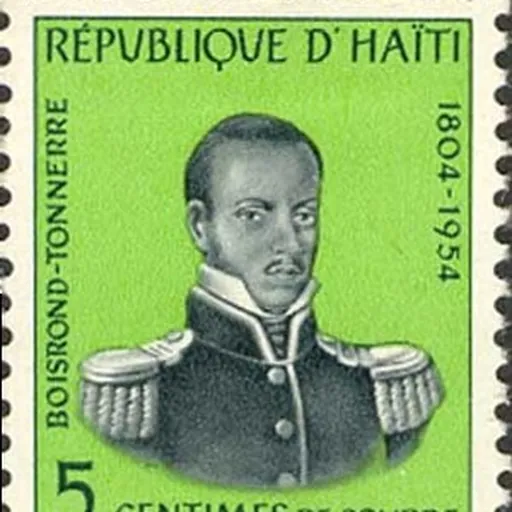
Boisrond-Tonnerre
Boisrond-Tonnerre was a mulatto Haitian writer and historian.
About Boisrond-Tonnerre
Lived 1776 – 1806 (aged 29–30). Boisrond-Tonnerre was a Haitian writer, historian and politician.
Louis Boisrond Tonnerre on a Haitian postage stamp for the 150-year anniversary of the Haitian Revolution, (1804-1954).
Louis Félix Mathurin Boisrond-Tonnerre (6 June 1776 24 October 1806), better known as simply Boisrond-Tonnerre, was a Haitian writer and historian who is best known for having served as Jean-Jacques Dessalines' secretary. Boisrond-Tonnerre was educated in Paris until 1798 when he returned to Haiti (Daut 56). He is the author of the 1804 Haitian Declaration of Independence, which formally declared Haiti's independence from the colonial rule of France. He is also known for his work chronicling the Haitian Revolution, Mémoires pour Servir à l'Histoire d'Haïti.
Boisrond-Tonnerre was born Louis Boisrond in Torbeck in southwest Haiti. He acquired the name "Tonnerre" (French for "thunder") as an infant, when his cradle was hit by lightning. His father, a carpenter named Mathurin Boisrond (see Daut below), amazed that his infant son was unharmed, gave him the name "Tonnerre". Boisrond-Tonnerre studied in France before returning to Haiti, where he took part in the Haitian Revolution.
Boisrond-Tonnerre became a victim of post-revolutionary infighting and was executed in October 1806. According to the Haitian author Christophe Phillippe Charles, Boisrond-Tonnerre scribbled the following quatrain on the walls of his cell before his execution on either the night of 23 or 24 October 1806:
Humide et froid séjour fait par et pour le crime Où le crime en riant immole sa victime Que peuvent inspirer tes fers et tes barreaux Quand un cœur pur y goûte un innocent repos? (Christophe 35).
Translation :
Cold and humid internment crime has both fashioned and formed Where crime, laughing, immolates and consumes its servant But what [fear] can your iron bars hope to inspire When a pure heart wrests from them a peaceful rest? (Christophe 35)
Dessalines had been assassinated seven or eight days prior on 17 October in Port-au-Prince.
Boisrond-Tonnere's personal narrative of the Haitian revolution was published posthumously: Mémoires pour servir à l'histoire d'Haiti précédés de différents actes politiques dus à sa plume et d'une étude historique et critique par Saint-Remy [Memoirs to serve the history of Haiti preceded by various political acts due to his pen with a historical and critical study by Saint-Remy] (Paris, 1851).
Don’t just read it —
keep it.
Full-length biographies made to live with: read them, listen on the way to work, watch them tonight.
- E-book
- Audio
- Video
Instant download · yours to keep · every purchase keeps this site free
Important facts
People in Boisrond-Tonnerre's life
Named in this biography and alive at the same time
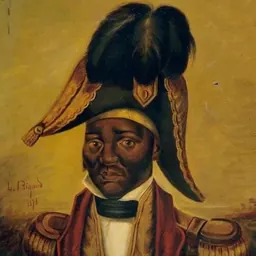
Related people
Same field, nearest in time




Contemporaries
People whose lives overlapped Boisrond-Tonnerre's



Frequently asked questions
Who was Boisrond-Tonnerre?
Boisrond-Tonnerre was a mulatto Haitian writer and historian. (1776-1806)
When was Boisrond-Tonnerre born?
Boisrond-Tonnerre was born in 1776 in Saint-Domingue.
When did Boisrond-Tonnerre die?
Boisrond-Tonnerre died in 1806 in Port-au-Prince.
What was Boisrond-Tonnerre's occupation?
Boisrond-Tonnerre was a writer, historian and politician.
What nationality was Boisrond-Tonnerre?
Boisrond-Tonnerre was Haitian.
Sources & further reading
· Wikipedia: Boisrond-Tonnerre
Cite this page
APA: Biography.guide. (2026). Boisrond-Tonnerre. https://biography.guide/boisrond-tonnerre/
MLA: "Boisrond-Tonnerre." Biography.guide, https://biography.guide/boisrond-tonnerre/.
Chicago: "Boisrond-Tonnerre." Biography.guide. https://biography.guide/boisrond-tonnerre/.
Data last updated: 2026-09-21 · Spot an error? Report a correction.
Portrait: Wikimedia Commons · author & licence
Page generated 2026-09-27 05:00 UTC