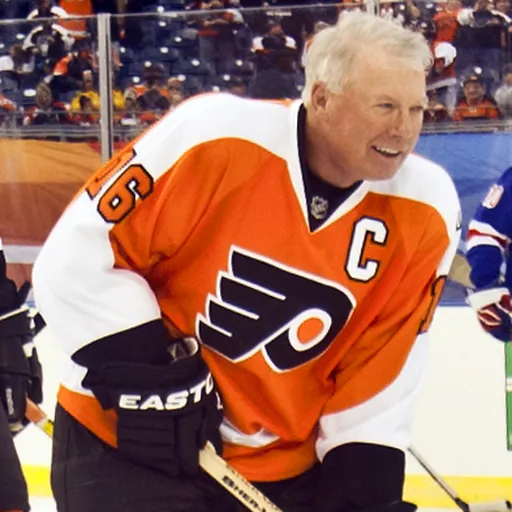
About Bobby Clarke
Born 1949. Bobby Clarke is a Canadian ice hockey player.
Robert Earle Clarke (born August 13, 1949) is a Canadian former professional ice hockey centre who played his entire 15-year National Hockey League (NHL) career with the Philadelphia Flyers and is currently an executive with the team. Clarke is acknowledged by some as being one of the greatest hockey players and captains of all time. He was captain of the Flyers from 1973 to 1979, winning the Stanley Cup with them in both 1974 and 1975. He was again captain of the Flyers from 1982 to 1984 before retiring. Clarke had three 100-point seasons, twice leading the league in assists, and was selected to play in nine NHL All-Star Games. He also won the Frank J. Selke Trophy in 1983, as the league's best defensive forward. A three-time Hart Trophy winner and 1987 Hockey Hall of Fame inductee, Clarke was rated number 24 on The Hockey News' list of The Top 100 NHL Players of All-Time in 1998. In 2017, Clarke was named one of the "100 Greatest NHL Players" in history.
Upon retiring at the end of the 1983–84 season with 358 goals and 852 assists for a total of 1,210 points in 1,144 career games, he immediately became general manager of the Flyers. He spent 19 of the following 23 seasons as a general manager of the Flyers, also briefly serving as general manager of the Minnesota North Stars and Florida Panthers, reaching the Stanley Cup Final three times with the Flyers and once with Minnesota. His time as an NHL general manager had its share of controversy, perhaps none greater than the rift between him and star player Eric Lindros during the late 1990s and early 2000s. He resigned from the general manager position less than a month into the 2006–07 season and is currently the Flyers' senior vice president.
Early life Bobby Clarke's Bombers jersey on display at the 2007 Memorial Cup in Vancouver. Born in the small northern Manitoban mining town of Flin Flon, Around the time he was 12 or 13 years old, he learned he had type 1 diabetes. Even though he progressed into a highly touted prospect playing for the Flin Flon Bombers, leading the league in which the Bombers played in scoring in each of his last three years of junior hockey, NHL teams feared Clarke would never be able to play in the NHL because of his diabetes. Bombers coach Pat Ginnell took Clarke to the Mayo Clinic in Minnesota following the 1967–68 season and the doctors concluded that as long as he took care of himself he could play professionally. — Poile drafted Bob Currier instead, a player who retired five years later and, ironically, never played a game in the NHL — Melnyk called a diabetes specialist in Philadelphia who said Clarke would be fine if he looked after his health. He recorded his first point on October 22 against the Toronto Maple Leafs, an assist on Lew Morrison's 3rd period goal, and he scored his first goal on October 30 against the New York Rangers, beating Rangers goaltender Ed Giacomin 16:36 into the 3rd period. Clarke played the entire 76-game schedule his rookie season and recorded 46 points (15 goals, 31 assists) while earning a trip to the NHL All-Star Game. He was also named NHL Rookie of the Year by The Sporting News, and finished fourth in voting for the Calder Memorial Trophy. In addition to the second championship, Clarke was awarded the Hart Trophy for the second time, while being voted to the league's First All-Star Team.
1975–76 was a record-breaking season for Clarke. Playing on the LCB line with Reggie Leach and Bill Barber, the trio set a record for most goals by a line with 141. He also tied his mark of the previous season with 89 assists and set a personal best and franchise record for most points in a single season with 119 (later broken by Mark Recchi in 1992–93). He also led the league in plus-minus rating with a plus 83. The Flyers, without Parent and Rick MacLeish, The Flyers made it to the Stanley Cup Finals before losing to the New York Islanders in six games. During the playoffs, Clarke scored 8 goals and assisted on 12 others in 19 games, all 8 goals coming on the power play. Prior to a road game on February 27, 1981, Clarke's jersey was stolen. A month later, Clarke hit a personal milestone in memorable fashion. On March 19 during a game against the Boston Bruins, a Reggie Leach slapshot struck Clarke. and his 1000th career point. Clarke retired on May 15, 1984, to become the general manager of the Flyers.
On January 14, 2017, Clarke played in the Flyers' 50th anniversary alumni game against the alumni of the Pittsburgh Penguins, where he combined with his longtime linemates, Bill Barber and Reggie Leach, which ended in a 3–3 tie before a sold-out crowd of over 19,000 at the Wells Fargo Center. Prior to the game Clarke announced that it would be his last alumni game.
International play
Clarke played for Team Canada three times during his career. He played a major role in defeating the Soviet Union during the Summit Series in 1972, captained the Canadian team to gold at the 1976 Canada Cup, and won a bronze medal at the 1982 World Championships. In addition, he led the Flyers to the only victory over the Soviet Union's best team, Soviet Red Army, during the 1976 Super Series, and took part in the 1979 Challenge Cup with the NHL All-Stars. After his playing career, he served as one of Canada's four general managers during the 1987 and 1991 Canada Cups His line with Ron Ellis and Paul Henderson turned out to be Canada's best during the series,
Clarke's line played against the line of the Soviets' top player, Valeri Kharlamov, during the entire series. Though Kharlamov finished the game, he missed the seventh game and was largely ineffective in the eighth. Kharlamov, prior to his death in 1981, said he thought Clarke was tasked with "taking me out of the game."
Nagano Olympics Named general manager of Team Canada on January 30, 1997, and choosing 24-year-old Eric Lindros as the team's captain over the likes of Wayne Gretzky, Ray Bourque, and Steve Yzerman. Ranked number one going into the tournament, Team Canada played strongly until being stymied by Czech goaltender Dominik Hašek in the semifinals, losing in a shootout. They then lost 3–2 to Finland in the bronze medal match.
NHL management Following his retirement, Clarke's first stint as Flyers general manager lasted six seasons and included two trips to the Stanley Cup Finals in 1985 and 1987. After making the playoffs in each of his first five seasons in the front office, the Flyers fell off during the 1989–90 season and missed the playoffs, resulting in his firing by Flyers President Jay Snider.
Clarke moved on to the Minnesota North Stars and spent two seasons as the North Stars general manager, one of which saw a surprise run to the Finals in 1991. and he rebuilt the team into a Cup contender. During his second tenure as general manager of the Flyers, the team made the playoffs 11 seasons in a row but reached the Final only once (1997). Following a poor start to the 2006–07 season, Clarke resigned citing a possible burnout and a lack of desire. Clarke returned to the franchise on December 4, 2006, and was named Senior Vice President.
Clarke received his harshest criticism after first-round playoff exits, including a string of four in five years from 1998 to 2002, Ramsay guided the team to the Eastern Conference Finals in 2000, but he was fired after a subpar start in 2000–01, being replaced by Clarke's former linemate Bill Barber. Barber was named coach of the year for 2000–01; however, under his watch the Flyers suffered two consecutive first-round eliminations, as their 2001 playoffs ended with an 8–0 defeat to Buffalo in Game Six, and their offense was held to just two goals by Ottawa during the 2002 playoffs, and this led to calls for Clarke's dismissal after he fired Barber. Clarke hired Ken Hitchcock as head coach for the 2002–03 season and Hitchcock remained until Clarke's resignation four years later, guiding the team to the 2004 conference finals. While Lindros was not traded and he played well during the 1998–99 season, his season was cut short after sustaining a collapsed lung during a game on April 1 against the Nashville Predators. Lindros' parents criticized team trainer John Worley and claimed Clarke tried to kill their son by trying to put him on a plane back to Philadelphia, which would have been fatal given his condition. Clarke stripped Lindros of the role of team captain. Lindros never played for the Flyers again, as he rejected the Flyers qualifying offer in the off-season and sat out the 2000–01 season. Lindros pushed for a trade to Toronto but that move fell apart at the last minute when Clarke and Leafs manager Pat Quinn could not agree on terms. Clarke finally traded Lindros to the New York Rangers in August 2001. Following the trade, Clarke said, "I don't give a crap whether he ever plays again or if I ever see him again. All he ever did was cause aggravation to our team."
Upon Lindros' retirement in November 2007, Clarke stated that Lindros belonged in the Hockey Hall of Fame. "Yes, based on his ability to play the game and based on his contributions as a player, I think you have to separate all the crap that went on. Particularly when he played for the Flyers, it was just outstanding, dominant hockey — the first of the huge, big men with small man's skill."
Lindros and Clarke both played for the Philadelphia Flyers Alumni during the 2012 Winter Classic Alumni Game on December 31, 2011. The opposing team was the New York Rangers Alumni. Both men acknowledged the game as an opportunity to mend fences.
(T)his Alumni Game has provided an opportunity to rebuild ... once-burnt bridges. In recent years, Clarke has stated multiple times that he believes Lindros belongs in the Hall of Fame, and Lindros has acknowledged his many disagreements with Clarke and expressed a desire to move on. later moving to Cherry Hill, New Jersey, then to Moorestown and in Haddonfield when he returned to the area after working in Minnesota and Florida.
Bobby Clarke remained close friends with NHLPA head Alan Eagleson even after Eagleson was indicted for (and subsequently found guilty of) fraud and embezzlement.
Clarke and his wife, Sandy, have four children, sons Wade and Lucas and daughters Jody and Jakki. They live in Ocean City, New Jersey.
Career statistics Regular season and playoffs Regular seasonPlayoffs Season Team League GP G A Pts PIM GP G A Pts PIM 1965–66 Flin Flon Bombers SJHL 4 4 3 7 0 — — — — — 1966–67 Flin Flon Bombers MJHL 45 71 112 183 123 14 10 18 28 51 1966–67 Flin Flon Bombers MC — — — — — 6 2 5 7 49 1967–68 Flin Flon Bombers WCHL 59 51 117 168 148 15 4 10 14 2 1968–69 Flin Flon Bombers WCHL 58 51 86 137 123 18 9 16 25 0 1969–70 Philadelphia Flyers NHL 76 15 31 46 68 — — — — — 1970–71 Philadelphia Flyers NHL 77 27 36 63 78 4 0 0 0 2 1971–72 Philadelphia Flyers NHL 78 35 46 81 87 — — — — — 1972–73 Philadelphia Flyers NHL 78 37 67 104 80 11 2 6 8 6 1973–74 Philadelphia Flyers NHL 77 35 52 87 113 17 5 11 16 42 1974–75 Philadelphia Flyers NHL 80 27 89 116 125 17 4 12 16 16 1975–76 Philadelphia Flyers NHL 76 30 89 119 136 16 2 14 16 28 1976–77 Philadelphia Flyers NHL 80 27 63 90 71 10 5 5 10 8 1977–78 Philadelphia Flyers NHL 71 21 68 89 83 12 4 7 11 8 1978–79 Philadelphia Flyers NHL 80 16 57 73 68 8 2 4 6 8 1979–80 Philadelphia Flyers NHL 76 12 57 69 65 19 8 12 20 16 1980–81 Philadelphia Flyers NHL 80 19 46 65 140 12 3 3 6 6 1981–82 Philadelphia Flyers NHL 62 17 46 63 154 4 4 2 6 4 1982–83 Philadelphia Flyers NHL 80 23 62 85 115 3 1 0 1 2 1983–84 Philadelphia Flyers NHL 73 17 43 60 70 3 2 1 3 6 NHL totals 1,144 358 852 1,210 1,453 136 42 77 119 152
International
All-Star Games
Legacy Clarke prepares for the ceremonial puck drop with Bobby Orr prior to the 2010 NHL Winter Classic. On November 15, 1984, Bobby Clarke Night was held at the Spectrum. The Flyers retired Clarke's #16 jersey and unveiled the Bobby Clarke Trophy which is awarded annually to the Flyers' Most Valuable Player.
Records Clarke finished his career 4th all-time in assists and 11th all-time in points, but he has since fallen to 29th all-time in assists and 51st all-time in points . His career plus-minus of +507 is 5th all-time. including:
All-time regular season 1st place - Most games played (1144) 4th place - Most goals (358) 1st place - Most assists (852) 1st place - Most points (1210) 4th place - Penalty minutes (1453) 1st place - Plus/Minus (+506) 1st place - Shorthanded goals (32)
All-time playoffs 1st place - Most games played (136) 5th place - Most goals (42) 1st place - Most assists (77) 1st place - Most points (119)
Awards
Award Year(s) Bill Masterton Memorial Trophy 1972 Brownridge Trophy 1968, 1969 Class Guy Award (Philadelphia Flyers team award) 1982 Frank J. Selke Trophy 1983 Hart Memorial Trophy 1973, 1975, 1976 Lester B. Pearson Award 1973 Lester Patrick Trophy 1980 Lionel Conacher Award 1975 Lou Marsh Trophy 1975 NHL All-Star Game 1970, 1971, 1972, 1973, 1974, 1975, 1977, 1978 NHL First All-Star Team 1975, 1976 NHL Second All-Star Team 1973, 1974 Stanley Cup champion 1974, 1975 WCHL MVP 1969 WCHL All-Star Team 1969 WCJHL First All-Star Team 1968
Don’t just read it —
keep it.
Full-length biographies made to live with: read them, listen on the way to work, watch them tonight.
- E-book
- Audio
- Video
Instant download · yours to keep · every purchase keeps this site free
Important facts
People in Bobby Clarke's life
Named in this biography and alive at the same time



Related people
Same field, nearest in time


Contemporaries
People whose lives overlapped Bobby Clarke's


Frequently asked questions
Who is Bobby Clarke?
Canadian ice hockey player
When was Bobby Clarke born?
Bobby Clarke was born on 13 August 1949 in Flin Flon.
What is Bobby Clarke's occupation?
Bobby Clarke is an ice hockey player.
What nationality is Bobby Clarke?
Bobby Clarke is Canadian.
Sources & further reading
Cite this page
APA: Biography.guide. (2026). Bobby Clarke. https://biography.guide/bobby-clarke-ice-hockey-player/
MLA: "Bobby Clarke." Biography.guide, https://biography.guide/bobby-clarke-ice-hockey-player/.
Chicago: "Bobby Clarke." Biography.guide. https://biography.guide/bobby-clarke-ice-hockey-player/.
Data last updated: 2026-09-24 · Spot an error? Report a correction.
Portrait: Wikimedia Commons · author & licence
Page generated 2026-09-27 05:09 UTC