
About Bob Cerv
Lived 1925 – 2017 (aged 91). Bob Cerv was an American baseball player and basketball player.
Robert Henry Cerv ( ; May 5, 1925 – April 6, 2017) was an American professional baseball left fielder. Prior to his professional career, he was a collegiate baseball and basketball player at the University of Nebraska. He was born in Weston, Nebraska, and served in the U.S. Navy during World War II.
Early life Cerv was born on May 5, 1925, in Weston, Nebraska to Anton Henry and Henrietta (Staska) Cerv, and raised among a small ethnic Bohemian community. His father was a refrigerated truck driver. In 1937, Cerv's father drove the 11- or 12-year old Cerv with him on a trucking job to New York City, where they attended a New York Yankees doubleheader at Yankee Stadium; witnessing Hall of Fame first baseman Lou Gehrig hit three home runs. After that day, Cerv's goal in life was to play Major League Baseball (MLB), and to someday play at Yankee Stadium. He learned to play baseball from his three older sisters, who played competitive team softball.
He returned from the war in 1946, and entered the University of Nebraska-Lincoln, where he played on the baseball and basketball teams. He was the first Nebraska player to be named an All-American in baseball. Cerv began the 1951 season with the Blues. In only 109 games, he batted .344, with 28 home runs, 108 RBIs, 85 runs scored and a 1.094 OPS.
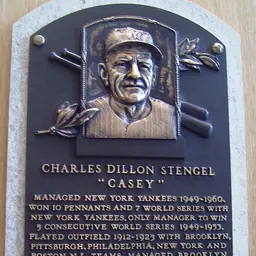
Cerv was called up to the Yankees on July 31. Yankees' Manager Casey Stengel had been impressed by Cerv during spring training because of Cerv's speed, hustle and determination, and eventually called him up to the Yankees because of the way he was hitting for Kansas City. Hank Bauer in right field (.293 and 17 home runs) and Gene Woodling in left field (.309). Cerv started 15 games in left field and eight in centerfield, but hit only .241 in 87 at bats with one home run that season for the Yankees. He was sent back to Kansas City in July, where he hit .297, with 12 home runs and 47 RBIs in 60 games. This would be a recurrent theme during his first stint with the Yankees, where he would do well in minor league play, but could not win the starting job from Stengel over Woodling, and later Irv Noren or Elston Howard.
In 1953, he played a full season with the Blues, batting .317, with 22 home runs, 91 RBIs and a .933 OPS. He played in only eight games for the Yankees. In 1954, he played in 56 games for the Yankees and hit .260 in 100 at bats. In 1955, he played in 55 games for the Yankees, but hit .341 in 96 at bats. He played in five games during the 1955 World Series against the Brooklyn Dodgers, which the Dodgers won in seven games. Cerv hit .125 in 16 at bats, but had a pinch hit home run against Roger Craig in Game 5. As a reserve outfielder in 1956, he hit .304 in 115 at bats, with three home runs and 25 RBIs. He had one hit in one at bat in the 1956 World Series.
Kansas City Athletics
Enos Slaughter and sale to the A's On August 25, 1956, the Yankees waived long time shortstop Phil Rizzuto and acquired Enos Slaughter from the Kansas City Athletics. It was reported at the time that in exchange for Slaughter, the Yankees would provide "'a player on their present roster'" to the A's at the end of the 1956 season. Despite Slaughter being acquired via waivers, and the trading deadline having passed on June 15, A's owner Arnold Johnson (who had a close business relationship with the Yankees' ownership) said on the day Slaughter was claimed off of waivers by the Yankees, that in exchange for Slaughter the A's would receive a Yankees player who was a regular on the Yankees' team. Johnson further publicly promised that Yankee player would become a regular player for the A's in 1957. Slaughter played his first game for the Yankees on August 26, 1956. This allowed him to both help the Yankees toward the 1956 AL pennant, and be eligible to participate in the 1956 World Series.
In mid-October 1956, the Yankees sold Cerv's rights to the Athletics. It was reported that this was to complete the transaction for Enos Slaughter; but it was also reported at the time that the Yankees denied the two transactions were related (despite what Arnold Johnson said the day he waived Slaughter and the Yankees acquired him). Even before the sale of his contract to the A's, however, there was anticipation that Cerv would be the Yankee moved to the A's to compensate them for Slaughter. Cerv later said that during a hot September day in 1956, he had pitched batting practice and was sitting alone in the dugout. He said Stengel came up to him in the dugout and said "We just received (Enos) Slaughter from Kansas City and by the way one of you guys is going to KC". He also finished fourth in the AL Most Valuable Player voting that year, just above Mantle. He was selected to United Press International's American League All-Star team at the end of the season.
He did all of this in 1958, while playing injured part of the season. He suffered a broken jaw in a collision at home plate with Detroit Tigers catcher Red Wilson. He had his jaw wired shut for a month and was on a liquid diet during that time; sometimes requiring oxygen during games when he had difficulty breathing. As the only bright spot, and most popular player, on a bad team, the A's honored Cerv during a July 1958 home game. Former President Harry S. Truman, with whom Cerv developed a friendship, attended the event. On August 20, 1959, Cerv hit three home runs against the Boston Red Sox in an 11–10 loss. In 1959, he led the A's in home runs and RBIs; was second in batting average for A's players with over 500 plate appearances; and was fourth on the team in runs scored. Cerv was known for his power, and once hit a 529-foot (161.2 m) home run while playing for the A's. Carey had played in four games for the Yankees that season, with three at bats, at the time of the trade. Carey had missed most of the 1959 season due to illness, and had lost his third base job to Gil McDougald and Clete Boyer in 1960. It was the 16th deal between the A's and Yankees since the A's had moved to Kansas City in 1955. He hit .357 in the Yankees seven game 1960 World Series loss to the Pittsburgh Pirates. Manager Stengel decided to start Cerv in Game 3 in left field, and made the unusual move of batting Cerv as the leadoff hitter, emphasizing the Yankees' power hitting. Cerv also started in left field in Game 4 as the Yankees' leadoff hitter. He went 2-for-5 and 1-for-4, respectively in the two games as a leadoff hitter. In Game 3, Cerv became the 11th player in World Series history to have two hits in the same inning. He also started Game 5 in left field, batting third (between Roger Maris and Mickey Mantle), again going 1-for-4. Yogi Berra started in left field for the final two games of the series.
The Yankees left Cerv exposed in the December 1960 expansion draft, and the Los Angeles Angels selected him with the 38th overall pick. In that game, he hit a home run against Baltimore Orioles starting pitcher Milt Pappas, after Pappas had just given up the first home run in Angels' history to Ted Kluszewski. Cerv played in only 18 games for the Angels, and was batting .158, when the Yankees traded Lee Thomas, Ryne Duren and Johnny James for Cerv and Tex Clevenger on May 8. He rejoined a Yankees team that went on to win the 1961 World Series, with teammate Roger Maris hitting 61 home runs, the most ever in a season at that time.
Cerv played in 57 games for the Yankees in 1961, hitting .271, with six home runs and 20 RBIs. The 36-year old Cerv started 24 games in left field and three at first base. During the 1961 season, Cerv lived in a $251-per-month apartment in Queens with Maris and Mickey Mantle.
On September 23, 1961, Cerv was pinch hitting against the Boston Red Sox, in Boston, when he felt a sharp pain in his knee after swinging at a pitch. He hit a home run on the next pitch, but knew something was wrong. He had surgery on his knee the next day in Boston, and his knee was never the same. Maris hit his record-setting 61st home run in Boston on October 1, and then visited with Cerv in the hospital that day.
After his 1961 knee operation, Cerv was slow to recover. He played in 20 games for the Yankees in 1962, with a .118 batting average, when the team sold his contract rights in late June to the Houston Colt .45s, who released him in August. offered Cerv a job with the Mets' organization; but Cerv wanted to return to his wife and family. From 1965 to 1974, Cerv taught at John F. Kennedy College in Wahoo, Nebraska, where he also coached the men's baseball and basketball teams. He also coached baseball at Sioux Empire College in Hawarden, Iowa, from 1976 to 1981.
Legacy and honors Although Cerv was never a regular playing for the Yankees, he played an important role in their success. Tony Kubek, a three-year All-Star and Rookie of the Year in his nine-season Yankee career (1957-65) said "'Cerv was a great asset for a Casey Stengel-type manager. He could use him as a pinch-hitter or a pinch-runner. When he was a pinch-runner, Mickey would stand at the dugout steps and yell to infielders, ‘Here comes Cerv!’ I think he scared a few guys'".
In 2000, Sports Illustrated named Cerv No. 28 among its list of Nebraska athletes of the century.
Personal life and death Cerv married Phyllis Pelton in 1948, and they had 10 children. He took great pride in assuring his children's education. Among others, he had a son who graduated the United States Military Academy at West Point and a daughter who headed a hospital's cardiovascular department. Phyllis Cerv died in 2005. Cerv died on April 6, 2017, in Blair, Nebraska, aged 91. He was survived by eight children, 32 grandchildren and 20 great-grandchildren.
In media Cerv was portrayed by actor Chris Bauer in 61*, a 2001 HBO movie directed by Billy Crystal about the 1961 New York Yankees season in which Roger Maris and Mickey Mantle attempted to break the single-season record of 60 home runs established by Babe Ruth in 1927.
Don’t just read it —
keep it.
Full-length biographies made to live with: read them, listen on the way to work, watch them tonight.
- E-book
- Audio
- Video
Instant download · yours to keep · every purchase keeps this site free
Important facts
People in Bob Cerv's life
Named in this biography and alive at the same time




Related people
Same field, nearest in time
Contemporaries
People whose lives overlapped Bob Cerv's



Frequently asked questions
Who was Bob Cerv?
American baseball player (1925-2017)
When was Bob Cerv born?
Bob Cerv was born on 5 May 1925 in Weston.
When did Bob Cerv die?
Bob Cerv died on 6 April 2017 in Blair.
What was Bob Cerv's occupation?
Bob Cerv was a baseball player and basketball player.
What nationality was Bob Cerv?
Bob Cerv was American.
Sources & further reading
Cite this page
APA: Biography.guide. (2026). Bob Cerv. https://biography.guide/bob-cerv/
MLA: "Bob Cerv." Biography.guide, https://biography.guide/bob-cerv/.
Chicago: "Bob Cerv." Biography.guide. https://biography.guide/bob-cerv/.
Data last updated: 2026-09-25 · Spot an error? Report a correction.
Page generated 2026-09-27 05:11 UTC