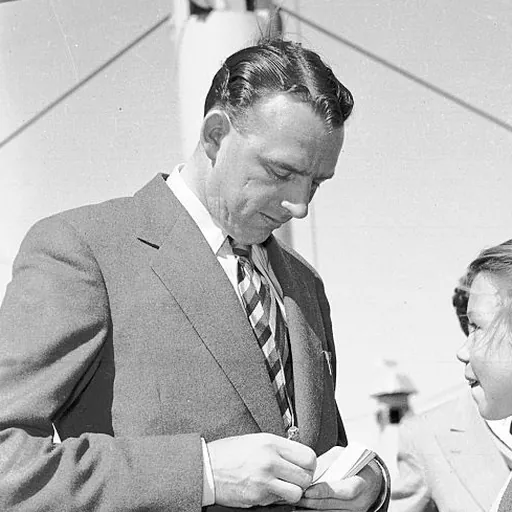
About Bob Appleyard
Lived 1924 – 2015 (aged 90). Bob Appleyard was a British cricketer.
Robert Appleyard (27 June 1924 – 17 March 2015) was a Yorkshire and England first-class cricketer. He was one of the best English bowlers of the 1950s, a decade which saw England develop its strongest bowling attack of the twentieth century. Able to bowl fast-medium swingers or seamers and off-spinners with almost exactly the same action, Appleyard's career was almost destroyed by injury and illness after his first full season in 1951. In his limited Test career, he took a wicket every fifty-one balls, and in first-class cricket his 708 wickets cost only 15.48 runs each. In the words of Wisden: "His mixture of in-swingers, off-spinners and leg-cutters; his variations of flight and pace, bore the make of a highly-skilled craftsman". As a consequence, Appleyard was chosen for the Ashes tour ahead of Jim Laker, and under Hutton's captaincy. He again bowled with skill on unusually erratic Australian wickets, most notably in the extreme heat at Adelaide in the Fourth Test, which clinched the Ashes. Appleyard enjoyed the more English conditions as the tour moved on to New Zealand, and played a leading role the dismissal of New Zealand at Wellington in March for the lowest score in the history of Test cricket. On a rain-affected pitch, he took 4 for 7, as New Zealand were rolled for 26.
In 1955, by then almost exclusively bowling spinners, Appleyard was almost unplayable on the wet wickets early in the summer, but a knee injury wiped out almost all his cricket after the middle of June. He recovered his form well enough in 1956, however, to regain his Test place for the first match as Trent Bridge but did not bowl well enough to challenge Jim Laker for the rest of the summer. Then, in 1957, Appleyard declined so badly that Yorkshire often left him out of their team: he seemed unable to show his old versatility when asked to open the bowling again with Fred Trueman and was not gaining as much penetration on rain-affected surfaces. Appleyard's decline continued in 1958, and Yorkshire dropped him for good in early June, and he never did well enough for the second eleven for them to consider retaining him.
Post-playing career Appleyard became a successful businessman after retirement from the game and founded a cricket school in Bradford. Cricket commentator Colin Bateman also noted that Appleyard won an out-of-court settlement from Maxwell, whom Appleyard had threatened to sue.
In 1997 he was awarded an honorary doctorate by the University of Bradford. He served as President of Yorkshire into his eighties, from 2006 to 2008, and was an Honorary Life Member of the club. Appleyard died aged 90 at his home in Harrogate, North Yorkshire, on 17 March 2015.
Don’t just read it —
keep it.
Full-length biographies made to live with: read them, listen on the way to work, watch them tonight.
- E-book
- Audio
- Video
Instant download · yours to keep · every purchase keeps this site free
Important facts
People in Bob Appleyard's life
Named in this biography and alive at the same time




Related people
Same field, nearest in time



Contemporaries
People whose lives overlapped Bob Appleyard's


Frequently asked questions
Who was Bob Appleyard?
English cricket player (1924-2015)
When was Bob Appleyard born?
Bob Appleyard was born on 27 June 1924 in Bradford, West Riding of Yorkshire.
When did Bob Appleyard die?
Bob Appleyard died on 17 March 2015 in Harrogate.
What was Bob Appleyard's occupation?
Bob Appleyard was a cricketer.
What nationality was Bob Appleyard?
Bob Appleyard was British.
Sources & further reading
Cite this page
APA: Biography.guide. (2026). Bob Appleyard. https://biography.guide/bob-appleyard/
MLA: "Bob Appleyard." Biography.guide, https://biography.guide/bob-appleyard/.
Chicago: "Bob Appleyard." Biography.guide. https://biography.guide/bob-appleyard/.
Data last updated: 2026-09-22 · Spot an error? Report a correction.
Portrait: Wikimedia Commons · author & licence
Page generated 2026-09-27 05:03 UTC