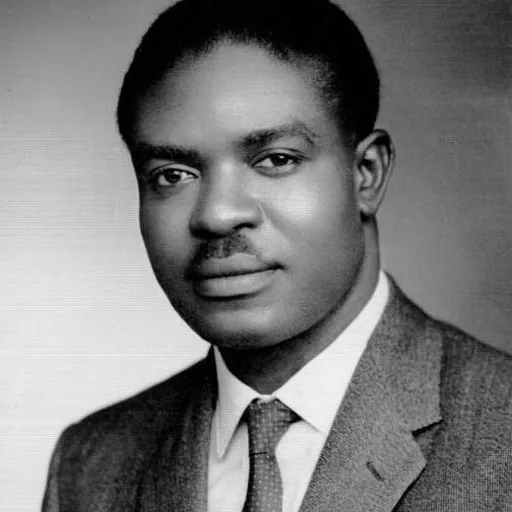
About Blasio Vincent Ndale Esau Oriedo
Lived 1931 – 1966 (aged 34). Blasio Vincent Ndale Esau Oriedo was a physician, politician and epidemiologist, known for Leishmaniasis and Public health.
Dr. Blasio Vincent Oriedo, in full Dr. Blasio Vincent Ndale Esau Oriedo (born 15 September 1931, Ebwali Village in Bunyore, Kenya Colony—died 26 January 1966, Aga Khan University Hospital, Nairobi, Kenya) was an African epidemiologist and a parasitological scientist known for his contributions to tropical medicine and work to stem disease epidemics in colonial and postcolonial Kenya, the countries of East and Central Africa, and the Sudan.
Oriedo was a patron of academic, healthcare, and socioeconomic development in East and Central Africa. He developed an interdisciplinary approach that connected the struggle for political freedom in Kenya with fully integrated healthcare, intellectual, socioeconomic, and civil infrastructures especially in the rural regions that bore the brunt of disease epidemics and their socioeconomic and sociocultural consequences. He embraced a revolutionary epidemiological perspective towards the economic and intellectual consequences of disease or public health strategy across the East and Central African region. He served as a member of Tom Mboya's interdisciplinary economic development advisory team from 1965 until his death in January 1966.
Oriedo was one of the forces behind the late 1950s–early 1960s US academic scholarship programme for East African students— The Kennedy Airlift.
Biography Oriedo was born to Esau Khamati Oriedo (d. 1 December 1992) and Evangeline Olukhanya Ohana Analo-Oriedo (d. 11 July 1982), both from the western Kenya's Luhya ethnic group of the Bantu lineage. His father was a Kenyan politician (freedom fighter and colonial-era political detainee, district representative and once chairman of the North Nyanza Local Native Council ), an entrepreneur, philanthropist, and a veteran of World Wars I and II. He was a Christian who challenged early white Christian missionaries in East Africa to embrace the African cultures as congruent with the Christian credo.
He received early education at government and mission schools, and sat, successfully with distinction, for the Cambridge School Certificate in 1946 at the former Government African School at Kakamega in North Nyanza (present-day Kakamega High School at Kakamega in western Kenya).
He was the first and the youngest native East and Central African epidemiologist in the field of tropical medicine and infectious diseases—both as researcher and a clinical practitioner—in the spread, control, and eradication of infectious agents. His parasitological epidemiology medical research and resulting treatments have received global acclaim and application. He supported indigenous medical research and the dissemination of homegrown scientific medical information. He foresaw this informational approach as an effective and dynamic forum for interchange of knowledge and viewpoints amongst various indigenous healthcare communities and their counterparts abroad. In 1964 he attended, as an invited expert panelist, the XII International Congress of Entomology at London, United Kingdom.
He was a supporter of health care as a basic human right long before the 1978 Alma Ata Declaration proclamation. In 1960 he directed a healthcare and hygiene strategy of tactical, strategic, operational, and performance indexing; a short-term and long-term planning strategy based on the application of preventative modalities that helped shift the medical science paradigm—in East Africa—away from the undue emphasis on curative means, and more so towards a balanced approach. That which effectually integrated strategic epidemiological knowledge with tactical, operational, and situational curative approaches.
He promoted and nurtured coordinated approaches, amongst healthcare practitioners and related bodies, to facilitate the most effective seamlessly integrated dispensary and operations of public health and other civic and societal welfare services. As of 1950 until his abrupt and inexplicable death in 1966, he is credited with stemming the tide of numerous endemic and pandemic diseases in the East and Central African regions and the Sudan. The following are examples of those feats.
A confidante of Tom Mboya, he allied with Mboya to successfully champion US education opportunities for East African Students. This experience led him to crusade for rural citizens. He declined a career in politics, despite being lobbied by his associates enter politics. Later he served, at Tom Mboya's behest, as a member of Mboya's multidisciplinary economic development team from 1965 until his death in January 1966.
He was a staunch opponent of fraud and abuse of the public trust; utterly stubborn—an uncompromising scrupulous—and demonstrative disdain for and impatient towards ineptitude. He was an outspoken critic of vice by those in power; thus, his policies became anathema to the rulers of colonial Kenya, and most postcolonial bureaucrats and political elites of the embryonic independent Kenya. In 1965, upon his return from a conference in the Netherlands and other official engagements in Europe, he summarily terminated the employment of several expatriates and native personnel for graft, ineptitude, and absconding from duty. His actions met with ad hominem assaults from a cadre of bureaucrats and political elites; nevertheless, he stood his ground and refused to be intimidated into rescinding the edicts. His view was that these public servants worked solely to enrich and empower themselves. —British Colonial Medical office, London; Dr. R. Bowen; Instead, he was appointed to an inferior position as an African assistant medical officer (AAMO). He rebuffed the appointment; in 1951 he was actualized as a senior public health officer with de jure commission which permitted him to serve across the East and Central African region. He also qualified for assignments under the auspices of the Colonial Medical Service. [ In 1954 he received academic fellowship to study tropical medicine & parasitological epidemiology He was also a recipient of a research stipend awarded by the Dutch Royal Institute in the Netherlands; the institute actively promoted his research on the "vector-borne tropical diseases: epidemiology of East African leishmaniasis (kala-azar)” in the Netherlands and other European countries. He worked feverishly, with diligent acumen, effectively combining vocational duties and scholarship research with travel abroad to various international scholarly medical conferences and special proceedings to promote awareness of the tropical diseases in Africa; and to help stimulate funding for research and drug discovery to stem epidemics and other preventable diseases on the continent. An epic accomplishment for an under 30-year old native African at the apogee of European colonialism in East Africa! In 1959 he gained full membership to The Royal Society of Tropical Medicine and Hygiene—a London-based organization promoting the study, control and prevention of tropical disease, and facilitation of discussion and exchange of information among those interested in tropical diseases and international health, and the overall promotion of the work of those interested in these objectives. In 1962, through his collaborative research with Tulane University's Medical College's School of Tropical and Infectious Diseases, he was endowed with a prestigious extramural medical research grant from the NIH—an agency of the United States Department of Health and Human Services.
Professional life Throughout his career he worked at the Ministry of Health and Housing, Nairobi, Kenya, and the Nairobi-based Division of Insect-Borne Diseases at Medical Research Laboratory under the auspices of the British Colonial Medical Services. and the Ministry of Health and Housing in the colonial and post-colonial Kenya.
In 1964 he was invited to panel of specialists at the XII International Congress of Entomology at London, United Kingdom.
Visceral leishmaniasis epidemic In October 1952, Oriedo led efforts to contain a visceral leishmaniasis outbreak in Kenya, parts of Uganda, and Sudan. In the North Kavirondo region of Kenya's Mount Elgon District, Bungoma County was one of hardest-hit areas. The disease ravaged the ethnic Bukusu population. His efforts to halt the disease were recognized by the Bukusu people who honoured him as a great healer by granting him the honorary title of omukasa, a Bukusu chieftain. His accomplishment also earned him a research stipend from the London School of Hygiene & Tropical Medicine.
Kwashiorkor In the 1940s kwashiorkor was a yet ill-defined nutritional disorder in Africa. Mortality-rates among children were disturbingly high. In 1960, based on his prior successful campaigns against epidemic disease outbreaks, colonial authorities gave Oriedo the job of creating a roadmap to guide and coordinate the kwashiorkor crisis management team. Using available data, he focused on the Kikuyu ethnic group, in one of the localities where the disease was rampant. The Kikuyu campaign was successful. The lessons learnt from the Kikuyu campaign gave impetus to an effective national strategy. One of the key elements of the programme was a national school milk program which provided a daily milk ration to children during morning and afternoon recesses. Teachers were required to check pupils for health and hygiene during physical education (PE) periods and schools were charged with keeping up-to-date student immunisation records.
Plasmodium falciparum malaria epidemics campaign During the late 1950s and 1960s he championed, coordinated, and buoyed the campaign against malaria amongst African and Asian communities in East Africa where the disease epidemics was poignantly endemic and had exacted a heavy mortality toll. Those communities, especially the native African tribes were mostly remote and in disadvantaged settings. Preceding his efforts, those communities had received, at best, spasmodic attention from the colonial regime. For instance, the 1961 heavy rainfall brought flooding and the rise of the outbreaks of malaria epidemics that extended deeply into the hinterland. He was a major force behind the resourcefulness in formulating and implementing an extensive public health control program; elements of the program entailed leveraging-in successful aspects from the Nairobi campaign of 1940 epidemic, scouting and mapping out the breeding sites, conducting entomological and epidemiological studies, oiling and larviciding of stagnant waters and bushes, and mass chemoprophylaxis administration. The approach succeeded in containing malaria epidemics in several remote and disadvantaged settings amongst African and Asian communities.
Situational, tactical, operational, and strategical national health system He was a strong proponent of an important performance indexed healthcare quality improvement program
An epidemiological perspective to economic consequences of disease As a physician and public health official, Oriedo developed an interdisciplinary approach that linked public health with social, economic, and institutional factors in East Africa, particularly in rural areas. According to the cited source, he argued that improving healthcare required not only trained medical professionals but also the development of local health infrastructure and institutions. He was a vocal critic of indigenous practices that placed the well-being of native communities in peril and easy prey for quacks. He recommended founding an ethnomedicine advisory board, at the national and provincial levels, under the auspices of the Ministry of Health and Housing; a board whose composition would include traditional healers and modern healthcare practitioners. His work in tropical medicine, hygiene, and infectious diseases has been posthumously published by collaborators, such as fellow laureate Dr. BA Southgate, and others.
In 1964, he was a recipient of a coveted medical research grant furnished by the US National Institutes of Health (NIH), Extramural Research Program. The grant was in support of his epidemiological, parasitological, and etiological research in tropical medicine and infectious diseases in East Africa. Oriedo's work has received global acclaim and application.
Studies in the epidemiology and parasitology of East African Leishmaniasis
Patron of academics
Memberships
Awards and honors
Legacy
Don’t just read it —
keep it.
Full-length biographies made to live with: read them, listen on the way to work, watch them tonight.
- E-book
- Audio
- Video
Instant download · yours to keep · every purchase keeps this site free
Important facts
People in Blasio Vincent Ndale Esau Oriedo's life
Named in this biography and alive at the same time

Related people
Same field, nearest in time

Contemporaries
People whose lives overlapped Blasio Vincent Ndale Esau Oriedo's

Frequently asked questions
Who was Blasio Vincent Ndale Esau Oriedo?
Kenyan doctor
When was Blasio Vincent Ndale Esau Oriedo born?
Blasio Vincent Ndale Esau Oriedo was born on 15 July 1931 in Bunyore, Ebwali Village, Kenya Colony.
When did Blasio Vincent Ndale Esau Oriedo die?
Blasio Vincent Ndale Esau Oriedo died on 26 January 1966 in Aga Khan University Hospital.
What was Blasio Vincent Ndale Esau Oriedo's occupation?
Blasio Vincent Ndale Esau Oriedo was a physician, politician and epidemiologist.
What was Blasio Vincent Ndale Esau Oriedo known for?
Blasio Vincent Ndale Esau Oriedo was known for Leishmaniasis and Public health.
Sources & further reading
· Wikipedia: Blasio Vincent Ndale Esau Oriedo
· DBpedia: Blasio Vincent Ndale Esau Oriedo
Cite this page
APA: Biography.guide. (2026). Blasio Vincent Ndale Esau Oriedo. https://biography.guide/blasio-vincent-ndale-esau-oriedo/
MLA: "Blasio Vincent Ndale Esau Oriedo." Biography.guide, https://biography.guide/blasio-vincent-ndale-esau-oriedo/.
Chicago: "Blasio Vincent Ndale Esau Oriedo." Biography.guide. https://biography.guide/blasio-vincent-ndale-esau-oriedo/.
Data last updated: 2026-09-22 · Spot an error? Report a correction.
Portrait: Wikimedia Commons · author & licence
Page generated 2026-09-27 05:03 UTC