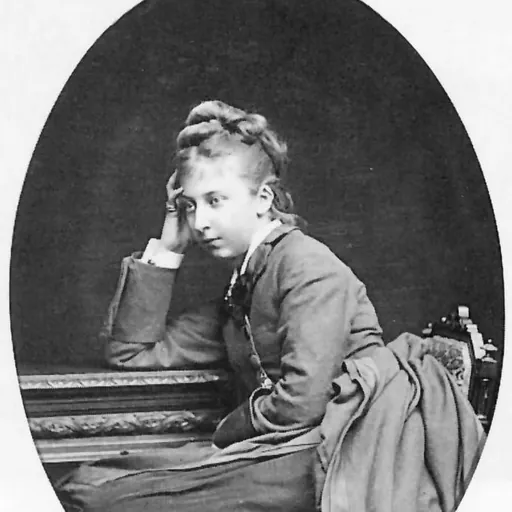
Blanche d'Orléans
French princesse
About Blanche d'Orléans
Lived 1857 – 1932 (aged 74). Blanche d'Orléans was a French.
Blanche Marie Amélie Caroline Louise Victoire d'Orléans (28 October 1857 – 4 February 1932) was the fourth and last child of Prince Louis, Duke de Nemours and Princess Victoria of Saxe-Coburg and Gotha, and the granddaughter of Louis Philippe I, the last king of France.
Biography
Early life
Blanche d'Orléans was born at Claremont House in Surrey in 1857. Her family had lived there after the February Revolution of 1848. She was the only child of the royal couple born in exile, and there was a gap of nine years between Blanche and her nearest sibling in age, Marguerite.
Her mother died two weeks after giving birth to Blanche. She was christened after her paternal grandmother, her godmother, her godfather, and her mother. Her godparents were her father's younger brother Henri, Duke of Aumale, and his wife Lina.
In addition to Marguerite, Blanche also grew up with her two brothers, Gaston (1842–1922) and Ferdinand (1844–1910). Blanche's paternal grandparents, King Louis Philippe and Queen Marie Amélie, also lived with them at Claremont. They were frequently visited by Queen Victoria, who was a first cousin and namesake of Blanche's mother.
The care of Blanche's older sister Marguerite had been entrusted to a close friend and lady in waiting of their mothers, Mlle Laure-Charlotte Bernard de la Grave in 1850, Blanche and her sister Marguerite were also day pupils at Gumley House school.
During the Franco-Prussian War Marguerite and Blanche d'Orléans, were at the head of relief committees in England for the wounded, prisoners, and French refugees. The d'Orléans family in 1886, as illustrated in Gazette de Paris illustrée. Blanche is third from the right on the bottom row.
Return to France From 1866 to 1871, the family lived at Bushy House following the death of Blanche's grandmother, Queen Marie Amélie. In 1871, the family's banishment ended, and they moved back to France. Unlike her sister, who married a Polish nobleman the next year, and the news of the day mentioning potential suitors such as the Louis-Napoléon, Prince Imperial, Count of Bari, the Prince de Ligne and Giovanni Andrea Doria Pamphili, Prince of Melfi.
Blanche never married and stayed with her father. According to the memoirs of her relative Isabelle, Blanche had been in love with an English lord but the relationship had been discouraged by her father.
Described as a tall but fragile looking and pale young woman and blue eyes, Blanche fell severely ill in 1880, with her death being feared, though she recovered , in order to strengthen her health Blanche spent time in seaside town of Dinard. with her former governess Mme Bernard acting as her lady in waiting. and was a pupil of painter Joseph Aubert. Among her work is an 1877 portrait of an African hunter. She painted many works with religious subject for churches, among them is mentioned a painting of Jeanne de France, with the saint looking like Blanche's deceased mother. The French art critic Antony Valabrègue, described her artistic personality as "..a nature that delights in the pious dreams of a fervent Catholicism. Her paintings, inspired by the primitives, are imbued with a naive sentiment..." She was remembered in her niece's memoirs:She would receive us standing, first looking us up with her small, pale, cold blue eyes; then, using a long, slender index finger at the end of a long, ivory-like hand, she would point us out one by one, asking for our names and ages. Afterward, she would sit in a Voltaire armchair by the window, and the interrogation would continue, covering all manner of subjects. We would stand frozen with shyness... When the session ended, we would take our leave after bowing and kissing her hand. Aunt Blanche was full of whims... She had lived alone since her youth and had always been of a sour disposition; I heard it said that she had once been in love with an English lord, but that her father, the Duke of Nemours, had adamantly refused to allow the marriage. From that time on, she harbored a certain loathing for the family. She had even stipulated in her will that she wished to be buried at Lourdes rather than at Dreux "with those people." To her godson—my brother Dom Joao—she bequeathed... her bulldog!
List of artworks
African hunters holding moukahla (1877) Triptych of Christ on the cross alongside Saint Lawrence and Saint John Nepomuk (1884) in the Saint-Wandrille church. Painted in memory of the Blanche's governess Laure Bernard de la Grave (1818–1884)
Don’t just read it —
keep it.
Full-length biographies made to live with: read them, listen on the way to work, watch them tonight.
- E-book
- Audio
- Video
Instant download · yours to keep · every purchase keeps this site free
Important facts
People in Blanche d'Orléans's life
Named in this biography and alive at the same time



Contemporaries
People whose lives overlapped Blanche d'Orléans's





Frequently asked questions
Who was Blanche d'Orléans?
French princesse (1857-1932)
When was Blanche d'Orléans born?
Blanche d'Orléans was born on 28 October 1857.
When did Blanche d'Orléans die?
Blanche d'Orléans died on 4 February 1932.
What nationality was Blanche d'Orléans?
Blanche d'Orléans was French.
Sources & further reading
· Wikipedia: Blanche d'Orléans
Cite this page
APA: Biography.guide. (2026). Blanche d'Orléans. https://biography.guide/blanche-d-orleans/
MLA: "Blanche d'Orléans." Biography.guide, https://biography.guide/blanche-d-orleans/.
Chicago: "Blanche d'Orléans." Biography.guide. https://biography.guide/blanche-d-orleans/.
Data last updated: 2026-09-24 · Spot an error? Report a correction.
Portrait: Wikimedia Commons · author & licence
Page generated 2026-09-27 05:09 UTC