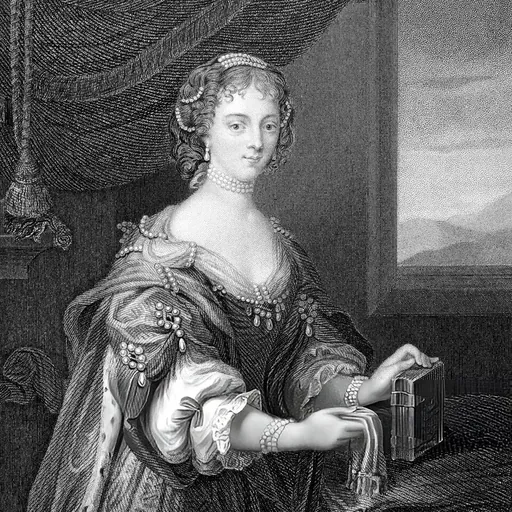
About Blanche Arundell
Lived 1583 – 1649 (aged 65–66). Blanche Arundell was a British aristocrat.
Blanche Arundell, Dowager Baroness Arundell of Wardour (née Lady Blanche Somerset; 1583 or – 28 October 1649) was an English noblewoman, known as the defender of Wardour Castle, that she defended for nearly a week with just 25 men and her maidservants against a force of 1,300.
Biography Arundell was born Blanche Somerset in 1583 or 1584, daughter of Edward Somerset, 4th Earl of Worcester, and Lady Elizabeth Hastings.
She danced in the masque at the marriage of Anne Russell and Henry Somerset, 1st Marquess of Worcester in June 1600. The other dancers, led by Mary Fitton, were Lady Dougherty, Mistress Carey, Elizabeth Southwell, Mistress Onslow, Bess Russell, and Mistress Darcy. They wore skirts of cloth of silver, waistcoats embroidered with coloured silks and silver and gold thread, mantles of carnation taffeta, and "loose hair about their shoulders" which was also "curiously knotted and interlaced".
On 11 May 1607 (date of settlement for the marriage) she married Thomas Arundell, 2nd Baron Arundell of Wardour, son of Thomas Arundell, 1st Baron Arundell of Wardour, and Lady Mary Wriothesley. They had three children: Henry Arundell, 3rd Baron Arundell of Wardour Katherine Arundell Anne Arundell
Arundell was a lady-in-waiting to Anne of Denmark. John Finet described the reception of Isabelle Brûlart, the wife of French ambassador Gaspard Dauvet, Sieur des Marets, at Denmark House on the Strand in December 1617. He brought her to a chamber in the first court where she was joined by Arundell, Mistress Barbara Sidney (daughter of the Viscountess Lisle), Mistress Southwell of the queen's privy chamber, and Mistress Gargrave (one of her Majesty's maids of honour). A gentleman usher then took Brûlart to the queen in the Privy Chamber.
During the Civil War, Lord Arundell brought together a regiment of horsemen in support of King Charles I, whom he led into the Battle of Stratton in Cornwall on 16 May 1643. He was injured during the battle and died on 19 May 1643. and artillery commanded by two Parliamentary officers, Sir Edward Hungerford and Colonel Edmund Ludlow. She finally was forced to surrender on honourable terms. However, the terms were not honoured: the castle was sacked and she was removed as a prisoner to Shaftesbury. However, due to her illness, she was instead moved to Dorchester.
She died at Winchester, Hampshire, and was buried at Tisbury. Her will dated 28 September 1649 was probated on 2 November 1649.
Don’t just read it —
keep it.
Full-length biographies made to live with: read them, listen on the way to work, watch them tonight.
- E-book
- Audio
- Video
Instant download · yours to keep · every purchase keeps this site free
Important facts
People in Blanche Arundell's life
Named in this biography and alive at the same time




Related people
Same field, nearest in time

Contemporaries
People whose lives overlapped Blanche Arundell's



Frequently asked questions
Who was Blanche Arundell?
English noblewoman
When was Blanche Arundell born?
Blanche Arundell was born in 1583.
When did Blanche Arundell die?
Blanche Arundell died on 28 October 1649 in Winchester.
What was Blanche Arundell's occupation?
Blanche Arundell was an aristocrat.
What nationality was Blanche Arundell?
Blanche Arundell was British.
Sources & further reading
· DBpedia: Blanche Arundell, Baroness Arundell of Wardour
Cite this page
APA: Biography.guide. (2026). Blanche Arundell. https://biography.guide/blanche-arundell/
MLA: "Blanche Arundell." Biography.guide, https://biography.guide/blanche-arundell/.
Chicago: "Blanche Arundell." Biography.guide. https://biography.guide/blanche-arundell/.
Data last updated: 2026-09-23 · Spot an error? Report a correction.
Portrait: Wikimedia Commons · author & licence
Page generated 2026-09-27 05:05 UTC