
About Blair Swannell
Lived 1875 – 1915 (aged 39). Blair Swannell was an Australian rugby union player.
Personal history Swannell was born in Weston Underwood, Buckinghamshire on 20 August 1875 to William and Charlotte Swannell, and was the third child of at least five siblings. His father was a farmer, who ran a farm which employed 17 adults and children. He remained single throughout his life.
In 1897 he made his first visit to Australia, as a mate on a schooner. On his return to Britain, Swannell joined the British Army and served in South Africa during the Second Boer War, where he was commissioned as a lieutenant in the 35th Battalion (Buckinghamshire) Imperial Yeomanry on 20 January 1902. He returned to the UK with his battalion on the SS Orotava in December 1902, and retained the rank of honorary lieutenant when he resigned his commission on 3 February 1903. It was reported that during his time in South Africa, he was personally recommended on the field for a commission by General Lord Methuen.
Swannell was a keen self-promoter, claiming a number of exploits that were so abounding, that his adventures were "too numerous to be recorded". Many of these claims are unsubstantiated. One claim that is problematic, made by the Fielding Star newspaper in 1909, He also joined the Australian Militia, and by 1914 had reached the rank of captain and had passed the promotion exams for the rank of major.
Rugby career Swannell played as a forward, and in his last Test specifically at number eight. He would turn up for training in unwashed kit, and wore the same pair of breeches for every game, again unwashed. He also guested for Sydney's Wallaroo FC in one game to improve his match fitness. Swannell scored in only one game on the tour, a try in a win over the New South Wales Waratahs on 29 July 1899.
Swannell returned to Britain with the touring team, and was reselected for the 1904 tour, this time taking in Australia and New Zealand. Swannell played in 15 games, including all four Test Matches, three against Australia and the final Test against New Zealand.
When the touring British team returned home after the 1904 campaign, Swannell along with team-mates David Bedell-Sivright, and Dr. Sidney Crowther decided to remain in Australia, to begin new lives, although Crowther later returned to England. Swannell joined club team Northern Suburbs, based in Sydney. In 1905 he was selected to play for the Australian national team, even though he had already faced them as an opponent on six occasions. The match was against New Zealand, and was the first overseas tour the Australians had undertaken; Australia lost 14–3. Wallaby captain Herbert Moran didn't mince words when speaking of Swannell in Viewless Winds saying "Swannell was, for a number of years, a bad influence in Sydney football...his conception of rugby was one of trained violence" In 1909, he became Secretary of the Metropolitan Rugby Union, Financial stress on the club lead him to resign in 1911 to save expense, but he continued in an 'honorary position'. He also served as a referee from 1911 to 1914,
While in Australia, Swannell was often approached by the sporting press for his opinion on rugby matters. Particularly on clashes between British and Antipodean teams, including the 1905 New Zealand tour. He was vocal in his support for maintaining the amateur nature of rugby, but did not side with Bedell-Sivright in denying that a stipend had been paid during the 1904 tour. In 1908 he was also hired to write a series of articles for the Star on the topic of forward play, and scrummaging.
Gallipoli and death Major B. I. Swannell (center) in Egypt in 1915. On his right is future VC recipient Alfred Shout. Already in the Australian Army, with the outbreak of the First World War, Swannell transferred to the Australian Imperial Force,
Swannell retained his rank of captain, and was posted to Egypt, travelling on the SS Afric on 18 October 1914, arriving in Egypt on 3 December 1914.
Although his promotion to the rank of major was effective 1 January 1915, his elevation in rank was not formally gazetted until 24 April 1915.
In April 1915, Swannell was part of the Australian forces that took part in the Gallipoli Campaign — an attempt to capture the Ottoman city of Istanbul.
Swannell and his men from D Company of the 1st Battalion, transported on the troopship SS Minewasska, landed at the peninsula on 25 April, and were immediately involved in heavy fighting after being diverted to reinforce the 12th Battalion. In the buildup to the assault on the hill known as Baby 700, Swannell and his men were pinned down under heavy enemy fire. While attempting to show his men the best method of aiming their rifles, he was shot in the head and killed by a sniper.
He is commemorated at Baby 700 Cemetery in Gallipoli, and also with a plaque on the walls at Weston-Underwood church in Buckinghamshire. Foden penned and read the following message at the grave of Blair Swannell in Turkey:
From the turf of Franklin's Gardens where you stood, To the shores of Gallipoli where you fell, A truer Saintsman I know not, Forever bleeding green, black and gold. Rest in peace
Don’t just read it —
keep it.
Full-length biographies made to live with: read them, listen on the way to work, watch them tonight.
- E-book
- Audio
- Video
Instant download · yours to keep · every purchase keeps this site free
Important facts
People in Blair Swannell's life
Named in this biography and alive at the same time
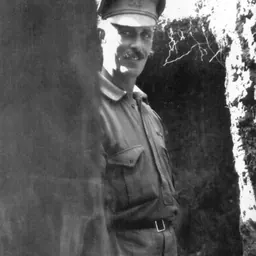
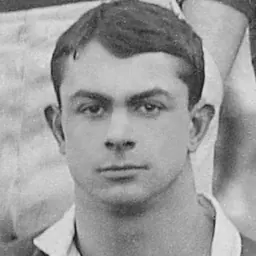
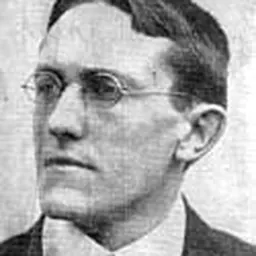
Related people
Same field, nearest in time


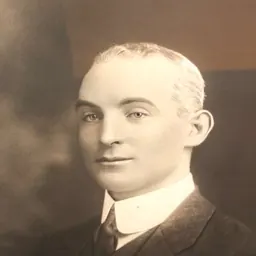

Contemporaries
People whose lives overlapped Blair Swannell's


Frequently asked questions
Who was Blair Swannell?
Australian rugby union footballer (1875-1915)
When was Blair Swannell born?
Blair Swannell was born on 20 August 1875 in Weston Underwood.
When did Blair Swannell die?
Blair Swannell died on 25 April 1915 in Gallipoli.
What was Blair Swannell's occupation?
Blair Swannell was a rugby union player.
What nationality was Blair Swannell?
Blair Swannell was Australian.
Sources & further reading
Cite this page
APA: Biography.guide. (2026). Blair Swannell. https://biography.guide/blair-swannell/
MLA: "Blair Swannell." Biography.guide, https://biography.guide/blair-swannell/.
Chicago: "Blair Swannell." Biography.guide. https://biography.guide/blair-swannell/.
Data last updated: 2026-09-20 · Spot an error? Report a correction.
Page generated 2026-09-27 05:27 UTC