
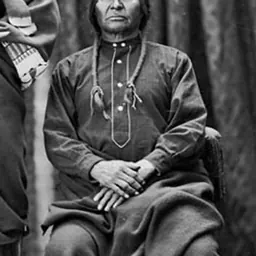
Black Bear
Leader of Northern Arapaho band
About Black Bear
Black Bear was a chief manager and indigenous peoples of the United States in North America.
Black Bear (died April 8, 1870) was an Arapaho leader into the 1860s when the Northern Arapaho, like other Native American tribes, were prevented from ranging through their traditional hunting grounds due to settlement by European-Americans who came west during the Pike's Peak Gold Rush. Conflicts erupted over land and trails used by settlers and miners. A watershed event was the Sand Creek massacre of 1864. This led to the Northern Arapaho joining with other tribes to prevent settlement in their traditional lands. In 1865, Black Bear's village was attacked during the Battle of the Tongue River. People died, lodges were set on fire, and food was ruined, all of which made it difficult for them to survive as a unit. He died during an ambush by white settlers on April 8, 1870, in the Wild Wind Valley of present-day Wyoming.
Background
This map illustrates the approximate territory of the Arapaho and Cheyenne tribes following the Treaty of Fort Laramie in 1851. The North Platte River and Arkansas River acted as the northern and southern border of this territory, respectively.
In the 19th century, the Arapahoes ranged north of the Arkansas River and east from the Medicine Bow Mountains of the Rocky Mountains and north and east into the plains. In the 1820s or the 1830s, at the beginning of contact with European-Americans, the Arapaho divided into Northern and Southern tribes based upon trading sources. British, French, and American trading posts were established north of the Arkansas River. Below that, Native Americans traded in the southwest with the Spanish (Santa Fe de Nuevo México), where it was easier to trade for horses. There were four bands of Northern Arapaho who ranged separately for food and came together for ceremonies, such as Sun Dance.
In 1851, the Fort Laramie Treaty was negotiated between Native Americans of the Western United States and the United States government. Native Americans, including the Arapaho, negotiated to protect their hunting grounds and buffalo herds. The United States government negotiated to protect settlers who moved westward into or through traditional native lands, and along westward trails such as the Oregon Trail. The Arapaho sought to abide by the treaty, but they suffered from starvation due to the sharp reduction of buffalo herds. There was a huge influx of settlers with the Gold Rush into the Rocky Mountains. The United States government's strategy was to put Native Americans on reservations and convert them to agrarian and Christian societies.
In 1859, Medicine Man, a leader of a band of Northern Arapaho and negotiator for the other Northern Arapaho bands, stated that "our sufferings are increasing every year… Our horses, too are dying because we ride them so far to get a little game for our Lodges. We wish to live…" Medicine Man and Black Bear were considered "the two most important Northern Arapaho leaders" of the time. Friday, another Arapaho leader, was a good interpreter who helped negotiate with the United States government.
Sand Creek massacre
A peaceful Arapaho and Cheyenne village on Sand Creek in eastern Colorado was attacked by Colorado troops in late 1864. About 200 people, mostly women and children, were massacred. In retaliation, Arapaho, Cheyenne, and Lakota people began fighting against Euro-Americans on the westward trails. As the military created more forts, the Cheyenne and Arapaho sought to remove European-Americans from the land given to them in the 1851 treaty. The Cheyenne moved back to their pre-1851 hunting grounds to the north and east of the Bighorn Mountains, which pushed the Crows west of the Bighorns.
In April 1865, Black Bear and 400 members of his band were assigned land along the Tongue River in the Powder River Basin as their hunting grounds, in exchange for a pledge of peace. Medicine Man's and Black Bear's bands left their encampment near Fort Collins, Colorado, for the Tongue River area. They allied themselves with Friday and Wolf Moccasin's bands, who had been in the Tongue River area since July 1864. Black Bear and Medicine Man arrived there by June 1865. They decided to forgo any rations that would be provided by the government to follow their traditional way of life, which relied on hunting buffalo for food. Following the lead of Cheyenne and Sioux natives, Black Bear and Medicine Man led their bands against Overland and Oregon Trail travelers beginning in June. They returned to the Tongue River area in August, by which time they were blamed for "most of the outrages committed on the overland mail route west of Denver." Black Bear then left the women and children of his band there while he and some warriors went to fight the Crows on the Bighorn River.
Battle of Tongue River
In the early morning of August 29, 1865, at present-day Ranchester, Wyoming, 125 cavalry and 90 Pawnee Scouts, led by General Patrick Edward Connor, attacked an Arapaho village. The village of Chief Black Bear and Old David's band was located in northeastern Wyoming along the Tongue River. Connor’s objective was to "attack and kill every male Indian over twelve years of age." or 700 people. Woman and children ran for safety, and were chased for ten miles by soldiers on horseback. Black Bear's band regrouped. They were also at risk due to cholera and smallpox that was running through their band at that time.
With Medicine Man and other Arapaho leaders, Black Bear met with Peace Commissioners in 1868. They sought to live a more peaceful existence on a reservation of their own in Wyoming.
Fort Laramie Treaty of 1868
Photograph of General William T. Sherman and Commissioners in Council with Native American Chiefs at Fort Laramie, Wyoming Black Bear was one of the signers of the Treaty of Fort Laramie of 1868, which allowed the Arapaho to continue to hunt in the Powder River Basin. There was no reservation established for the Northern Arapaho. They had options to live at one of three reservations—one in Indian Territory (now Oklahoma with southern Arapaho and Cheyenne relatives, another with the Crows in Montana Territory, or on the Missouri River with the Lakotas. If they stayed on a reservation, they were to have farm equipment, schools, and rations for 30 years. The Shoshone reservation kept Black Bear and Medicine Man's bands in Wyoming. They wanted to reside in Wyoming, but it was a difficult proposition to live among the Shoshone.
The Northern Arapaho bands had an increasingly harder time hunting for sufficient game to feed its people and they began to rely on government rations. Miners and settlers crossed into Native American lands along the Sweetwater and Popo Agie Rivers. This led to periodic skirmishes.
The Arapaho had a camp in the Wind River Valley. A group of white people, along with Shoshone and Bannocks, attacked Black Bear, his family, and his unarmed band as they traveled to Camp Brown (Fort Washakie) for trading. Black Bear and up to 16 others were killed. His wife and child and an additional seven children were captured. One of the children was Destchewa ("Runs on top of ice") who was adopted by Captain Charles A. Coolidge and his wife. He was renamed Sherman Coolidge.
Chief Black Coal, among the most influential Arapaho chiefs of his time. Chief Black Coal was able to largely keep the Arapaho at peace with the United States during the Great Sioux War of 1876. He served as a U.S. Army scout and helped the tribe find a home on Wind River. After Black Bear's death, the band split up. Some went to Colorado Territory, led by Chief Friday, and others went to the Milk River Agency to live among their relatives, the Gros Ventres. Most of them gathered at Fort Fetterman by August 1870. Medicine Man died in 1871. Chief Black Coal began the leader of the Northern Arapaho.
Don’t just read it —
keep it.
Full-length biographies made to live with: read them, listen on the way to work, watch them tonight.
- E-book
- Audio
- Video
Instant download · yours to keep · every purchase keeps this site free
Important facts
Related people
Same field, nearest in time

Frequently asked questions
Who was Black Bear?
leader of Northern Arapaho band
When did Black Bear die?
Black Bear died on 8 April 1870.
What was Black Bear's occupation?
Black Bear was a chief manager and indigenous peoples of the United States in North America.
Sources & further reading
Cite this page
APA: Biography.guide. (2026). Black Bear. https://biography.guide/black-bear/
MLA: "Black Bear." Biography.guide, https://biography.guide/black-bear/.
Chicago: "Black Bear." Biography.guide. https://biography.guide/black-bear/.
Data last updated: 2026-09-20 · Spot an error? Report a correction.
Page generated 2026-09-27 05:22 UTC