About Binnya U
Lived 1323 – 1384 (aged 60–61). Binnya U was a Myanmar monarch.
Binnya U (, , ; also known as Hsinbyushin; 1323–1384) was king of Martaban–Hanthawaddy from 1348 to 1384. His reign was marked by several internal rebellions and external conflicts. He survived the initial rebellions and an invasion by Lan Na by 1353. But from 1364 onwards, his effective rule covered only the Pegu province, albeit the most strategic and powerful of the kingdom's three provinces. Constantly plagued by poor health, U increasingly relied on his sister Maha Dewi to govern. He formally handed her all his powers in 1383 while facing an open rebellion by his eldest son Binnya Nwe, who succeeded him as King Razadarit.
King Binnya U is best remembered in Burmese history as the father of King Razadarit. One enduring legacy of his reign was Pegu's (Bago's) emergence as the new power center in Lower Burma. The city would remain the capital of the Mon-speaking kingdom until the mid-16th century.
Early life
Born late 1323, Binnya U was the only son of Queen Sanda Min Hla and King Saw Zein (r. 1323–1330) of Martaban. He was a grandnephew of the founder of the dynasty King Wareru. He had two elder sisters Mwei Ne and Mwei Na although the eldest sister Ne died young. He also had two younger half-siblings: Mi Ma-Hsan and Min Linka.
As the eldest son, U was the heir-presumptive until his father was assassinated in 1330. But he remained an important prince as his mother remained a powerful, feared kingmaker in the following years. After eliminating the usurper and the next successor in the following eight weeks, the queen placed her half-brother Binnya E Law on the throne, and made herself the chief queen. Probably in deference to the queen's sensitivities, E Law did not name an heir-apparent. The rivalry between E Law's son Binnya E Laung and U escalated in the 1340s when E Law's health declined. The half-cousins ended up fighting an elephant-back duel in which U defeated E Laung. The king was furious, and had U arrested. But Sanda Min Hla intervened, and E Law released U. At any rate, E Laung died from smallpox soon after, and U emerged as the heir-presumptive. E Law himself died in 1348, and the 25-year-old prince succeeded. He ascended the throne with the title of Hsinbyushin (ဆင်ဖြူရှင်, "Lord of the White Elephant") because he possessed a white elephant, a propitious symbol of Burmese monarchs.
Lan Na invasion (1351–1352) His attempts to gain control of the vassal regions were not as successful. Although he was able to appoint Linka to the key governorship at Pegu (Bago), other key vassal rulers remained unimpressed. The invasion force quickly overran the northern Martaban (present-day northern Mon State), and reached the outskirts of Martaban and Moulmein (Mawlamyaing). He actually built a Buddhist pagoda, housing a holy relic he had received from Ceylon,
Pegu rebellion (1352–1353) U's job was not finished. His half-brother Gov. Min Linka of Pegu never sent any help during the invasion. In 1352–53, he sent his army to retake Pegu. The mission was successful. Linka was brought back to Martaban, and subsequently executed. Linka's wife, Mwei Daw, became a queen of U.
Golden years (1353–1363) The decade between 1353 and 1363 were the golden years for Binnya U. The country was at peace, and prosperity returned at least to the capital Martaban.
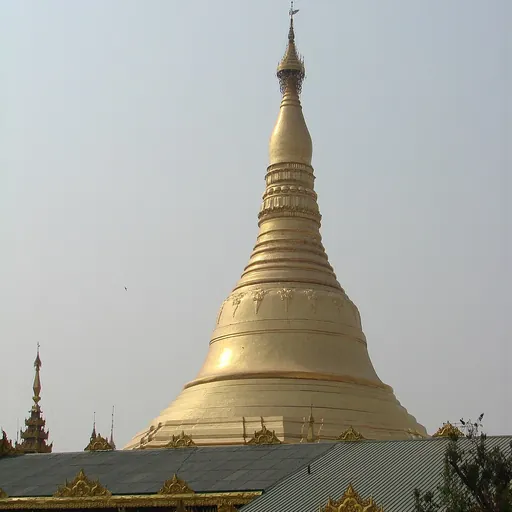
His regime was able to steer the kingdom out of the troubles that were enveloping his northern and eastern neighbors. Martaban's former overlord Sukhothai had been eclipsed by the emerging Ayutthaya Kingdom. The northern Pinya had no effective control over its southern vassals at Prome and Toungoo. U established direct relations with Toungoo's restive governor Theingaba. When Theingaba formally revolted against Pinya in 1358, he stayed on good terms with the rebel governor but did not want Toungoo to become too strong either. U readily gave shelter to Theingaba's son Pyanchi in Pegu when Pyanchi sought refuge. By the early 1360s, both Pinya and Sagaing kingdoms had been under repeated raids by the northern Shan state of Maw. Martaban was an island of stability. In 1362, the king raised the height of the Shwedagon Pagoda in Dagon to 20 meters (~66 feet).
Middle reign Coup The end to Martaban's tranquil years came not from the widespread instabilities that surrounded the kingdom but from within. According to the chronicle Razadarit Ayedawbon, the main cause was the king's penchant for months-long elephant hunting trips away from the capital. U had been trying to find another "propitious" white elephant since the death of his first white elephant in 1354/55, believing that the late elephant was the reason he defeated the 1351–52 Lan Na invasion. In the dry season of 1363–64, he with over 2000 troops went on a hunting trip. he received news that a coup led by princes Byattaba and his brother Laukpya had taken place at the capital. He rushed back to the capital, and ordered two separate missions to retake Martaban. But he did not have enough manpower, and both missions failed. In the Irrawaddy delta too, Laukpya's forces reigned supreme.
Donwun years (1364–1369) U now set up camp at the dynasty's ancestral home Donwun. His realm had suddenly been reduced to the Pegu province and the northern tip of the Martaban province. His hold over the Pegu province was helped by the effective rule of his elder sister, Maha Dewi, whom he appointed governor of Dagon in 1364.
Lan Na continued to loom large in the politics of Lower Burma. When he heard that Byattaba was seeking Lan Na's help, U tried to repair relations with the Tai kingdom by sending his eldest daughter Tala Mi Thiri to Chiang Mai in a marriage of state. It apparently did the job as Lan Na did not interfere. (Queen Thiri would have a terrible time at Chiang Mai, and constantly urged her father to bring her back. U would bring her back 1371. )
What followed was a stalemate for the next five plus years. U did not try to regain the rebellious regions but neither did the rebel brothers try to dislodge U from Donwun. U heavily relied on his chief minister Pun-So, who kept the remaining territories intact. Then in 1369, Pun-So died. Taking advantage of the ensuing commotion, Byattba sent 700 warriors disguised as mourners, who managed to get inside Donwun, and seize U's palace. The king barely escaped to the nearby woods, and fled to Pegu, about 120 km northwest of Donwun, across the Bay of Martaban. Byattaba now controlled the entire Martaban province. Laukpya also raided Dala several times although U loyalists held the line.
Reign at Pegu Emergence of Pegu U's realm was now reduced to just the Pegu (Bago) province (present-day southern Bago Region and Yangon Region). It turned out to be a fortuitous move for him. Not only was Pegu strategically located between the other two provinces but the province was also the most populous. Then ongoing sedimentation and silting since 1300 had increased the once swampy province's "agricultural and demographic potential". On the other hand, Martaban was located on the upper Tenasserim coast, and too close to the Tai kingdoms to the east. By 1370, Pegu was "ready to supplant Martaban as regional leader". Indeed, all subsequent monarchs of the Wareru dynasty would remain at the more strategic Pegu even after Martaban returned to the fold. The kingdom would be known as the Hanthawaddy Kingdom, after Pegu's classical name Hanthawaddy—the academic and popular name by which the dynasty which lasted from 1287 to 1539, inclusive of the Martaban years, is known.
Peace treaty with Ava U's first actions at Pegu was to stabilize his reduced realm. In 1370–71, he quickly signed a peace treaty with King Swa Saw Ke of the emerging Ava Kingdom in the north. Both monarchs wanted a quiet border: U was dealing with his ongoing rebellions; Swa was focused on securing his northern border against the Maw Shans. Swa wanted U to acknowledge Toungoo (Taungoo) as part of Ava's sphere of influence. The Ava king did not trust his nominal vassal Gov. Pyanchi I of Toungoo, who was educated and lived in Pegu for several years. The two kings met in 1370/71 at the frontier, and signed a treaty demarcating the border. History shows that the treaty was an act of political expediency. The two kingdoms would fight a proxy war over Toungoo in 1375–76. But he paused when Byattaba and Laukpya again appealed to Lan Na. Though he was technically allied with King Kue Na of Lan Na through a marriage of state, his daughter Thiri had not gotten along with Kue Na, and wanted a divorce. Concerned by Chiang Mai's potential interference, U agreed to a truce with the brothers. The agreement called for U to pay the brothers 10 viss (16.33 kg) of gold and ten elephants in exchange for the brothers recognizing U as their sovereign as well as to broker an agreement with Kue Na to send Queen Thiri back. As the Razadarit Ayedawbon recounts, U realized the absurdity of the overlord paying tribute to the vassals but he ultimately decided to swallow his pride, and agreed to the terms. On the other hand, Byattaba and Laukpya realized that they needed Lan Na's support in order to neutralize U's stronger position at Pegu. The brothers sent 15 viss (24.49 kg) of gold in total to retain Chiang Mai's support. The king of Lan Na also sent back Tala Mi Thiri back. sought to impose tighter control over Toungoo. According to a contemporary inscription, by the time the dust had settled, Ava had sent three expeditions against Toungoo, and caused widespread starvation in the region. Fortunately for Pegu, Ava would have its hands full with Toungoo for the next seven years, and leave Pegu alone until after U's death. For his part, U essentially stayed out of Toungoo for the rest of his reign. The Toungoo Yazawin chronicle reports a single embassy (by Gov. Phaungga of Toungoo in 1383) to Pegu between 1376 and 1384. deteriorated further in the 1370s, he began asking her to take on administrative duties. However, a powerful faction of the court, led by Chief Minister Zeik-Bye, secretly opposed her. Her enemies tried to undermine her by making public her alleged affair with a much younger married Smim Maru, who was also her nephew-in-law and U's son-in-law. But the king continued to trust his sister. By the early 1380s, she had emerged as the de facto ruler. The main opposition to her rule would come from her nephew and adopted son Binnya Nwe in 1383.
Binnya Nwe's rebellion Binnya U frequently showed his disgust to his eldest son, Binnya Nwe. An illustration from Rachathirat, a Thai version of Razadarit Ayedawbon, 1946 printed edition. According to the chronicle Razadarit Ayedawbon, the king and his eldest son were never close. Prince Nwe, whose mother died at childbirth, had been raised by his aunt Maha Dewi since his birth. Nwe was never his father's favorite. The king deemed him "ruthless", and once told his sister that Nwe was not to ascend the throne. U had chosen the younger son Baw Ngan-Mohn as heir-apparent. Nwe responded in kind. In 1382, he eloped with his half-sister Tala Mi Daw. U was aghast. When the young couple was soon caught, the king had Nwe imprisoned. Maha Dewi had to repeatedly plead with her brother to free Nwe, and allow the young couple to be married. U finally relented; she wedded the young couple. Furious, U asked his sister to fix the situation. Advised by Zeik-Bye, Maha Dewi did not make much of the "rebellion". She believed her adopted son's conciliatory letter, saying he would soon return by August. It was only at the end of August that she decided to use force, after learning that Nwe had sent missions to enlist help from Martaban and Myaungmya.
Maha Dewi's regency Meanwhile, U's health took a turn for the worse. He could not even attend meetings with the court anymore. In October, he officially handed power to his sister, giving her the right to raise the white umbrella, a symbol of Burmese sovereigns. The act formalized what had been the reality for sometime. She was now referred to as Min Maha Dewi ("Queen Maha Dewi"). However, she continued to refer to her brother as the sovereign in her official edicts.
At any rate, she never won the court's support. With U on his deathbed, Zeik-Bye not so secretly undermined Maha Dewi's plans. Zeik-Bye was in secretly in league with Nwe, and provided the necessary intelligence. Undermined by Zeik-Bye, the Pegu army was driven back by Nwe's small army on 19 November 1383. Indeed, by December, neither Maha Dewi nor U had any authority. When Nwe and his small army appeared outside Pegu's walls on 10 December 1383, she could do nothing other than hunker down inside the city walls.
The stalemate ended with Binnya U's death on 2 January 1384. Maru tried to rally the court but found no support. When he and his wife tried to flee, they were captured. On 4 January 1384, the Zeik-Bye-led court handed the power to Nwe. The new king, known by the title of Razadarit, decided not to punish his adoptive mother, and reappointed her to her old post at Dagon but strictly in a ceremonial role.
Family The following a list of family members as reported in the Razadarit Ayedawbon.
Queen Rank Issue Reference Sanda Min Hla II Chief queen (1348–1365) none Hnin An Daung Senior queen Chief queen (1365–1384) Tala Mi Thiri Sanda Dewi Senior queen Tala Mi Daw Yaza Dewi Queen Baw Ngan-Mohn Thiri Maya Dewi Queen (r. 1353–1368) Razadarit
Ancestry
Don’t just read it —
keep it.
Full-length biographies made to live with: read them, listen on the way to work, watch them tonight.
- E-book
- Audio
- Video
Instant download · yours to keep · every purchase keeps this site free
Important facts
Family & relationships
People in Binnya U's life
Named in this biography and alive at the same time



Related people
Same field, nearest in time


Contemporaries
People whose lives overlapped Binnya U's
Frequently asked questions
Who was Binnya U?
King of Hanthawaddy Kingdom
When was Binnya U born?
Binnya U was born in 1323 in Mottama.
When did Binnya U die?
Binnya U died on 23 January 1384 in Bago.
What was Binnya U's occupation?
Binnya U was a monarch.
What nationality was Binnya U?
Binnya U was Myanmar.
Sources & further reading
Cite this page
APA: Biography.guide. (2026). Binnya U. https://biography.guide/binnya-u/
MLA: "Binnya U." Biography.guide, https://biography.guide/binnya-u/.
Chicago: "Binnya U." Biography.guide. https://biography.guide/binnya-u/.
Data last updated: 2026-09-23 · Spot an error? Report a correction.
Portrait: Wikimedia Commons · author & licence
Page generated 2026-09-27 05:08 UTC