
About Bill Wager
Lived 1904 – 1965 (aged 61). Bill Wager was a British explorer, university teacher, geologist and mountaineer.
Early life
Wager was born in Batley, Yorkshire, and was the son of Morton Ethelred Wager and Adelina Rickard. Wager attended Hebden Bridge Grammar School, where his father was headmaster. He later lived with his uncle Harold Wager, FRS, a botanist and mycologist, while studying at Leeds Grammar School.
He then entered Pembroke College, Cambridge, where he gained a first class degree in geology in 1926. While at Cambridge, he developed an interest in climbing, spending a number of holidays in the Wales, Scotland and the Alps, and serving as president of the university's mountaineering club. After three years of further research at Cambridge, he was appointed lecturer in the geology department at the University of Reading in 1929. The expedition (which continued over the winter) also proved his mettle as an explorer; at one point the relief of a station required him to undertake a 125-mile sledge journey to the highest point on the ice-cap in atrocious conditions – an endeavour which took 39 days. Wager also made an attempt to climb Mount Forel in Schweizerland, at the time the highest known peak in the Arctic at 11,500 ft. The party turned back 500 ft below the summit, but had still made the highest climb in the Arctic to date. which Wager led. The aim was to map the Skaergaard Intrusion in detail, and as much of the surrounding area as possible. A total of 35,000 km2 of difficult terrain was mapped, and the results of his explorations were published in four volumes of Meddelelser om Grønland. The work on the Skaergaard Intrusion has been described as possibly "the most significant single contribution yet made to the science of petrology". The team assembled included Percy Wyn-Harris, who had known Wager at Cambridge, and when Noel Odell was forced to drop out for business reasons, Wager was selected as a late replacement. On 30 May, Wager and Wyn-Harris made the team's first attempt on the summit. They followed the traverse route below the mountain's northeast ridge, as pioneered by Norton in 1924, rather than the ridge itself. They reached approximately the height Norton had gained (28,200 ft) before turning back due to poor snow conditions and the lateness of the hour. In doing so, they equalled the highest point reached in mountaineering at the time, and set an altitude record for climbing without supplemental oxygen which would not be bettered until Messner and Habeler reached the summit of Everest in 1978. and promoted to flying officer a year later. In 1942 he braved the notorious Murmansk Run as part of a small reconnaissance team attempting to track down the German battleship Tirpitz. Wager was Mentioned in Despatches for his work. He was promoted to temporary flight lieutenant on 1 September 1942, and the rank was made substantive on 11 February 1943. He resigned his commission on 1 July 1944.
In 1944 Wager was appointed to the Chair of Geology at the University of Durham. In 1946, Wager was elected a Fellow of the Royal Society His nominators included Herbert Hawkins (his former Head of Department from Reading), EB Bailey, HH Read and Harold Jeffreys. He moved to the University of Oxford in 1950 as Professor of Geology (along with a fellowship at University College, Oxford). There he helped to modernise what had been a failing department. He made a further expedition to Greenland in 1953 with Alex Deer, but in 1955 a heart attack put an end to his career as an active mountaineer and explorer. Soon after they were married, Phyllis accompanied Wager to East Greenland on the 1935–1936 expedition, along with her sister-in-law Elizabeth Mary (Kit) Wager. Phyllis and Kit were the first British women to spend a winter there.
Wager's extensive archives are held at the Oxford University Museum of Natural History.
Honours The Wager Glacier in Alexander Island, Antarctica, was named after him.
Awards 1933 Polar Medal 1936 Mungo Park Medal 1938 Back Award, Royal Geographical Society 1945 Bigsby Medal 1948 Spendiarov Prize 1962 Lyell Medal
Don’t just read it —
keep it.
Full-length biographies made to live with: read them, listen on the way to work, watch them tonight.
- E-book
- Audio
- Video
Instant download · yours to keep · every purchase keeps this site free
Important facts
People in Bill Wager's life
Named in this biography and alive at the same time

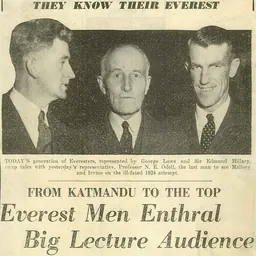

Related people
Same field, nearest in time

Contemporaries
People whose lives overlapped Bill Wager's




Frequently asked questions
Who was Bill Wager?
British explorer (1904–1965)
When was Bill Wager born?
Bill Wager was born on 5 February 1904 in Batley.
When did Bill Wager die?
Bill Wager died on 20 November 1965 in London.
What was Bill Wager's occupation?
Bill Wager was an explorer, university teacher, geologist and mountaineer.
What nationality was Bill Wager?
Bill Wager was British.
Sources & further reading
Cite this page
APA: Biography.guide. (2026). Bill Wager. https://biography.guide/bill-wager/
MLA: "Bill Wager." Biography.guide, https://biography.guide/bill-wager/.
Chicago: "Bill Wager." Biography.guide. https://biography.guide/bill-wager/.
Data last updated: 2026-09-20 · Spot an error? Report a correction.
Page generated 2026-09-27 05:26 UTC