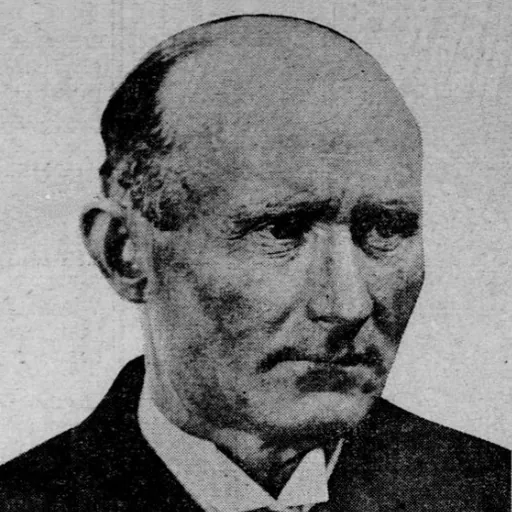
Bill Brown
American rancher
About Bill Brown
Lived 1855 – 1941 (aged 85). Bill Brown was an American ranching.
William Walter Brown (July 19, 1855 – January 11, 1941) was an American pioneer rancher in central Oregon. He owned two large ranches between Burns and Prineville, Oregon. Together, his properties comprised one of the largest privately owned sheep and horse operations in the United States. He was known as the Horse King of the West and the Millionaire Horse King because over 10,000 horses carried his Horseshoe Bar brand. Brown was also a well-known philanthropist who gave hundreds of thousands of dollars to a wide range of religious and educational institutions.
Early life
Brown's parents, Samuel Brown and Hannah (Ellis) Brown were both born in England. Their families immigrated together to the United States in 1848. The two families settled in Wisconsin in 1850. Samuel and Hannah married in 1851. Their son William was born in Kenosha, Wisconsin on 19 July 1855. He was the third of seven children, which included five boys and two girls.
The Brown family moved to Iowa in 1855, shortly after William's birth. In 1869, the family moved on to Oregon, settling on a farm in Clackamas County between Oregon City and Canby. Brown attended the Oregon City Seminary School and then went on to college in San Jose, California. On his way to California, Brown visited Central Oregon and liked the area. He attended California State Normal School, a state teachers college (now San Jose State University). After graduating in 1878, he taught school in California for three years while he saved his money to invest in a ranching operation.
In 1886, Brown was engaged in a gunfight with a neighbor's hired hand named John Overstreet. The trouble began when Overstreet started grazing his sheep on meadowland owned by the Brown brothers. Brown warned Overstreet that he was trespassing, but Overstreet would not move his sheep off the Brown brother's property. Both men got their guns and exchanged shots, resulting in Overstreet's death. Brown immediately reported the incident to the local justice of the peace in Silver Lake, Oregon. A grand jury later refused to indict him, citing self-defense.
By 1889, the brothers' sheep herds had grown to 10,000 animals. However, that winter was long and extremely cold, with deep snow. As a result, only 500 sheep survived the winter. At that time, Brown bought his brothers' shares in the operation and his brothers returned to the Willamette Valley to start farms. In the following years, Brown rebuilt his sheep herd until his operation had approximately 22,000 animals.
In 1895, a range war between cattlemen and sheepherders began in central Oregon. It was generally a one-sided war with armed cattlemen attacking sheep herds, often killing hundreds (sometimes thousands) of sheep in a single raid. For the most part, Brown's herds escaped this slaughter. This was due in part to the size of his operation and the fact that he owned enough property that he was not reliant on grazing on public lands. However, on one occasion in 1903, 487 of Brown's sheep were killed by riders who were probably part of the Paulina Sheepshooters Association. The range war finally ended in 1906, when the United States Forest Service took control of a large part of the disputed public lands and began issuing grazing permits to local ranchers, with range quotas for both cattle and sheep.
Ranching empire
Brown owned between and of range land. His holdings were spread across at least 30 parcels which included much of the surface water in the very dry high desert environment between the towns of Prineville and Burns. His property included large tracts of land in four Oregon counties: Crook, Harney, Lake, and Deschutes (which was part of Crook County until 1916). Because he controlled most of the water sources in the area, his herds could graze freely across a wide expanse of high desert including large tracts of public lands. The area ran approximately north to south and east to west. Brown's eastern neighbor was the cattle baron Bill Hanley, who owned two large ranches south and east of Burns. Prior to 1910, the Buck Creek Ranch was a collection of ramshackle buildings; woolsheds, storehouses, stables, rustic living quarters, and a company store. In 1910, Brown added a new modern fourteen-room house to the ranch complex. The new house had a modern water system, indoor bathrooms, seven or eight bedrooms, a large living room, and an office. Brown furnished it with fine furniture including a dining room table that seated twelve, a piano, and an organ. In addition to the two main ranches, Brown had at least twenty sheep camps that supported eight herds that were constantly moving between his properties and adjacent public lands. In 1907, Brown paid for a new music building at Willamette University and later gave the school in Harney County. Other significant gifts included a $30,000 donation to Willamette University as well as large contributions to the Presbyterian seminary in Pendleton, another seminary in San Francisco, and the College of Puget Sound in Tacoma, Washington. When his niece was accepted at the University of Oregon, Brown sent the school $25,000 .
Horse King
Sometime around 1892, Brown began buying small horse herds from his neighbors. At that time, horses sold for $3 to $10 per head. Soon he had 7,000 or more horses that he kept on the open range. Brown marked his horses with his Horseshoe Bar brand. To protect his brand he never sold horses to anyone who would use them in Oregon. As a result, Brown could claim any horse in the state that had a Horseshoe Bar brand. Even though Brown owned thousands of horses, he regularly walked the between his two ranches, a practice that contributed to his reputation as an eccentric character.
When the United States went to war with Spain in 1898, the demand for cavalry and pack horses drove the price up. During the war, Brown sold thousands of horses to the United States Army for $80 to $100 each. During this same period, the British Army also sent buyers to central Oregon to purchase horses for service in the Boer War. After those wars ended, Brown continued to sell thousands of horses to the Army each year.
The peak of his horse empire came during World War I, when Brown sold horses to armies from the United States, Canada, Great Britain, and France. He held regular auctions at his Buck Creek Ranch and several other locations, often selling five hundred horses in a single day. Buyers would then hire trail hands to move their newly acquired horses to the railheads at Bend, Crane, or Lakeview for shipment to California, Kansas, and east coast ports. During the war, Brown often sold his horses for $100 ahead. Over the course of the war, he realized an average sale price of $87 per horse.
Later life
In 1935, Brown sold his last property holding and remaining livestock for a small amount of money to the Wool Grower Credit Corporation of Portland in lieu of foreclosure. He moved to the Methodist Old People's Home in Salem. Brown had financed the construction of the Methodist home in 1923, one of his many philanthropic gifts to institutions affiliated with the Methodist Church. He remained a bachelor all his life. Brown died of a heart attack at the Methodist home on 11 January 1941. He was buried in the Brown family plot at the Zion Memorial Park cemetery in Canby.
Today, he is remembered as one of eastern Oregon's most colorful characters. He is also remembered for his generous philanthropic gifts to religious and educational institutions throughout the Pacific Northwest. The exact amount of his charitable gifts is unknown, but it was certainly in the hundreds of thousands of dollars. In an interview with the Oregon Journal newspaper in 1936, Brown pointed out that, "The money I have given away will go on doing good long after I am gone".
Don’t just read it —
keep it.
Full-length biographies made to live with: read them, listen on the way to work, watch them tonight.
- E-book
- Audio
- Video
Instant download · yours to keep · every purchase keeps this site free
Important facts
People in Bill Brown's life
Named in this biography and alive at the same time



Related people
Same field, nearest in time

Contemporaries
People whose lives overlapped Bill Brown's





Frequently asked questions
Who was Bill Brown?
American rancher
When was Bill Brown born?
Bill Brown was born on 19 July 1855 in Kenosha.
When did Bill Brown die?
Bill Brown died on 11 January 1941 in Salem.
What was Bill Brown's occupation?
Bill Brown was a ranching.
What nationality was Bill Brown?
Bill Brown was American.
Sources & further reading
· DBpedia: Bill Brown (rancher)
Cite this page
APA: Biography.guide. (2026). Bill Brown. https://biography.guide/bill-brown-bill-brown-rancher-personfunction-1/
MLA: "Bill Brown." Biography.guide, https://biography.guide/bill-brown-bill-brown-rancher-personfunction-1/.
Chicago: "Bill Brown." Biography.guide. https://biography.guide/bill-brown-bill-brown-rancher-personfunction-1/.
Data last updated: 2026-09-23 · Spot an error? Report a correction.
Portrait: Wikimedia Commons · author & licence
Page generated 2026-09-27 05:05 UTC