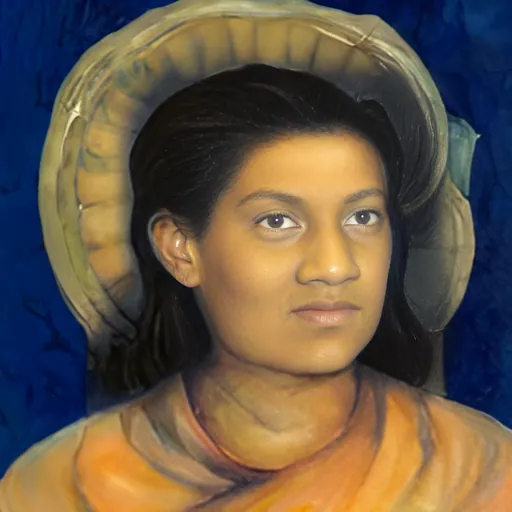
About Bhima Bhoi
Lived 1850 – 1895 (aged 44–45). Bhima Bhoi was a composer, songwriter, poet and writer.
Bhima Bhoi (1850 – 1895) was a 19th-century saint, Odia poet, mystic, and social reformer from the state of Odisha in India. He was a follower of Mahima Swami, and his teachings and poetry were deeply influenced by Mahima Dharma, a monotheistic religious movement in Odisha. Bhima Bhoi was a bhakta (Odia: devotee) of Mahima Gosain, the founder of Satya Mahima Dharma, an Indian religious tradition that challenged the authority of caste and other forms of discrimination. Bhima Bhoi is remembered for his mystical poetry, which was primarily in the Odia language, and his social reform efforts aimed at uplifting the marginalized sections of society.
Early life Bhima Bhoi was born in Madhupur in Rairakhol in 1850, though various sources have cited different years as well as different places of birth. Bhima Bhoi's family belonged to the Kondh tribe. Bhoi's family was not well off and by most accounts, his early life was not happy. Despite losing eyesight in one eye to smallpox in his early childhood, Bhima Bhoi gained knowledge by listening to the recitation of religious texts from a nearby Bhagabata Tungi. Bhima Bhoi soon left his place of birth and reached the Rairakhol area and was employed as a servant by a farmer. He worked as a cattle caretaker and lived in a chawl near the farmer's cowshed as he was from an "untouchable" tribe.
Spiritual journey and teachings At the age of twelve, Bhima Bhoi left his job and began his spiritual journey, performing penance at Kapilas, where his guru Mahima Swami had meditated and preached. Four Brahmin disciples inscribed the songs that he recited. After working in the Joronda region for some time, Bhima Bhoi established his ashram in Khaliapali near Sonepur. He attracted numerous disciples, married, and started a family. Bhima Bhoi died in Khaliapali in 1895.
Stuti Chintamani Stuti Chintamani is considered the most important poetical work of Bhima Bhoi. It consists of 100 chapters, each containing 20 two-line stanzas, totaling 4,000 lines. The poem is a set of prayers to Brahma, with the poet asking for redemption from the suffering and injustices that humanity experiences in the Kaliyuga. Bhima Bhoi emphasizes the importance of devotion (bhakti) over knowledge (gyana) in achieving salvation. In honour of Bhima Bhoi, Bolangir Medical College is named Bhima Bhoi Medical College.
Don’t just read it —
keep it.
Full-length biographies made to live with: read them, listen on the way to work, watch them tonight.
- E-book
- Audio
- Video
Instant download · yours to keep · every purchase keeps this site free
Important facts
Related people
Same field, nearest in time



Contemporaries
People whose lives overlapped Bhima Bhoi's


Frequently asked questions
Who was Bhima Bhoi?
Indian poet
When was Bhima Bhoi born?
Bhima Bhoi was born in 1850 in redhakhol madhupur.
When did Bhima Bhoi die?
Bhima Bhoi died in 1895 in Khaliapali.
What was Bhima Bhoi's occupation?
Bhima Bhoi was a composer, songwriter, poet and writer.
Sources & further reading
Cite this page
APA: Biography.guide. (2026). Bhima Bhoi. https://biography.guide/bhima-bhoi/
MLA: "Bhima Bhoi." Biography.guide, https://biography.guide/bhima-bhoi/.
Chicago: "Bhima Bhoi." Biography.guide. https://biography.guide/bhima-bhoi/.
Data last updated: 2026-09-20 · Spot an error? Report a correction.
Page generated 2026-09-27 05:10 UTC