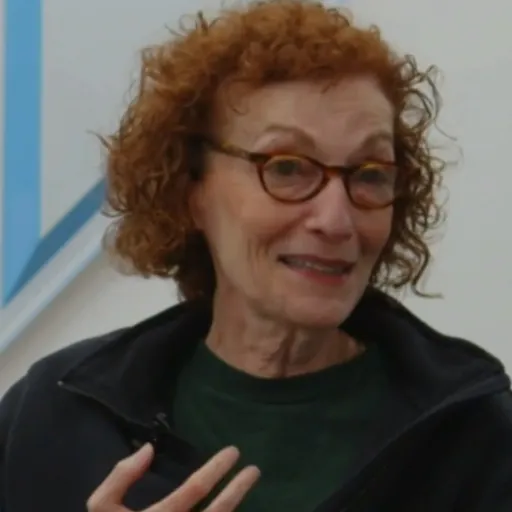
About Beverly Fishman
Born 1955. Beverly Fishman is an American painter.
Beverly Fishman (born 1955, Philadelphia, Pennsylvania) is an American painter and sculptor whose work explores science, medicine, and the body. She is a Guggenheim Fellow, a National Academy of Design Academician, an Anonymous Was a Woman awardee, and was Artist-in-Residence at Cranbrook Academy of Art between 1992 and 2019, where she was Head of the Painting Department. Although best known for her painted reliefs based on the forms of drugs and pharmaceuticals, Fishman has consistently worked in multiple media, such as cast-resin and glass sculpture, as well as silkscreen painting on metal, large-scale wall painting, and outdoor murals. While Fishman's artworks often look abstract, they are based on appropriated shapes, patterns, and images drawn from the pharmaceutical and illicit drug industries as well as multiple forms of scientific and medical imaging. As she noted in 2017, "Although they look abstract, my paintings are tied to problems like attention-deficit disorder, opioid addiction, anxiety, and depression. Their forms connect them to the social problems of today."
Work of the 1980s While at Yale, Fishman began to explore sculpture, an investigation that occupied her intensely for the first half of the 1980s.
During the late 1980s, Fishman switched processes again and began to create mixed-media paintings on wood that incorporated collage elements made with photocopier machines. "Appropriating and abstracting images of [human] cells, I sought to link the reproduction of images to mutation and biological development. Living in New York during the AIDS crisis, I was aware of how a virus could define one’s identity. I wanted to represent the body while engaging with the technologies through which our interiors were visualized and reproduced." These tondo-shaped canvases culminated in large-scale installations like Intervention at the Detroit Institute of Arts in 1995, which incorporated the DIA’s great entrance hall—lined with vitrines containing medieval armor—to evoke questions about how human beings continuously change their identities through science and technology. In the mid-1990s, Fishman began creating installations of cell-like modules consisting of photo-collage, acrylic, and resin. Referencing post-minimalism, feminism, and commodity art, she explored shaped module as a mixture of appropriated and hand-painted elements, while simultaneously using grid-like installations to present the body as commodity as well as to destabilize oppositions between biological and technological modes of reproduction. New forms of cluster paintings emerged in the late 1990s, in which up to 100 elements were combined into single, multi-component works. the Pill Spills evoke the idea of medicine as pharmakon—both poison and cure—a concept first articulated in Plato’s Phaedrus and later elaborated by Jacques Derrida in “Plato’s Pharmacy” to signify the unstable duality of substances, images, and technologies as simultaneously remedial and toxic. By invoking the pharmakon, Fishman underscored the ambivalence of pharmaceutical culture and its oscillation between healing and harm. Fragile yet substantial, these glass forms—scattered and accumulated on the floor—challenged the preciousness of their material while dissolving boundaries between interior and exterior, consciousness and the unconscious. Fishman later extended the series by adding glass tablets and placing capsules in vitrines or “pillboxes,” evoking luxury product displays and bespoke “drug cocktails” for collectors. For Fishman, science and medicine represent humanity’s highest yet most ambivalent achievements—life-saving, terrifying, and creative at once. In transforming the capsule into a medium rather than a subject of art, Pill Spill asked what it means when a form of technological healing becomes a site of aesthetic and philosophical reflection.
In 2012, informed by sustained research into the design strategies of pharmaceutical corporations, generic manufacturers, and producers of illicit drugs, Beverly Fishman initiated the series of polychrome reliefs in wood and urethane paint for which she has since become best known. These meticulously fabricated wall works—ranging in scale from approximately twenty-five inches to fifteen feet—translate the formal and chromatic vocabularies of prescription pharmaceuticals into the language of contemporary abstraction. Although especially prevalent among older adults, polypharmacy has become a widespread feature of modern life across age groups, emblematic of a culture in which chemical enhancement and dependence are mutually constitutive.
In a related body of work, Fishman appropriated the distinctive silhouettes of ecstasy tablets, exposing how the illicit drug market deploys the visual logics of corporate branding—logos, icons, and cartoon imagery—to market illegal substances and cultivate consumer loyalty. By situating these forms within the lineage of Pop art, she reveals the porous boundary between the aesthetics of counterculture and those of advanced capitalism.
Formally, Fishman’s reliefs stage a dynamic interplay between glossy and matte surfaces. Their chromatic range—derived in part from the spectrum of human skin tones and in part from the synthetic palette of technological and industrial production—project an aura of both seduction and control. The beveled edges of the works, which extend slightly from the wall, generate radiant halos that appear to animate the reliefs from within. In doing so, they blur the conventional boundaries between painting, sculpture, and architectural space, producing an environment charged with optical and affective intensity.
As Fishman herself has noted, these works “explore our contemporary global condition in which drugs construct and contest our identities, and in which the production and consumption of art can seem like an addiction.”
The exhibition Beverly Fishman: Dose, curated by Nick Cave was exhibited in 2017. In 2018 she exhibited Chemical Sublime at Kavi Gupta Gallery in Chicago. In 2019, she exhibited Future Perfect at Kavi Gupta.
In 2020, she exhibited “I Dream of Sleep” at the Miles McEnery Gallery.
Related publications Fishman's art has been the subject of major reviews by art critics Donald Kuspit and Jason Stopa in Art in America. Dorothy Mayhall published the exhibition catalog for the show Beverly Fishman: Paintings, Drawings and Sculpture, shown November 4 – December 6, 1985 at the Housatonic Museum of Art.
Fishman was interviewed by Leslie Wayne of the online magazine Art Critical about three solo shows: Pain Management at the Library Street Collective in Detroit, Michigan; Another Day in Paradise at the Abroms-Engel Institute for the Visual Arts in Birmingham, Alabama, and Dose, curated by Nick Cave at the CUE Foundation in NYC.
In 2017 Zachary Small reviewed Beverly Fishman: Color Coding Big Pharma for art21 magazine, and she was interviewed by Jason Stopa for Art in America magazine about her abstract art derived from a focus on pill and medication addictions. Stopa wrote that Fishman "creates powerful abstract paintings that address technology and the pharmaceutical industry" and adds, "Fishman is a painter with the concerns of a sculptor, making paintings that require high levels of production. Her studio practice includes manufacturing uniquely shaped supports and consulting with automotive paint specialists to get the background she needs to achieve industrial finishes."
Awards and honors Fishman was awarded an Anonymous Was A Woman Award in 2018. Fishman received her BFA from Philadelphia College of Art (now the University of the Arts) in 1977. Fishman received her MFA degree from Yale University in 1980. At Yale she studied under Judy Pfaff and Elizabeth Murray. Her work is included in the Hallmark Collection. She was awarded a Guggenheim Fellowship in 2005.
Don’t just read it —
keep it.
Full-length biographies made to live with: read them, listen on the way to work, watch them tonight.
- E-book
- Audio
- Video
Instant download · yours to keep · every purchase keeps this site free
Important facts
People in Beverly Fishman's life
Named in this biography and alive at the same time



Related people
Same field, nearest in time



Contemporaries
People whose lives overlapped Beverly Fishman's

Frequently asked questions
Who is Beverly Fishman?
head of the Painting Department at Cranbrook Academy (born 1955)
When was Beverly Fishman born?
Beverly Fishman was born in 1955 in Philadelphia.
What is Beverly Fishman's occupation?
Beverly Fishman is a painter.
What nationality is Beverly Fishman?
Beverly Fishman is American.
Sources & further reading
Cite this page
APA: Biography.guide. (2026). Beverly Fishman. https://biography.guide/beverly-fishman/
MLA: "Beverly Fishman." Biography.guide, https://biography.guide/beverly-fishman/.
Chicago: "Beverly Fishman." Biography.guide. https://biography.guide/beverly-fishman/.
Data last updated: 2026-09-22 · Spot an error? Report a correction.
Portrait: Wikimedia Commons · author & licence
Page generated 2026-09-27 05:03 UTC