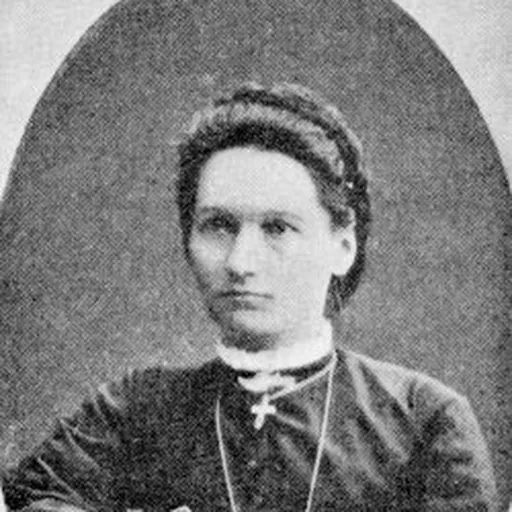
About Betty Elfving
Lived 1837 – 1923 (aged 85–86). Betty Elfving was a Finnish writer.
Betty Gustafva Lovisa Elfving (16 March 1837 – 29 October 1923) pen name Aura, was a Finnish writer. She is known for her Historical fictions, which once gained popularity especially among young people.
Personal history Betty Elfving was born in Pori in 1837 to a middle-class family. His father was Professor Johan Fredrik Elfving, who was originally the son of a blacksmith, but then rose to an exceptionally high social rank: professor and district physician. The mother's name was Vendla Elfving (own surname Sucksdorff), and she belonged to a middle-class family.
Betty Elfving's home was Swedish-speaking, but Elfving became an avid lover of the Finnish language at a young age. Nevertheless, she wrote the novels in Swedish, from which they were translated into Finnish. Elfving's works were not published in Swedish at all. Elfving was also interested in History of Finland, which is reflected in his works. Betty Elfving was completely different in her hobby of the Finnish language from her younger brother, botany professor Fredrik Elfving, who was one of Sweden's most enthusiastic supporters. Politically, Betty Elfving was close to Finnish youth circles.
The beginning of a literary career and Härkmann's sons Elfving only started her literary career at the age of 50, and even then under the pseudonym Aura, as it used to be common for women to write, because women's writing was not accepted in the same way as men's. Her first work was Härkmann's sons, a historical war novel about the times of great hatred. The main characters of the work are Miihkali and Yrjö Härkman, the sons of the vicar of Keuruu who swept against Russia, Miihkali's wife Elina and Alli from Karja. Härkman's sons are historically based on real priests' sons Gabriel, Juhana and Kustaa Herpman, who defended their home region against the Russians in 1714–1715.
Miihkal's problem is the choice between military and spiritual activity; eventually he ends up joining the war. Alli, on the other hand, looks for help for her enslaved family among influential men, but is only met with disappointment. A triangular drama is built around Miihkal, Elina and Alli, which calls into question the virtue of Miihkal, who otherwise appears as a hero. Heroism is indeed problematic in Härkmann's sons in a way that is often foreign to other war literature of the time.
Works Härkman's sons (Werner Söderström 1887; second edition 1908 as Härkman's sons) Pupils of Sprengtporten (unpublished) The Legacy of the Centenary, Part 1, Lot Cast – Part 2, Murrosaikana (Werner Söderström 1902; joint work 1914)
Don’t just read it —
keep it.
Full-length biographies made to live with: read them, listen on the way to work, watch them tonight.
- E-book
- Audio
- Video
Instant download · yours to keep · every purchase keeps this site free
Important facts
People in Betty Elfving's life
Named in this biography and alive at the same time

Related people
Same field, nearest in time

Contemporaries
People whose lives overlapped Betty Elfving's




Frequently asked questions
Who was Betty Elfving?
Finnish writer
When was Betty Elfving born?
Betty Elfving was born in 1837.
When did Betty Elfving die?
Betty Elfving died in 1923.
What was Betty Elfving's occupation?
Betty Elfving was a writer.
What nationality was Betty Elfving?
Betty Elfving was Finnish.
Sources & further reading
Cite this page
APA: Biography.guide. (2026). Betty Elfving. https://biography.guide/betty-elfving/
MLA: "Betty Elfving." Biography.guide, https://biography.guide/betty-elfving/.
Chicago: "Betty Elfving." Biography.guide. https://biography.guide/betty-elfving/.
Data last updated: 2026-09-22 · Spot an error? Report a correction.
Portrait: Wikimedia Commons · author & licence
Page generated 2026-09-27 05:01 UTC