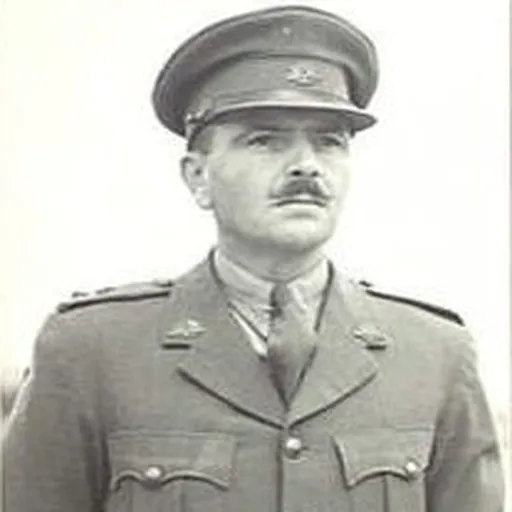
Bernard Evans
Australian Army general and Australian politician
About Bernard Evans
Lived 1905 – 1981 (aged 75). Bernard Evans was an Australian architect and list of mayors and lord mayors of Melbourne.
Brigadier Sir Bernard Evans, (13 May 1905 – 19 February 1981) was an Australian army officer, architect, builder and Lord Mayor of Melbourne (1959–1961).
Early years Evans was born in Manchester, England on 13 May 1905. In 1913 his family emigrated to Melbourne, initially living in St Kilda, and subsequently in Hampton. After completing his secondary schooling, he studied architectural drawing at night, and then worked as a designer and builder for his father, a builder. He was commissioned in the cadets in 1923, and the Militia in 1924. At Hampton Church of England on 21 September 1929 he married Dorothy May Ellis. In 1937, Evans remodeled De Bernales' mansion Overton Lodge in the Spanish Mission style, which now serves as the Cottesloe Civic Centre. In 1936, Evans' company General Construction Co. proposed a 10-storey block of flats for the corner of Robe and Acland Streets St Kilda, which would have been the tallest and largest block of flats in the city, but the council refused permission.
Meanwhile, in 1934, he became a major in the 46th Battalion.
In 1937 he went to London to oversee the design and construction of 'Westralia House' in Gresham Street, another de Bernales project (demolished c2006). While in Britain he was accepted into the Incorporated Association of Architects and Surveyors.
On return to Australia in 1938, he was appointed lieutenant colonel commanding the 57th/60th Infantry Battalion, and in 1940 registered as an architect in Victoria.
Second World War On 1 July 1940 he was appointed to the Second Australian Imperial Force and ordered to form and command the 2/23rd Battalion, "Albury's Own".
Tobruk, (April–October 1941).
El Alamein, 1 November 1942, command of the 24th Brigade as a temporary brigadier.
New Guinea, 1943.
Land Headquarters Tactical School (School of Tactics and Military Intelligence), Beenleigh, Queensland.
On 23 October 1945 he transferred to the Reserve as an honorary brigadier.
2/23 Infantry Battalion He very soon followed this with Sheridan Close in St Kilda road, built 1951–53, the largest `own-your-own’ development in Melbourne at the time, designed in a style described as a hybrid of Regency and Art Deco, and was followed in 1953–4 by Elizabeth Court, another own-your-own development in nearby Queen Road in a restrained Georgian style.
In 1958 he won the tender from the Housing Commission of Victoria for Emerald Hill Court, South Melbourne, for low income families, which included the first high-rise towers to be built by the commission. It also included a number of low-rise blocks, as well as a pair of joined high-rise blocks constructed using economical slip-form construction. (which was demolished in 2011 despite being heritage listed ).
This was soon followed by his most well known project, the CRA Building at 99 Collins Street, the tallest building to be built within the Hoddle Grid, completed in 1962. At 26 floors, it was 10 storeys taller than other new office towers, and as the first tower on top of the Collins Street hill in the eastern half of the city it was a very prominent. With its vertical ribbing emphasising its vertical proportions, the CRA towered over the still largely Victorian and Edwardian streetscape of the 'Paris End' of Collins Street, which it was later seen to unduly dominate, and it was not missed when it was demolished in 1988. Another tower that still stands by the firm is the white gridded Legal and General Assurance buildings on the corner of Collins and Queen Streets, completed in 1967.
Smaller projects included the Golden Square car park in Lonsdale Street (1955), a 'dream home' built in 1958 in St Kilda Road that was a prize benefitting the Queen Victoria Hospital (dem), the London Assurance office built in Bourke Street (1959), an office building at 505 St Kilda Road (1960, dem), and headquarters for the Victoria Automobile Chamber of Commerce (VACC) at 464 St Kilda Road (1965).
Evans's private companies were responsible for large suburban subdivisions, such as Witchwood Close, South Yarra, and industrial estates at Moorabbin. –73. During this period he served two terms as Lord Mayor, 1959–60, and 60–61. With his expertise in planning and architecture, he was chairman of the building and town planning committee for many years (1956–58, 1964, 1966–70), as well the town hall and properties committee (1957–58) and the finance committee (1961). Citing European examples, he argued for taller buildings and more people living in the city, greater open space, and new buildings set back from the street to save the city from becoming `a dull, dusty jungle’. for the site that was eventually chosen in 1966, which became the City Square. He was frequently in the news with opinions on a range of matters, such as Council's role in providing housing, the problems of traffic and parking, putting trams underground, use of the Olympic Pool, an underground train (eventually built as the City Loop), and advocating a lower Yarra crossing (eventually built as the West Gate Bridge).
Evans's reputation suffered in 1970 when his public role and private interests were alleged to have been in conflict. It was claimed that companies he controlled had benefited through the purchase of properties near the West Gate Bridge project and along the proposed underground rail loop, and through the sale of buildings to the Royal Melbourne Institute of Technology (which dated back to the 1950s when Evans had been a councillor ), claims which he strenuously denied. In 1971 he resigned from his firm—by then Bernard Evans, Murphy, Berg & Hocking Pty Ltd—and in 1973 from the city council.
Retirement
In retirement he continued involvement in activities such as chairing the Royal Commonwealth Society of Australia, as well as courting controversy. In 1973 he provoked the resignation of businessman and Melbourne City Councillor David Wang from the Society by his racist remarks.
Evans was appointed/awarded:
He was Mentioned in Despatches three times.
DSO Citation: 'The untiring energy and enthusiasm of this commanding officer, his solid leadership and total disregard of personal danger has been the main factor to the successes which have attended the activities of 2/23 Aust. Inf. Bn. With the exception of very brief periods in reserve positions this Bn has been in the FDLs of Tobruk since early in April and during that period Lt-Col. Evans has personally planned and supervised the numerous enterprises designed to ensure the defence of his sector and inflict losses in men, material and morale on the enemy. His personality and unceasing interest in his men has been an inspiration to all ranks.'
Don’t just read it —
keep it.
Full-length biographies made to live with: read them, listen on the way to work, watch them tonight.
- E-book
- Audio
- Video
Instant download · yours to keep · every purchase keeps this site free
Important facts
People in Bernard Evans's life
Named in this biography and alive at the same time

Related people
Same field, nearest in time
Contemporaries
People whose lives overlapped Bernard Evans's





Frequently asked questions
Who was Bernard Evans?
Australian Army general and Australian politician
When was Bernard Evans born?
Bernard Evans was born on 13 May 1905 in Manchester.
When did Bernard Evans die?
Bernard Evans died on 19 February 1981 in Toorak.
What was Bernard Evans's occupation?
Bernard Evans was an architect and list of mayors and lord mayors of Melbourne.
What nationality was Bernard Evans?
Bernard Evans was Australian.
Sources & further reading
· DBpedia: Bernard Evans (architect)
Cite this page
APA: Biography.guide. (2026). Bernard Evans. https://biography.guide/bernard-evans-architect/
MLA: "Bernard Evans." Biography.guide, https://biography.guide/bernard-evans-architect/.
Chicago: "Bernard Evans." Biography.guide. https://biography.guide/bernard-evans-architect/.
Data last updated: 2026-09-23 · Spot an error? Report a correction.
Portrait: Wikimedia Commons · author & licence
Page generated 2026-09-27 05:05 UTC