
About Bernard Dix
Lived 1925 – 1995 (aged 70). Bernard Dix was a trade unionist.
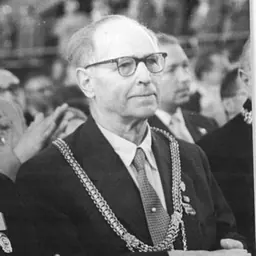
Bernard Hubert Dix (30 March 1925 – 20 April 1995) was a British trade unionist.
Born in Woolwich, Dix left school when he was fourteen and worked as a fitter at the Royal Arsenal. During World War II, he served with the Queen's Own Royal West Kent Regiment, then with the Royal Engineers, where he used his skills as a fitter. In 1945, he was hospitalised in South Africa with tuberculosis, and there began reading material from the Communist Party of South Africa. He also met Jack Rae, a fellow patient who was a member of the Communist Party of Great Britain (CPGB), and the two put together a hospital newsletter based largely on communist sources. He began assisting the African Mine Workers' Union and the Springbok Legion. He married a nurse, but the marriage rapidly fell apart, and the British Army decided to repatriate him to England in 1947.
In England, Dix joined the Young Communist League. He remarried, and began working, initially as a building labourer, then in a clerical post for the Soviet Embassy. In 1949, he was finally admitted onto a training scheme for engineering draughtspeople. He drifted away from the CPGB, joining the Labour Party, and began devoting much of his time to the Association of Engineering and Shipbuilding Draughtsmen (AESD). He won a scholarship to the London School of Economics, where he completed a one-year course in trade unionism, and also began writing for Tribune, the left-wing Labour-supporting newspaper. , while he and a small group of co-thinkers, including Stanley Newens, joined Tony Cliff's Socialist Review Group. Dix edited Socialist Review for short periods in 1955 and 1957. Also in 1955, he began working in the Editorial Department of the Trades Union Congress, and in order to avoid difficulties, he began using the pseudonym "Owen Roberts" for his socialist activities.
In 1959, Dix left Socialist Review Group after Cliff won a majority for a position arguing that the Labour Party did not have revolutionary potential. Shachtman had also wound up his political organisation, although Dix remained close to Hal Draper, a former supporter of Shachtman in the U.S. He himself left Labour in 1961, disappointed with Hugh Gaitskell's leadership, and developed an interest in anarchism, but he rejoined Labour in 1963, and also began working as the publicity and research officer of the National Union of Public Employees (NUPE). Although he was able to reinvent the union's newspaper, he had a poor working relationship with Sydney Hill, the union's general secretary, and only remained in the post after Vic Feather personally persuaded him that he would find Dix a more senior position once Hill retired. With this backing, and that of Alan Fisher, who succeeded Hill, Dix was able to create a shop steward system in the union, and developing a novel strategy of rolling industrial action. Working closely with Fisher, NUPE became one of the most active unions in the late 1970s, and grew rapidly.
Dix stood repeatedly for the National Executive Committee (NEC) of the Labour Party. Although never elected, he was co-opted to its social policy group, and after taking the runner-up spot for the NEC in 1980, he was the automatic replacement for Tom Bradley when he defected to the Social Democratic Party. However, Dix was again defeated in the 1981 election for the NEC. He retired in 1981, and left the Labour Party in 1981, concerned about its direction after the editorial board of Militant was expelled.
Don’t just read it —
keep it.
Full-length biographies made to live with: read them, listen on the way to work, watch them tonight.
- E-book
- Audio
- Video
Instant download · yours to keep · every purchase keeps this site free
Important facts
People in Bernard Dix's life
Named in this biography and alive at the same time






Related people
Same field, nearest in time





Contemporaries
People whose lives overlapped Bernard Dix's


Frequently asked questions
Who was Bernard Dix?
British trade unionist
When was Bernard Dix born?
Bernard Dix was born on 30 March 1925.
When did Bernard Dix die?
Bernard Dix died on 20 April 1995.
What was Bernard Dix's occupation?
Bernard Dix was a trade unionist.
Sources & further reading
Cite this page
APA: Biography.guide. (2026). Bernard Dix. https://biography.guide/bernard-dix/
MLA: "Bernard Dix." Biography.guide, https://biography.guide/bernard-dix/.
Chicago: "Bernard Dix." Biography.guide. https://biography.guide/bernard-dix/.
Data last updated: 2026-09-20 · Spot an error? Report a correction.
Page generated 2026-09-27 05:04 UTC