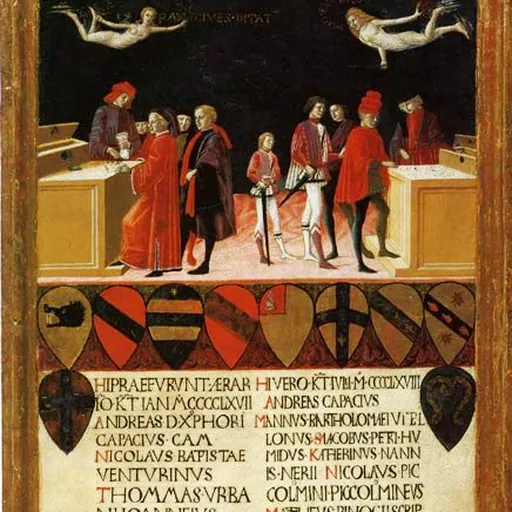
About Benvenuto di Giovanni
Lived 1436 – 1518 (aged 81–82). Benvenuto di Giovanni was a painter and illuminator.
Benvenuto di Giovanni (13 September 1436 – c. 1518), also known as Benvenuto di Giovanni di Meo del Guasta, was an Italian painter and artist known for his choral miniatures, pavement designs, and frescoes. Working chiefly in Siena, he was first recognized to be working as an artist in 1453 and continued his work nearly until his death in approximately 1518. During his lifetime, he was influenced by various artists and in the 1480s, Benvenuto's style changed drastically.
Though Benvenuto did explore other fields of work, painting was consistently a part of his life. His son, Girolamo di Giovanni, followed in his footsteps and also became a painter. In fact, there have often been instances of the work of one of the two being confused for that of the other. Nevertheless, Benvenuto left behind significantly more works. Some of his works were both signed and dated, some were only signed, and some only dated. However, regardless of debate over date or authorship, Benvenuto left behind a significant number of works, both ones that are quite well known as well as others that are more minor in their distinction. His pieces that are signed, dated, and still existing have dates spanning a period of 43 years. The combination of his efforts to depict realistic figures, to strategically utilize colors, and to manipulate space in order to give his paintings depth led to a style that was both distinct and uniquely his. These shifts in his style can be seen in paintings such as Maestà and Ascension.
Major works Annunciation
It is known that Benvenuto painted at least two versions of the Annunciation. His first Annunciation is the earliest known painting by him, dated in 1466. Despite this being his first work, there was little evidence of the influence of his teacher, Vecchietta. Rather, this work was very clearly inspired by Simone Martini's 1333 painting of the same name. Many other Annunciation works by other artists during Benvenuto's lifetime used landscapes and backgrounds, but Benvenuto employed a more simple gold ground that was typical in works of the early Trecento. Benvenuto's 1466 version resides in the church of St. Girolamo in Volterra.
Benvenuto's growth as an artist is evident through comparison of his 1466 Annunciation with his 1470 version. In 1466, Benvenuto opted for a more subtle coloration in his work. However, in 1470, while many of his contemporaries still utilized softer palettes, Benvenuto chose to paint with rich, deep colors that pleased the viewer's eye. This shift in style is likely to have been inspired by two artists that were quite famous during the latter part of the Quattrocento, Girolamo da Cremona and Liberale da Verona. Additionally, Benvenuto traded in his previous flat gold background for one of detailed scenery, including lush gardens, mountains, and lakes. This painting, done by many artists, depicts Adam and Eve being cast out of the Garden of Eden by the archangel, Jophiel. However, Benvenuto's version stands out from the others because his depiction of Eden is far more realistic than that of other artists. He paints Eden as a lush green forest rather than a land full of a myriad of plants and animals. He expertly constructs the figures in a way that makes the subjects come alive through the intermingling of their arms and angling of their bodies. It is believed that these paintings were created in or around 1491 due to the similarities in the landscapes of The Crucifixion and Benvenuto's 1491 Ascension.
Painting the Virgin Mary fainting is an artistic choice that was very common in fourteenth-century Sienese representations of this event. However, what was not common, was Benvenuto's choice to include the children on the hill in the upper left corner. They are, from a distance, pointing towards and spectating the cruelty that is occurring in the center of the painting. This inclusion had never been made before, thus, it exemplified Benvenuto's creativity and inventiveness. Gallery
Don’t just read it —
keep it.
Full-length biographies made to live with: read them, listen on the way to work, watch them tonight.
- E-book
- Audio
- Video
Instant download · yours to keep · every purchase keeps this site free
Important facts
People in Benvenuto di Giovanni's life
Named in this biography and alive at the same time

Related people
Same field, nearest in time

Contemporaries
People whose lives overlapped Benvenuto di Giovanni's
Frequently asked questions
Who was Benvenuto di Giovanni?
Italian painter (1436-1518)
When was Benvenuto di Giovanni born?
Benvenuto di Giovanni was born on 13 September 1436 in Siena.
When did Benvenuto di Giovanni die?
Benvenuto di Giovanni died in 1518 in Siena.
What was Benvenuto di Giovanni's occupation?
Benvenuto di Giovanni was a painter and illuminator.
Sources & further reading
· Wikipedia: Benvenuto di Giovanni
· DBpedia: Benvenuto di Giovanni
Cite this page
APA: Biography.guide. (2026). Benvenuto di Giovanni. https://biography.guide/benvenuto-di-giovanni/
MLA: "Benvenuto di Giovanni." Biography.guide, https://biography.guide/benvenuto-di-giovanni/.
Chicago: "Benvenuto di Giovanni." Biography.guide. https://biography.guide/benvenuto-di-giovanni/.
Data last updated: 2026-09-20 · Spot an error? Report a correction.
Portrait: Wikimedia Commons · author & licence
Page generated 2026-09-27 04:58 UTC