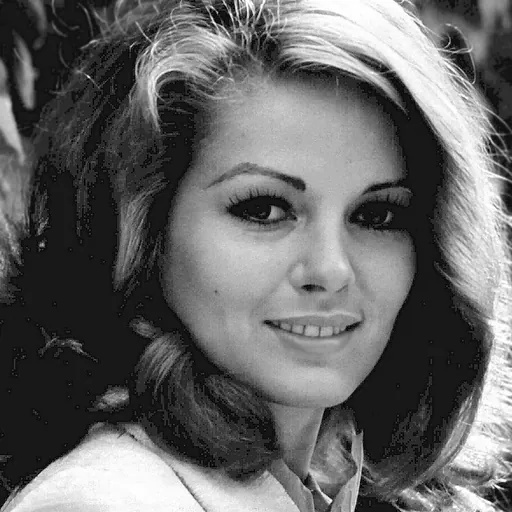
About Beba Lončar
Born 1943. Beba Lončar is a Yugoslav and Serbian film actor, television actor and actor.
Desanka "Beba" Lončar (Serbian Cyrillic: Десанка „Беба“ Лончар; born 28 April 1943) is a former Yugoslav and Serbian film actress. She appeared in 52 films between 1960 and 1982. She was born in Belgrade, Serbia. Known for her film career during the 1960s and 1970s, she first became a star in native Yugoslavia before moving to Italy where she achieved considerable success.
Early life Lončar was born on 28 April 1943 in Belgrade, war-torn Serbia, and grew up in Belgrade's neighbourhood of Dorćol. Lončar became involved with performing at an early age. During the late 1950s she was given on-camera speaking bits in kids' and youth programmes on the newly launched TV Belgrade. She studied acting under the tutelage of director Soja Jovanović who gave Lončar her film debut—an uncredited bit part in 1960's .
Career
Debut Lončar's acting break came via being cast, alongside two more first-time film performers: twenty-year-old Boris Dvornik and fifteen-year-old Dušica Žegarac, in France Štiglic's Deveti krug, a Jadran Film-produced Holocaust story about a Jewish family from Zagreb. The film would go on to achieve notable critical success.
By the time Deveti krug was released, sixteen-year-old Lončar had already landed her first lead role—the part of a beautiful young girl Sonja Ilić in the teenage comedy Ljubav i moda produced by Avala Film.
Early career in Yugoslavia
Deveti krug premiered in late April 1960 to good reviews. Although the lead role of Ruth Alkalaj went to another teenage upstart—Dušica Žegarac—Lončar's portrayal of Magda also received very positive notices. The film got selected for competition at the 1960 Cannes Film Festival during May with Lončar and Žegarac, both still high school students, getting their first taste of glitz and glamour as they made the rounds at the festival. Several months later in August, the film won the Golden Arena award at the 1960 Pula Film Festival in addition to becoming Yugoslav official submission for the best foreign movie and actually getting nominated for the Best Foreign Language Film at the 33rd Academy Awards.
Later that fall Ljubav i moda (Love and Fashion) came out, creating a sensation the likes of which hadn't been seen in the country to date. Backed by a pop music soundtrack that achieved its own popularity on the strength of the "Devojko mala" track sung by Đuza Stojiljković, the cheeky picture became a commercial smash hit in communist Yugoslavia. Though a decision was made by the film's director and producers for teenage Lončar's voice to be dubbed by the twenty-nine-year-old actress , the youngster still successfully carried the breezy comedy alongside as well as established stars of Yugoslav cinema Miodrag Petrović Čkalja and Mija Aleksić. The general audiences responded well to the teenager's beauty and youthful charm, making her an overnight star in the country and paving the way for her subsequent movie career.
With only two films under her belt, by the end of 1960, seventeen-year-old Lončar's cinematic profile was raised beyond all expectations. She additionally signed a five-year contract with Avala Film, and its executive had begun guiding her career. She next got cast as the female lead in Aleksandar Petrović's directorial debut—Avala Film-produced romantic drama Dvoje—alongside Miha Baloh and Miloš Žutić. Playing the role of mysteriously flirtatious Belgrade girl Jovana Zrnić, she once again got plenty of positive reactions in the press. The movie got released in late July 1961, and the following year got selected for the competition programme at Cannes. Although it ended up not quite matching the success of Deveti krug on the festival circuit, Dvoje got very good reviews for its innovative approach as a breath of fresh air in the Yugoslav cinema that up to that point had mostly been making genre films of very specific and rigid structure and narrative. The movie also marked the first time Lončar was officially billed using her nickname "Beba" rather than her given first name, a practice that would be continued for the remainder of her career.
Already a bona fide film star in Yugoslavia as well as a nationwide sex symbol, Lončar started getting parts in Avala Film co-productions with foreign production companies being shot in Yugoslavia. Franz Antel cast her in the supporting role of Afra in the Austrian movie , marking the first time she took part in a foreign film. Following a few more Yugoslav movies where she had notable roles—Soja Jovanović's comedy based on Branislav Nušić's eponymous novel and 's —Lončar took a supporting part in the high-budget British-Yugoslav over-the-top adventure co-production The Long Ships directed by Jack Cardiff and starring Richard Widmark, Sidney Poitier, Russ Tamblyn and Rosanna Schiaffino, that was entirely shot in Yugoslavia. She reportedly got the role of Gerda after another actress that had already been cast for the role abruptly left the set. Forced to scramble, Cardiff looked for a local replacement and ended up casting blonde Lončar whose physical features fit the requirements of the Viking woman role.
Another foreign production in Yugoslavia Lončar took part in was the West German-funded musical western Freddy in the Wild West, directed by Sobey Martin, with the young actress in the female lead role opposite Austrian singer-actor Freddy Quinn. In between she also starred along with Milena Dravić (another young Belgrade actress whose career path resembled Lončar's) as well Ljubiša Samardžić, Boris Dvornik, and in a romantic summer youth comedy about local boys from the Dalmatian coastline seducing young tourist girls.
Italian period
Lončar's career in the Italian cinema began in 1964 when she was cast by Mauro Bolognini for his segment within , a three-segment film. According to Yugoslav press reports, her initial appearance in Italian movies was facilitated by Avala Film chairman Dražević who had many connections within Italian film industry. She rarely makes media appearances.
Don’t just read it —
keep it.
Full-length biographies made to live with: read them, listen on the way to work, watch them tonight.
- E-book
- Audio
- Video
Instant download · yours to keep · every purchase keeps this site free
Important facts
People in Beba Lončar's life
Named in this biography and alive at the same time




Related people
Same field, nearest in time



Contemporaries
People whose lives overlapped Beba Lončar's

Frequently asked questions
Who is Beba Lončar?
Yugoslav actress from Serbia
When was Beba Lončar born?
Beba Lončar was born on 28 April 1943 in Belgrade.
What is Beba Lončar's occupation?
Beba Lončar is a film actor, television actor and actor.
What nationality is Beba Lončar?
Beba Lončar is Yugoslav and Serbian.
Sources & further reading
Cite this page
APA: Biography.guide. (2026). Beba Lončar. https://biography.guide/beba-loncar/
MLA: "Beba Lončar." Biography.guide, https://biography.guide/beba-loncar/.
Chicago: "Beba Lončar." Biography.guide. https://biography.guide/beba-loncar/.
Data last updated: 2026-09-22 · Spot an error? Report a correction.
Page generated 2026-09-27 05:10 UTC