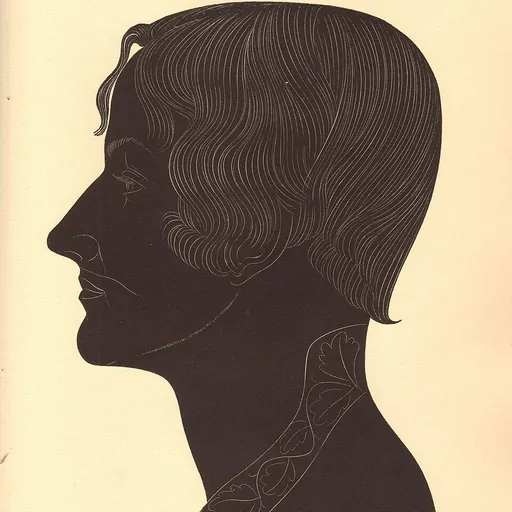
About Beatrice Warde
Lived 1900 – 1969 (aged 68). Beatrice Warde was an American historian, art historian, typographer and typesetter.
Beatrice Lamberton Warde (September 20, 1900 – September 16, 1969, née Beatrice Becker) was a twentieth-century writer and scholar of typography. As a marketing manager for the British Monotype Corporation, she was influential in the development of printing tastes in Britain and elsewhere in the mid-twentieth century and was recognized at the time as "ne of the few women typographers in the world". Her writing advocated higher standards in printing, and championed intelligent use of historic typefaces from the past, which Monotype specialised in reviving, and the work of contemporary typeface designers.
Early life and interests Born in New York, Warde was the only daughter of May Lamberton Becker, a journalist on the staff of the New York Herald Tribune, and Gustave Becker, composer and teacher. Warde was educated at Barnard College at Columbia University. At the age of thirteen her school introduced her to the art of calligraphy.
Recognising that the future of typographic and book design was in London with the new Monotype Composing Machine., Warde later recalled she had amused herself imagining her 'Paul Beaujon' persona to be "a man of long grey beard, four grandchildren, a great interest in antique furniture and a rather vague address in Montparnasse." She noted that the deception confused, but was not immediately suspected by other historians, who were surprised to read a work by a Frenchman in idiomatic English and mocking received wisdom by quoting from The Hunting of the Snark. Warde penned her famous broadside "This is a Printing Office", to show the Perpetua typeface off. It has since been found on the walls of numerous printing offices and has been cast in bronze and is mounted at the entrance to the United States Government Publishing Office in Washington, D.C.; it has been translated into numerous languages and has been parodied.
Warde's approach of connecting the craft of typography with the concerns of business were not always welcome, even within Monotype. She exchanged many heated letters with Eric Gill about the nature of this relationship, with Gill denigrating the use of promotional materials to sell his designs. She often visited printing schools, universities, and factories both in England and abroad to bring this message. During an invitation to speak in Australia, she spoke for cultivating "a print-conscious public" as a necessity for the printing industry to do its best. For Warde, this meant teaching good handwriting and designing attractive schoolbooks for children. All of this was to promote "a general, high, critical standard in the public at large".
Works The Crystal Goblet "The Crystal Goblet" is an essay on typography by Beatrice Warde. The essay was first delivered as a speech, called "Printing Should Be Invisible," given to the British Typographers' Guild at the St Bride Institute in London, on October 7, 1930. Like many of Warde's other writings, the essay was written with the intent to be spoken before printed, as she carefully considered the invocations of voice, presence, and personal connection while reading aloud. "The Crystal Goblet" is rich with metaphors. The title itself is a reference to a clear vessel holding wine, where the vessel, the printed word, gives no obstruction to the presentation of its content, the text. Warde poses a choice between two wine glasses: one of "solid gold, wrought in the most exquisite patterns" and one of "crystal-clear glass."
Throughout the essay, Warde argues for the discipline and humility required to create quietly set, "transparent" book pages.
Other works
An American in England (Pen name of Warde), Enjoying England: A book about an enchanted Island, published by the LNER, 1931
During World War 2 she also contributed to American Outpost Newsletter, and her mother featured her letters about London in the New York Herald Tribune Compiler of Token of Freedom c 1940, (An anthology given to every child who was evacuated to North America during World War II)
Legacy Warde's success as a design communicator has placed much of her work, like The Crystal Goblet, within the canon of graphic design and typography history. She had, as one historian has noted, "the popular touch" which connected printing education with the printing trade. Her work has been continually referred to within discussions on graphic design and typography, for example during the 1990s "legibility wars" or debates concerning electronic interface design.
In 2010, an archive relating to her life and work was established at the Cadbury Research Library, University of Birmingham.
TDC Beatrice Warde Scholarship The Type Directors Club and Monotype offer a scholarship under her name for young women who demonstrate exceptional talent, sophistication, and skill in the use of typography. The Beatrice Warde scholarship emphasizes the merging of technology and typography, as she used to encourage the best use of technology in design.
Personal life In 1922, Beatrice married Frederic Warde, printer to Princeton University and a typographic designer. After moving to Europe in 1925, their marriage ended in separation in November 1926, followed by divorce in 1938. Although it is known that the glamorous Warde posed for Eric Gill, it was Stanley Morison with whom she had a long intimate relationship. Morison divorced his wife for her, and Beatrice left her husband for him. Although, Morison, being a Catholic, decided he could not actually marry Warde, she was with him when he died in 1967.
Don’t just read it —
keep it.
Full-length biographies made to live with: read them, listen on the way to work, watch them tonight.
- E-book
- Audio
- Video
Instant download · yours to keep · every purchase keeps this site free
Important facts
more
Beatrice Lamberton Becker Warde, Beatrice Lamberton nee Becker, Beatrice Lamberton WardePeople in Beatrice Warde's life
Named in this biography and alive at the same time



Related people
Same field, nearest in time


Contemporaries
People whose lives overlapped Beatrice Warde's




Frequently asked questions
Who was Beatrice Warde?
American art historian
When was Beatrice Warde born?
Beatrice Warde was born on 20 September 1900 in New York City.
When did Beatrice Warde die?
Beatrice Warde died on 16 September 1969 in Epsom.
What was Beatrice Warde's occupation?
Beatrice Warde was a historian, art historian, typographer and typesetter.
What nationality was Beatrice Warde?
Beatrice Warde was American.
Sources & further reading
Cite this page
APA: Biography.guide. (2026). Beatrice Warde. https://biography.guide/beatrice-warde/
MLA: "Beatrice Warde." Biography.guide, https://biography.guide/beatrice-warde/.
Chicago: "Beatrice Warde." Biography.guide. https://biography.guide/beatrice-warde/.
Data last updated: 2026-09-23 · Spot an error? Report a correction.
Portrait: Wikimedia Commons · author & licence
Page generated 2026-09-27 05:07 UTC