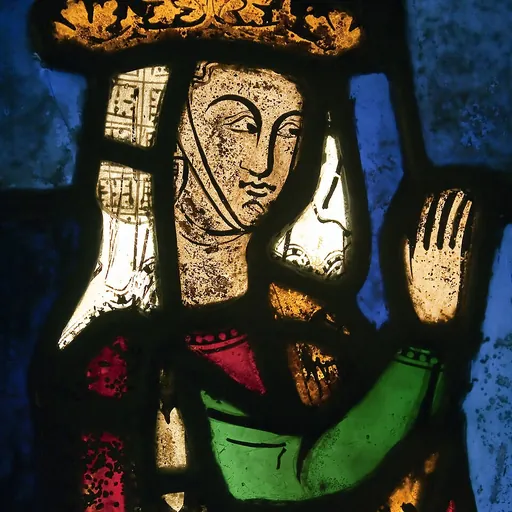
About Beatrice of Falkenburg
Lived 1253 – 1277 (aged 23–24). Beatrice of Falkenburg was an aristocrat.
Beatrice of Falkenburg ( – 17 October 1277), also referred to as Beatrix of Valkenburg, was the third and last wife of Richard of Cornwall, and as such nominally queen of Germany.
Daughter of , and his first wife, Bertha, daughter of Walram IV, Duke of Limburg. She and Richard were married on 16 June 1269 in Kaiserslautern when she was only 16 years old and Richard was 60. They had no children. After Richard's death, Beatrice chose to stay in England until her death in 1277 at the age of 23, and she was buried at the Friars Minors at Oxford.
Background One of several children of Dirk II and Bertha of Limburg, Beatrice was born into the Meuse-Rhineland aristocracy. Her father was a supporter of Richard of Cornwall's claim to the imperial crown of Germany following Richard's coronation in Aachen. Her paternal uncle, Engelbert II of Valkenburg, archbishop-elector of Cologne, was neither loyal to Richard nor interested in him, but when he became imprisoned during the turmoil, when Richard's candidacy was opposed by Alfonso X of Castile who was elected by Saxony, Brandenburg and Trier, Richard decided to liberate him. In October 1268, the king along with the lord of Valkenburg invaded the electorate of Cologne, only to be completely defeated; Beatrice's father was killed in the struggle and her uncle remained imprisoned.
Marriage and queenship During the conflict, Richard became infatuated with Beatrice, then 15 years old and renowned for her beauty. Concerned for her safety, Richard had her taken to her paternal half-uncle, Philip of Bolanden-Hohenfels, and soon began negotiating marriage with her. Beatrice became his third wife and queen of Germany (formally "queen of the Romans") in Kaiserslautern on 16 June 1269. With her father dead and her powerful uncle hopelessly imprisoned, Beatrice was not a political asset; Richard married her simply because he was attracted to her and was unable to be separated from her for even one night.
As no invitation to Rome for the couple's coronation as emperor and empress of the Holy Roman Empire was forthcoming, Richard announced that he wished to show Beatrice his vast lands in England and departed from Germany. They reached Dover on 3 August 1269 but neither ever returned to Germany. It was thought to originate from the Franciscan church in Oxford, which would have indicated that Beatrice was a significant benefactress to the order. This is the only indication that Beatrice donated to the Church. She died aged 23 on 17 October 1277. She was buried at Greyfriars, Oxford, as queen of Germany.
Don’t just read it —
keep it.
Full-length biographies made to live with: read them, listen on the way to work, watch them tonight.
- E-book
- Audio
- Video
Instant download · yours to keep · every purchase keeps this site free
Important facts
Family & relationships
People in Beatrice of Falkenburg's life
Named in this biography and alive at the same time

Related people
Same field, nearest in time



Contemporaries
People whose lives overlapped Beatrice of Falkenburg's



Frequently asked questions
Who was Beatrice of Falkenburg?
Peerage person ID=102225
When was Beatrice of Falkenburg born?
Beatrice of Falkenburg was born in 1253.
When did Beatrice of Falkenburg die?
Beatrice of Falkenburg died on 17 October 1277 in Oxford.
What was Beatrice of Falkenburg's occupation?
Beatrice of Falkenburg was an aristocrat.
Sources & further reading
· Wikipedia: Beatrice of Falkenburg
· DBpedia: Beatrice of Falkenburg
Cite this page
APA: Biography.guide. (2026). Beatrice of Falkenburg. https://biography.guide/beatrice-of-falkenburg/
MLA: "Beatrice of Falkenburg." Biography.guide, https://biography.guide/beatrice-of-falkenburg/.
Chicago: "Beatrice of Falkenburg." Biography.guide. https://biography.guide/beatrice-of-falkenburg/.
Data last updated: 2026-09-22 · Spot an error? Report a correction.
Portrait: Wikimedia Commons · author & licence
Page generated 2026-09-27 05:03 UTC