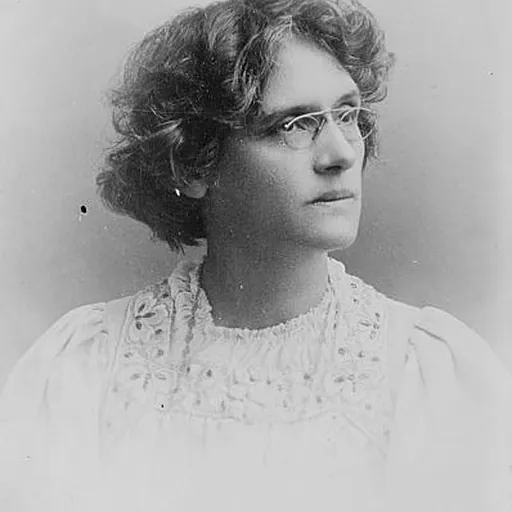
Beatrice Harraden
British suffragette, writer and feminist
About Beatrice Harraden
Lived 1864 – 1936 (aged 72). Beatrice Harraden was a British suffragist, writer, women's rights activist, novelist and suffragette.
Beatrice Harraden (24 January 1864 – 5 May 1936) was a British novelist, playwright and suffragette. She was a founding member of the Women's Social and Political Union (WSPU) and a member of the Women Writers Suffrage League. She published writing in the Votes for Women newspaper and novels. Her most successful work was Ships That Pass in the Night.
Life Harraden was born in Hampstead, London on 24 January 1864, to parents Samuel Harraden, a Cambridge-educated businessman who exported musical instruments to British India, and Rosalie Lindstedt Harraden, an Anglo-Indian woman. Harraden grew up to become an influential feminist writer and suffragette. She studied at Cheltenham Ladies' College in Gloucestershire, as well as at Queen's College and Bedford College in London. In 1883, she received her BA degree as well as an honours degree in Classics and Mathematics, which would have been a noteworthy feat for a woman in this era.
Harraden suffered lifelong illness which included a severe case of diphtheria and damage to her ulnar nerve as a result of playing the violoncello. In the early 1890s, she tried the rest cure at Menton on the French Riviera; took the Alpine Cure at a sanitarium in Davos, Switzerland; and experimented with hydrotherapy at a spa in Harrogate in the West Riding of Yorkshire, among other efforts to recover her health.
Her experience in the Alps resulted in her first novel Ships That Pass in the Night (1893), a best-seller which sold over one million copies. The love story set in a tuberculosis sanatorium, follows protagonist, Bernadine, an independent teacher, writer and activist, who falls in love with Robert, the Disagreeable man. After recovering and leaving the sanatorium, Bernadine returns to England. The popular novel ends rather tragically with Bernadine dying suddenly in a traffic accident. Though Harraden continued her career as a writer, she failed to achieve similar success with subsequent books which included novels, short stories and books for children.
Harraden was both a leader of the suffragette movement and a founding member of the Women's Social and Political Union (WSPU), befriending new members like Helen Craggs, and she was also an integral member of the Women Writers' Suffrage League and Women's Tax Resistance League.
Unlike the WSPU, who only welcomed women as members, the Women Writers Suffrage League welcomed men, women and members from diverse political parties. The only dictate for membership to the Writer's League, other than having been paid for a literary work, was support of the suffragette cause. These writers were agitators demanding access to the male dominated civic and social institutions, but they used their pens to influence society's social scene and the theatre. Harraden therefore turned to this group as the WSPU became increasingly militant and exclusive. She also involved herself as a reader for the Oxford English Dictionary, and this, too is reflected in her fiction: The Scholar's Daughter (1906) is set among lexicographers.
In 1930, she received a Civil List pension for her literary work. She died at Barton-on-Sea, Hampshire, on 5 May 1936, aged 72.
Works Harraden's commitment to the women's rights movement can be seen throughout her writing. Many of her works—if not directly referencing the suffragette cause—include themes of gender dynamics, male/female power struggles, and address "the alienation of the individual in the modern world". In the play, Lady Geraldine, has agreed to make a speech at an anti-suffrage meeting, but quickly realizes she has little information about the issue and needs a ghostwriter to help develop her argument. Lady Geraldine turns to her old-friend Dr. Alice Romney, a pro-suffragette progressive to help her construct her speech. Throughout the course of the play, Romney's suffragette friends continually arrive at the house for their own meeting. The characters include a famous pianist, a famous artist, a literature professor, a typist, and a maid. Lady Geraldine actually begins to admire these independent, intelligent, and driven women as they all pitch in to help her with her speech.
Harraden humorously summarizes the flawed arguments of the anti-suffragist with Romney finishing Geraldine's speech by telling her to stress the "degradation of Womanhood. Degradation and disintegration of entire Empire... Emphatic, nay passionate, insistence on your own brainlessness-that is very important."
Harraden even cites Shakespeare's writings and his strong, independent female characters to suggest he would support the suffragette cause. She emphasizes the positive aspects of suffragette women and focuses on their intellect, as well as their acceptance of others as can be seen in Lady Geraldine's Speech—upon meeting an anti-suffragist, the suffragettes, rather than berating her for her ideals, instead choose to help her with her speech and tell her their own personal reasons for joining the suffrage movement. Ships That Pass in the Night (1893) In Varying Moods (short stories, 1894) Hilda Stafford and The Remittance Man (Two Californian Stories) (1897) The Fowler (1899) The Scholar's Daughter (1906) Interplay (1908) Lady Geraldine's Speech (1909) Out of the Wreck I Rise (1914) The Guiding Thread (1916) Patuffa (1923) Rachel (1926) Search Will Find It Out (1928)
Don’t just read it —
keep it.
Full-length biographies made to live with: read them, listen on the way to work, watch them tonight.
- E-book
- Audio
- Video
Instant download · yours to keep · every purchase keeps this site free
Important facts
Related people
Same field, nearest in time


Contemporaries
People whose lives overlapped Beatrice Harraden's




Frequently asked questions
Who was Beatrice Harraden?
British suffragette, writer and feminist
When was Beatrice Harraden born?
Beatrice Harraden was born on 24 January 1864 in Hampstead.
When did Beatrice Harraden die?
Beatrice Harraden died on 5 May 1936 in Barton on Sea.
What was Beatrice Harraden's occupation?
Beatrice Harraden was a suffragist, writer, women's rights activist, novelist and suffragette.
What nationality was Beatrice Harraden?
Beatrice Harraden was British.
Sources & further reading
· Wikipedia: Beatrice Harraden
Cite this page
APA: Biography.guide. (2026). Beatrice Harraden. https://biography.guide/beatrice-harraden/
MLA: "Beatrice Harraden." Biography.guide, https://biography.guide/beatrice-harraden/.
Chicago: "Beatrice Harraden." Biography.guide. https://biography.guide/beatrice-harraden/.
Data last updated: 2026-09-21 · Spot an error? Report a correction.
Portrait: Wikimedia Commons · author & licence
Page generated 2026-09-27 05:00 UTC