
About Beatrice d'Este
Lived 1268 – 1334 (aged 65–66). Beatrice d'Este was an aristocrat.
Beatrice d’Este (Ferrara, 1268 - Milan, 15 September 1334) was an Italian noblewoman, now primarily known for Dante Alighieri's allusion to her in Purgatorio, the second canticle of the Divine Comedy. Through her first marriage to Nino Visconti, she was judge (giudichessa) of Gallura, and through her second marriage to Galeazzo I Visconti, following Nino’s death, lady of Milan.
Biography Beatrice was born in Ferrara in 1268. She was the daughter of the Marquis Opizzo II d’Este, of the Este family, who was also the lord of Ferrara, Modena and Reggio Emilia, and Jacopina Fieschi. Her brother was Azzo VIII. She was married off at a very young age to a man from Pisa named Nino Visconti, who was a judge in the district of Gallura in northeast Sardinia. Nino Visconti was also the grandson of Count Ugolino della Gherardesca.
Nino died in 1296, only five years after his marriage to Beatrice. Nino and Beatrice only had one child: a daughter named Joanna, who was born in 1291. Beatrice returned to Ferrara after Nino’s death. Because she was a widow who only had a daughter and no male heir, she was placed in the responsibility and authority of her brother Azzo, who had a reputation for being unkind. After returning to Ferrara, Beatrice was first engaged to one of the sons of Alberto Scotti, lord of Piacenza. This engagement was arranged by Azzo to use her sister’s status as a young widow to form a favorable alliance with a different family.
In the Divine Comedy
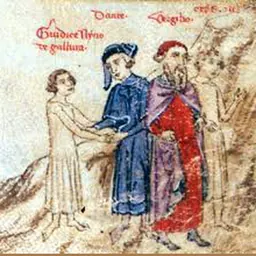
Beatrice is now remembered primarily due to her presence in Dante's Divine Comedy. In Purgatorio, the second canticle of the poem, Dante and Virgil meet Nino Visconti in Ante-Purgatory, or the area outside St. Peter’s gate, which is reserved for people who neglected their spiritual and religious undertakings for the sake of their country. The souls here have to wait for a period that is same as their lifetime on earth before being allowed into Purgatory, so that they can begin their journey of purgation from their vices. Dante, who was friends with Nino while he was still alive, is glad to see him here and not in Hell, and treats him warmly.
In Purgatory, the sentences of the souls could be shortened and made better if those still alive on earth would pray for their souls. Nino begs Dante to make his daughter, Joanna, who is nine years old at the time in which the events of the Divine Comedy take place (the year 1300), to pray for his soul, since he fears his wife does not love him anymore:
Nino tells Dante that his widow, Beatrice, who remains unnamed in the canto, remarried into a different branch of the Visconti in Milan. He expresses his disgust at Beatrice’s disrespect and says that she should not be associated with his family’s symbol, the rooster, anymore. He refers to how quickly Beatrice removed the "white veils" (bianche bende) that signal her status as a widow, to express how quickly women abandon their husbands once they are dead. He also expresses his disgust towards the Milanese, and says that the Milanese emblem, the serpent, will not make for a better tomb.
Beatrice, when she did die, had both emblems on her tomb. which some argue, she did in subversion to Dante’s defamation of her in this passage of the Divine Comedy.
Some critics have argued that Dante had personal reasons for condemning Beatrice, which came out of his personal dislike of the Estensi. There are other references and allusions to the Estensi and they are all critical. Obizzo d’Este and Azzo VII d’Este can be found in the river of blood in Inferno.
Here, Dante accuses Azzo VII of killing his own father to ensure his position as the marquisate of Ferrara. In Purgatorio 5.78, Jacopo del Cassero says that he died at the hands of Azzo VII, because he had tried to keep them from annexing Bologna.
Dante’s dislike and anger towards to Estensi might have stemmed from the abuse of his ancestors at the hands of the Estensi, who were Ferrarese rulers. Ferrara was essentially controlled by the Guelphs since Azzo VII, and by 1329, the Estensi had acquired Ferrara as a papal vicariate. Alfonso Lazzari points out that Dante was a relative of a noble Ferrarese family who had descended from the Aldighieri, and that the Fontanesi had even supported the Estensi in the past.
Don’t just read it —
keep it.
Full-length biographies made to live with: read them, listen on the way to work, watch them tonight.
- E-book
- Audio
- Video
Instant download · yours to keep · every purchase keeps this site free
Important facts
People in Beatrice d'Este's life
Named in this biography and alive at the same time



Related people
Same field, nearest in time




Contemporaries
People whose lives overlapped Beatrice d'Este's



Frequently asked questions
Who was Beatrice d'Este?
Noblewoman who died in 1334
When was Beatrice d'Este born?
Beatrice d'Este was born in 1268 in Ferrara.
When did Beatrice d'Este die?
Beatrice d'Este died on 15 September 1334 in Milan.
What was Beatrice d'Este's occupation?
Beatrice d'Este was an aristocrat.
Sources & further reading
· DBpedia: Beatrice d'Este (1268–1334)
Cite this page
APA: Biography.guide. (2026). Beatrice d'Este. https://biography.guide/beatrice-d-este/
MLA: "Beatrice d'Este." Biography.guide, https://biography.guide/beatrice-d-este/.
Chicago: "Beatrice d'Este." Biography.guide. https://biography.guide/beatrice-d-este/.
Data last updated: 2026-09-26 · Spot an error? Report a correction.
Page generated 2026-09-27 05:16 UTC