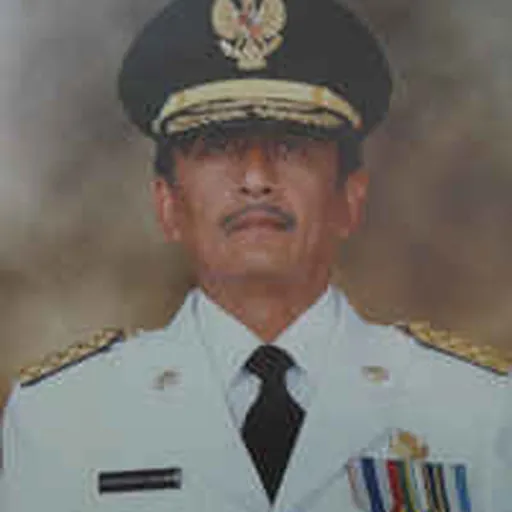
About Basofi Sudirman
Lived 1940 – 2017 (aged 76). Basofi Sudirman was an Indonesian military personnel.
Basofi Sudirman (28 December 1940 – 7 August 2017) was an Indonesian military officer and politician. He was Governor of East Java between August 1993 and August 1998, and was previously Vice Governor of Jakarta between December 1987 and May 1993. He served in the Indonesian Army, reaching the rank of major general. He took part in the Garuda Contingent to Egypt and the Indonesian invasion of East Timor during his time in the army, and was commander of Kodam I/Bukit Barisan.
Early life Basofi Sudirman was born on 28 December 1940 in Bojonegoro. His father, Soedirman, was a santri and schoolteacher who became a military officer during the Indonesian National Revolution, and would eventually become a lieutenant general. In 1960, Basofi would enroll at the Indonesian Military Academy, and he graduated in 1963. In December 1973, the 512th battalion was deployed to Egypt as part of the Garuda Contingent of United Nations Emergency Force II. Basofi, then ranked major, became chief of staff of the Indonesian contingent which was based in Ismailia. Basofi remained in Egypt until the contingent's return to Indonesia in September 1974.
The following year, Basofi commanded the battalion when it took part in the Indonesian invasion of East Timor. He had been promoted to lieutenant colonel by the time of the invasion, and was appointed commander of a joint task force. In 1977, Basofi was appointed commander of the 824th military district in Jember. After a stint at the Indonesian Army Command and General Staff College between 1978 and 1981, he returned to field service to become commander of the 18th airborne brigade of Kostrad (1981–1983), commander of Malang's military sub-region (1984–1986), and commander of Kodam Bukit Barisan before his retirement from service in 1987. and was sworn on 19 December to replace Eddie Marzuki Nalapraya. He concurrently served as chairman of Jakarta's branch of the ruling party Golkar. He resigned from his post as vice governor on 12 May 1993.
While he was vice governor in Jakarta, in 1992 he released a solo recording of the dangdut song "Tidak Semua Laki-Laki", which saw an unexpected success. Basofi wrote that Wijogo was concerned that President Suharto would not allow a high-ranking government official to enter entertainment. Instead, Suharto approved of Basofi's actions, with the recording being promoted by TVRI and used by Golkar in campaigns for the 1992 Indonesian legislative election. Basofi in 1994 claimed "with dangdut we will success-ify development".
Governor of East Java Basofi was then appointed Governor of East Java, being sworn in on 28 August 1993. His tenure as governor was strongly focused on political issues. In 1996, Basofi announced a provincial election committee for the 1997 Indonesian legislative election, which excluded members of the Indonesian Democratic Party citing the party's ongoing schism. East Java was considered important electorally, and many of (disputed) party chairman Megawati Sukarnoputri's internal opponents were based there. Basofi had in the previous year prohibited "politicking" at the 25-year commemoration of Sukarno's death at his grave in Blitar.
On 25 September 1993, four villagers were killed by security forces in Sampang, Madura related to the construction of a dam. With local demands to remove Sampang regent Bagus Hinayana from his post, Basofi instead claimed responsibility and refused to remove Hinayana. He also planned to develop a bridge between Surabaya and Madura, visiting Japan with Vice President B.J. Habibie in 1997 to discuss financing, but the Asian financial crisis shortly afterwards caused the project to be shelved.
He was replaced by Imam Utomo on 26 August 1998.
Later life Following his retirement from politics, several political parties offered Basofi party positions, but he refused. He also became active within the Nahdlatul Ulama organization, by 2003 becoming chairman of its economic institute. After two years of illness, Basofi died at the Medistra Hospital in Jakarta at 10:58 AM on 7 August 2017, and was buried at the San Diego Hills cemetery in Karawang the following day. He had three children and six grandchildren at the time of his death.
Don’t just read it —
keep it.
Full-length biographies made to live with: read them, listen on the way to work, watch them tonight.
- E-book
- Audio
- Video
Instant download · yours to keep · every purchase keeps this site free
Important facts
People in Basofi Sudirman's life
Named in this biography and alive at the same time


Related people
Same field, nearest in time


Contemporaries
People whose lives overlapped Basofi Sudirman's





Frequently asked questions
Who was Basofi Sudirman?
Indonesian military officer and politician
When was Basofi Sudirman born?
Basofi Sudirman was born on 20 December 1940 in Bojonegoro.
When did Basofi Sudirman die?
Basofi Sudirman died on 7 August 2017 in Jakarta.
What was Basofi Sudirman's occupation?
Basofi Sudirman was a military personnel.
What nationality was Basofi Sudirman?
Basofi Sudirman was Indonesian.
Sources & further reading
Cite this page
APA: Biography.guide. (2026). Basofi Sudirman. https://biography.guide/basofi-sudirman/
MLA: "Basofi Sudirman." Biography.guide, https://biography.guide/basofi-sudirman/.
Chicago: "Basofi Sudirman." Biography.guide. https://biography.guide/basofi-sudirman/.
Data last updated: 2026-09-20 · Spot an error? Report a correction.
Page generated 2026-09-27 05:09 UTC