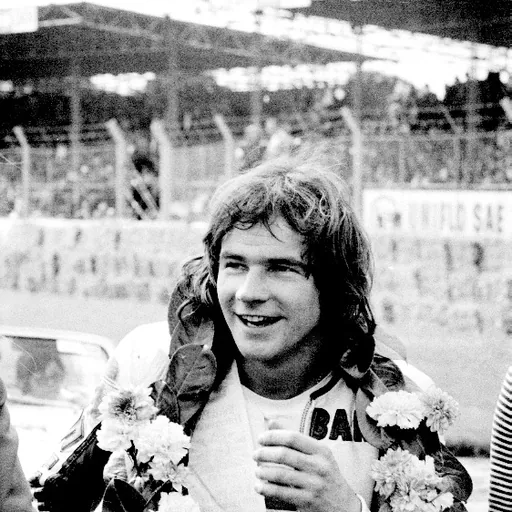
Barry Sheene
British motorcycle racer
About Barry Sheene
Lived 1950 – 2003 (aged 52). Barry Sheene was a British motorcycle racer, sports commentator and television presenter.
Barry Steven Frank Sheene (11 September 1950 – 10 March 2003) was a British professional motorcycle racer and television sports presenter. He competed in Grand Prix motorcycle racing between and , most prominently as a member of the Suzuki factory racing team where he won two consecutive FIM World Championships in and . Sheene remains the last British competitor to win the premier class of FIM road racing competitions.
He was the first motorcycle racer to gain commercial endorsements from outside the sport, including television advertisements for Brut cologne.
Sheene was also a strong proponent of race track safety, and was one of the first competitors to object to racing at the notoriously dangerous Isle of Man TT street circuit. He recognized his value to race promoters as a gate attraction and used his influence to force race promoters to increase rider safety.
Early life Barry Steven Frank Sheene was born on September 11, 1950, off the Gray's Inn Road, Bloomsbury, London, where his father, Frank Sheene, worked as the resident engineer at the Royal College of Surgeons. His father was a former competitive motorcyclist and an experienced motorcycle mechanic. Frank Sheene was one of the first proponents of the two-stroke engine that began to dominate the smaller engine classes of motorcycle racing in the mid-1960s. Sheene had no plans to become a motorcycle racer, instead he focused on learning the art of tuning two-stroke engines, which were difficult to master unless a person was prepared to dedicate considerable time in a workshop learning the intricacies of the engines. In 1969, Sheene began wearing a crash helmet with an image of Donald Duck on the front of his helmet to stand out from the crowd.
Sheene made a big impression as an eighteen-year-old in 1969 when he rode a Bultaco to place second behind Chas Mortimer in the 1969 125cc British Championship, and then dominated the 1970 125cc British Championship. Although it was an expensive purchase, the ex-factory race bike helped to launch Sheene's international racing career. The Transatlantic Trophy match races pitted the best British riders against the top American road racers on 750cc motorcycles in a six-race series during Easter weekend in England. The two racers bonded and developed a lifelong friendship. Sheene began wearing his Gary Nixon t-shirt beneath his leather riding suit as a good luck charm every time he raced.
Grand Prix racing In , Sheene entered the 125cc World Championship aboard the same Suzuki. As a young boy, Sheene had attended the TT races with his father and appreciated the history of the event: however, he felt that racing against the clock on a street circuit for world championship points was too dangerous.
Sheene scored his maiden Grand Prix victory with a win at the 125cc Belgian Grand Prix held at the challenging Circuit de Spa-Francorchamps.
The 125cc championship then moved to the Scandinavian countries where Sheene won the Swedish and Finnish Grands Prix races to take the lead in the 125cc World Championship going into the final round at the Spanish Grand Prix held at the Jarama Circuit. The following weekend, while riding with the broken rib, he finished in third while his principle rival, Ángel Nieto won the race to clinch the 125cc World Championship. Nieto's victory relegated Sheene to second place in the World Championship, a respectable result considering it was his rookie season. Sheene had immense respect for Nieto, calling him one of his greatest rivals. However, at the third round in Austria, after losing a sprint to the finish line to the Australian John Dodds for third place, he voiced his displeasure to team management about the performance of the motorcycle. The next Grand Prix was the Grand Prix of Nations at Imola at the end of May, but Sheene crashed in practice and broke his collarbone, preventing him from taking part in the race, and in the subsequent Isle of Man TT race as well. The next seven races of the world championship all took place in close succession in June and July and Sheene was not fit to take part in them.
After the Yugoslavian Grand Prix, Sheene's factory-supported Yamaha YZ635 was given to Jarno Saarinen, already a Yamaha factory rider in the 350cc class, who went on to win four races and the 250cc World Championship that year. Once back to fitness, Sheene would get factory-supported Yamahas back for British races over the summer (Silverstone, Scarborough, Mallory Park) and for the last Grand Prix of the season, at the Montjuïc circuit in Spain on 23 September, where he scored a third place in the 250cc class. He was the first as well as the only non-Yamaha rider to win a Formula 750 championship. At the end of the year, Sheene was voted "Man of the Year" by the readers of Motor Cycle News.
1974: Development of the RG500
Suzuki introduced the new RG500 motorcycle for the season, and Sheene secured its first podium results when he rode the raw, unrefined machine to a second place in France and a third place in Austria to start the season. However, Sheene suffered a broken leg in a crash at the Nations Grand Prix held at the Imola Circuit forcing him to miss the next six rounds of the World Championship. Upon recovering from his injury, he placed fourth at the Czechoslovakian Grand Prix, and finished the season ranked sixth in the 1974 500cc World Championship.
At the end of the 1974 season, the Suzuki factory was left disappointed by their efforts on the RG500 project and seemed to be losing their motivation to continue. However, Sheene had become vested in the project and took pride in seeing his suggested modifications being implemented and improving the motorcycle's performance. The 1974 victory by 15-time world champion Giacomo Agostini assisted in solidifying the Daytona 200's reputation as a prestigious motorcycle race. The BBC crew was filming Sheene during practice for the race when the tyre on Sheene's motorcycle delaminated at approximately 180 mph. He was often seen in the company of fashion models and musicians and was personal friends with James Hunt, Ringo Starr and George Harrison.
Sheene became the motorcycling racing's first multi-millionaire, purchasing homes in Putney, in south-west London, and in Wisbech, Cambridgeshire, and in 1977 he purchased a 700-year-old manor house in Charlwood, Surrey once owned by the actress Gladys Cooper. Sheene then claimed a dramatic victory in the race with a well-planned, last corner pass around the outside of Agostini. Both competitors received the same race time.
At the 1975 Swedish Grand Prix, Sheene set the lap record while winning the Formula 750 round on Saturday, then set the 500cc lap record while winning the 500cc Grand Prix race on Sunday. He started the 500cc race slowly, but worked his way through the field to catch and pass both Agostini and Phil Read, who were the championship points leaders. Sheene once again won the Mallory Park Race of the Year. However, by 1976 the 750cc class was becoming dominated by the powerful Yamaha TZ750.
Back in Europe, Sheene was the top British points scorer and the only British rider to score a win with a victory at Mallory Park, as Great Britain defeated the United States in the 1976 Transatlantic Trophy match races. However, Yamaha's Steve Baker was the dominant rider with four victories in the six race series.
1976 World Champion In the 500cc World Championships, Sheene worked hard to develop the RG500 race bike with his Suzuki team engineers, and by the season, his Suzuki was at the cutting edge of motorcycle racing technology. The factory also began to produce customer versions of the RG500 and made them available to the public in 1976.
Suzuki's British importer intervened and convinced the Suzuki factory to allow the importer to continue as Suzuki's representative in the World Championships. Riders John Newbold and John Williams joined Sheene on the British Suzuki team that became known as the Heron-Suzuki team after their principle sponsor, Heron International. Without Japanese mechanics to support him, Sheene put together a team consisting of his father Frank and Don Mackay, an electrician by trade. After sitting out the 1976 Isle of Man TT (then in its final season on the World Championship calendar), he won the Dutch TT by 45 seconds over Hennen before his motorcycle experienced mechanical trouble at the Belgian Grand Prix and he placed second to his Suzuki GB teammate John Williams.
Sheene then clinched the World Championship by winning the Swedish Grand Prix with three races left in the championship. Hennen was joined on the Suzuki team by Steve Parrish, who rode Sheene's 1976 Suzuki 500cc machine.
Sheene was once again the top British points scorer at the 1977 Transatlantic Match races, however Suzuki lacked a 750cc motorcycle to compete with the dominant Yamaha TZ750 and Roberts won the first four races of the series before his motorcycle failed during the first race at Oulton Park allowing Sheene to claim the victory. The top American points scorer at the Match races was Sheene's Suzuki teammate, Hennen, serving notice that he would be a contender in the coming 500cc World Championship. The lack of onsite medical facilities exasperated the situation and exposed the race organizers' callousness and indifference regarding the safety of competitors. Sheene's popularity had injected some much-needed interest back into the sport along with the arrival of American champion Kenny Roberts. Roberts said that he was initially indifferent about competing in Europe. However, after reading a guest column written by Sheene in the Motor-Cycle News in which he dismissed Roberts as being, "No threat", citing the Yamaha rider's lack of familiarity with most of the European race circuits, the American rider made up his mind to compete.
Roberts brought a new style of riding, forged on the dirt track ovals of America that would revolutionize road racing. His riding style was reminiscent of dirt track riding, where sliding the rear tire to one side is used as a method to steer the motorcycle around a corner.
At the pre-season 1978 Transatlantic Trophy match races, Sheene won the first of two races at Brands Hatch, but in the second race, Hennen was able to pass Sheene on the inside of the final corner to win the race. Later in the week, Sheene continued the psychological warfare on his teammate when he repeated the accusation of dangerous riding in his guest column in Motor-Cycle News. Hartog had made the correct tyre choice for the deteriorating weather conditions and was able to win by a 16-second margin. Sheene took to the public address system during the confusion to declare that he had won the race however, an FIM Jury eventually declared that Roberts was the winner with Sheene being awarded third place behind privateer Steve Manship, who did not stop for a tyre change. At the final round in Germany, Roberts finished third ahead of Sheene in fourth place to claim the 500cc title, dropping Sheene to second place in the world rankings. Sheene, used to receiving preferential treatment from Suzuki, was outvoted when Ferrari and Hartog chose the motorcycle that he had rejected and, he was forced to ride their choice rather than his preferred choice. Sheene's motorcycle suffered engine problems at Oulton Park allowing Gene Romero to win the final two races of the series. The race began with Roberts, Sheene and Wil Hartog breaking away from the rest of the field of riders. Hartog eventually fell behind as Roberts and Sheene continued to battle for the lead. Roberts began talking to journalists about forming a rival racing series to compete against the FIM's monopoly.
The death of Gilberto Parlotti at the 1972 Isle of Man TT along with the deaths of Jarno Saarinen and Renzo Pasolini in 1973, highlighted the need for improved safety standards for motorcycle racers. At the time, many motorcycle Grand Prix races were still being held on street circuits with hazards such as telephone poles and railroad crossings.
Although the competing series was not successful due to difficulties in securing enough venues, it forced the FIM to take the riders' demands seriously and make changes regarding their safety. Then American newcomer, Freddie Spencer crashed and damaged his Honda so badly in the first race, that he had to abandon the remainder of the series. Although he would return to the world championships in racing a privateer Suzuki RG500, he never regained his old form and he retired in .
The final major victory of Sheene's motorcycle racing career came at the 1984 Scarborough Gold Cup held at the Oliver's Mount circuit, one of his favorite venues. In later years, Sheene became involved in historic motorcycle racing, Following reconstruction of the Brands Hatch Circuit in England for safety concerns after requests by the FIM, the Dingle Dell section was changed for safety, and shortly after Sheene's death the new section was renamed Sheene's Corner in his honour. The FIM named him a Grand Prix "Legend" in 2001.
In popular culture
A song titled "Mr. Sheene" that describes "Mr. Sheene's riding machine" was recorded by comedians Eric Idle and Rikki Fataar and released in 1978 as the B-side of the single "Ging Gang Goolie" under the names Dirk and Stig, their characters in Beatles-parody band The Rutles.
In the Sleaford Mods song Dirty Den, the character is mentioned "falling off the wagon like Barry Sheene".
Career statistics The following is a list of results achieved by Sheene.
Motorcycle Grand Prix results
Position 1 2 3 4 5 6 7 8 9 10 Points 15 12 10 8 6 5 4 3 2 1
(key) (Races in bold indicate pole position; races in italics indicate fastest lap)
Year Class Team Machine 1 2 3 4 5 6 7 8 9 10 11 12 13 Points Rank Wins 1970 125cc Sheene Suzuki RT67 GER- FRA- YUG- IOM- NED- BEL- DDR- CZE- FIN- ULS- NAT- ESP2 12 13th 01971 50cc Kreidler Kreidler 50 AUT- GER- NED- BEL- DDR- CZE1 SWE4 NAT- ESP- 23 6th 1 125cc Sheene Suzuki RT67 AUT3 GER- IOMDNF NED2 BEL1 DDR2 CZE3 SWE1 FIN1 NAT3 ESP3 79 2nd 3 250cc Derbi Derbi 250 AUT- GER- IOM- NED- BEL- DDR6 CZE- SWE- FIN- ULS- NAT- ESP- 5 33rd 0 1972 250cc Sheene Yamaha TD-3 (YZ635) GER- FRA- AUT4 NAT- IOM- YUG- NED- BEL- DDR- CZE- SWE- FIN- ESP3 18 13th 0 1973 Formula 750 Suzuki TR750 ITA- FRA1 SWE3 FIN2 GBRDSQ GER2 ESP2 61 1st 1 1974 500cc Suzuki RG500 FRA2 GER- AUT3 NAT- IOM- NED- BEL- SWE- FIN- CZE4 30 6th 01975 500cc Suzuki RG500 FRA- AUT- GER- NAT- IOM- NED1 BELDNF SWE1 FIN- CZEDNF 30 6th 2 Formula 750 Suzuki TR750 USA- ITA- BEL- FRA1 SWE1 FIN- UK1 NED- GER- 45 2nd 3 1976 500cc Heron-Suzuki RG500 FRA1 AUT1 NAT1 IOM- NED1 BEL2 SWE1 FIN- CZE- GER- 72 1st 5 1977 500cc Heron-Suzuki RG500 VEN1 AUT- GER1 NAT1 FRA1 NED2 BEL1 SWE1 FIN6 CZE- GBRNC 107 1st 6 1978 500cc Heron-Suzuki RG500 VEN1 ESP5 AUT3 FRA3 NAT5 NED3 BEL3 SWE1 FINNC GBR3 GER4 100 2nd 2 1979 500cc Heron-Suzuki RG500 VEN1 AUT12 GERNC NAT4 ESPNC YUGNC NED2 BELDNS SWE1 FIN3 GBR2 FRA1 87 3rd 3 1980 500cc Akai-Yamaha YZR500 (OW48) NAT7 ESP5 FRANC NEDNC BEL- FIN- GBRNC GER- 10 15th 0 1981 500cc Akai-Yamaha YZR500 (OW54) AUT4 GER6 NAT3 FRA4 YUG5 NEDNC BEL4 RSM2 GBRNC FINNC SWE1 72 4th 1 1982 500cc JPS-Yamaha YZR500 (OW60) ARG2 AUT2 FRA- ESP2 NAT- NED3 BEL2 YUG3 GBRDNS SWEDNS RSMDNS GERDNS 68 5th 0 1983 500cc HB-Suzuki RG500 RSA10 FRA7 NAT9 GERNC ESP- AUT13 YUG13 NEDNC BEL- GBR9 SWENC RSMNC 9 14th 0 1984 500cc HB-Suzuki RG500 RSA3 NATNC ESP7 AUT10 GER10 FRA5 YUG7 NEDNC BEL9 GBR5 SWENC RSMNC 34 6th 0Sources: † Events with 2 races staged for the different classes.
Complete European Touring Car Championship results
(key) (Races in bold indicate pole position) (Races in italics indicate fastest lap) Year Team Car 1 2 3 4 5 6 7 8 9 10 11 12 13 14 DC Pts 1979 The Akai Golf Volkswagen Golf GTI MNZ VAL MUG BRH JAR ZEL BRN NUR ZAN SAL PER SILRet ZOL NC 0 1985 Jermaine Jackson / Toyota Racing Toyota Celica Supra MNZ VAL DON AND BRN ZEL SAL NUR SPARet SIL NOG ZOL EST JAR NC 0 1986 BBW Turbosport Mitsubishi Starion Turbo MNZ DON HOC MIS AND BRN ZEL NÜR SPA SILRet NOG ZOL JAR EST NC 0
Don’t just read it —
keep it.
Full-length biographies made to live with: read them, listen on the way to work, watch them tonight.
- E-book
- Audio
- Video
Instant download · yours to keep · every purchase keeps this site free
Important facts
People in Barry Sheene's life
Named in this biography and alive at the same time



Related people
Same field, nearest in time


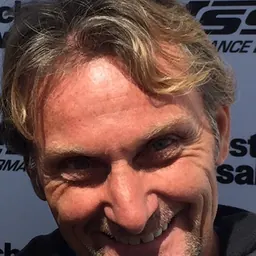
Contemporaries
People whose lives overlapped Barry Sheene's




Frequently asked questions
Who was Barry Sheene?
British motorcycle racer (1950-2003)
When was Barry Sheene born?
Barry Sheene was born on 11 September 1950 in London.
When did Barry Sheene die?
Barry Sheene died on 10 March 2003 in Sydney.
What was Barry Sheene's occupation?
Barry Sheene was a motorcycle racer, sports commentator and television presenter.
What nationality was Barry Sheene?
Barry Sheene was British.
Sources & further reading
Cite this page
APA: Biography.guide. (2026). Barry Sheene. https://biography.guide/barry-sheene/
MLA: "Barry Sheene." Biography.guide, https://biography.guide/barry-sheene/.
Chicago: "Barry Sheene." Biography.guide. https://biography.guide/barry-sheene/.
Data last updated: 2026-09-23 · Spot an error? Report a correction.
Portrait: Wikimedia Commons · author & licence
Page generated 2026-09-27 05:07 UTC