
About Barbara Carrasco
Born 1955. Barbara Carrasco is an American painter.
Barbara Carrasco (born 1955) is a Chicana artist, activist, painter and muralist. She lives and works in Los Angeles. Her work critiques dominant cultural stereotypes involving socioeconomics, race, gender and sexuality, and she is considered to be a radical feminist. Her art has been exhibited nationally and internationally.
Her work was exhibited in the 1990-1993 traveling exhibition Chicano Art: Resistance and Affirmation.
Biography Carrasco was born in El Paso, Texas to Mexican-American parents. She was the oldest girl and second oldest child of four siblings. When she was around a year old, her family moved to Los Angeles. Her experiences with being simultaneously perceived as not truly Mexican-American and being told to "take advantage of being light skinned" makes up of part of her artistic subject matter later on in life.
Carrasco was encouraged by her father to broaden her horizons, go to college and perform her artwork.
Carrasco attended Catholic school from first to eighth grade. She heard him speak at UCLA when she was nineteen and she says that she "volunteered right after the speech."
In the mid-1980s, Carrasco was commissioned to create a mural, The History of Los Angeles: A Mexican Perspective which led to a great deal of controversy. The publicity generated from the controversy, however, helped Carrasco in some ways: she was chosen to go with a group of artists to the Soviet Union in 1985 and paint a mural in the Children's Museum in Yerevan, Armenia. After graduating from CalArts, she didn't feel inspired and stopped producing art for about two years. and serves as a board member. Carrasco was a UC Regents Professor in 2002-2003.
Art
Carrasco is an artist, a painter and a muralist who is very involved in the community. Her artwork reveals the real history against indigenous people in the US and how they were treated. She has been a part of The Getty Museum, Self-Help Graphics, and the Center for Political Graphics. Carrasco's art is often very focused on social commentary. She uses her art to advocate change in the treatment of women. She has been publicly acknowledged for her role in making the Chicano art movement aware of sexist attitudes. Her art also addresses problems that she sees with religious dogma as it relates to women. Carrasco herself has stated that because she was so political, her art hasn't been taken as seriously. The city approved the sketches of the mural but when Carrasco began the process of painting it, the agency told her to remove fourteen images from the work that depicted incidents of discrimination directed at communities of color. Carrasco refused to do so, resulting in the cancellation of the project. The mural was then put in a storage room for nearly a decade. There were fifty-one separate events depicted in the mural.
Carrasco refused to censor her mural because she felt "that it would be compromising the integrity of--not only my integrity as an artist but the mural, the history of L.A."
In response to the censorship of the L.A. History: A Mexican Perspective, Carrasco created the serigraph, Self-Portrait (1985) at Self-Help Graphics. Self-Portrait depicts an artist dressed as a runner crossing a finish line. The runner, carrying a paintbrush looks over her shoulder in horror as a paint roller whitewashes the mural grid behind her. The whitewashing of Siqueiros's controversial mural is referenced again on the brush itself. It was considered "controversial."
Names Can Hurt (1991), was the first piece that Carrasco did which contained text. It was acrylic on canvas and contains many of the names she was called as a child growing up in Culver City.
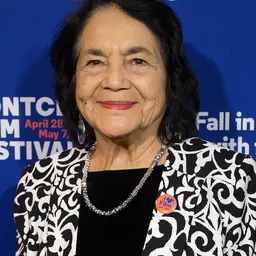
One of Carrasco's most iconic images is her print, Dolores (1999). The image depicts a bust of Dolores Huerta on a flat background with just her name. The image has a pop art sensibility to it. Carrasco states that she isolated her portrait in such a way to show that Huerta was "strong enough on her own."
Don’t just read it —
keep it.
Full-length biographies made to live with: read them, listen on the way to work, watch them tonight.
- E-book
- Audio
- Video
Instant download · yours to keep · every purchase keeps this site free
Important facts
People in Barbara Carrasco's life
Named in this biography and alive at the same time
Related people
Same field, nearest in time


Contemporaries
People whose lives overlapped Barbara Carrasco's


Frequently asked questions
Who is Barbara Carrasco?
American painter (born 1955)
When was Barbara Carrasco born?
Barbara Carrasco was born in 1955 in El Paso.
What is Barbara Carrasco's occupation?
Barbara Carrasco is a painter.
What nationality is Barbara Carrasco?
Barbara Carrasco is American.
Sources & further reading
Cite this page
APA: Biography.guide. (2026). Barbara Carrasco. https://biography.guide/barbara-carrasco/
MLA: "Barbara Carrasco." Biography.guide, https://biography.guide/barbara-carrasco/.
Chicago: "Barbara Carrasco." Biography.guide. https://biography.guide/barbara-carrasco/.
Data last updated: 2026-09-20 · Spot an error? Report a correction.
Page generated 2026-09-27 05:17 UTC