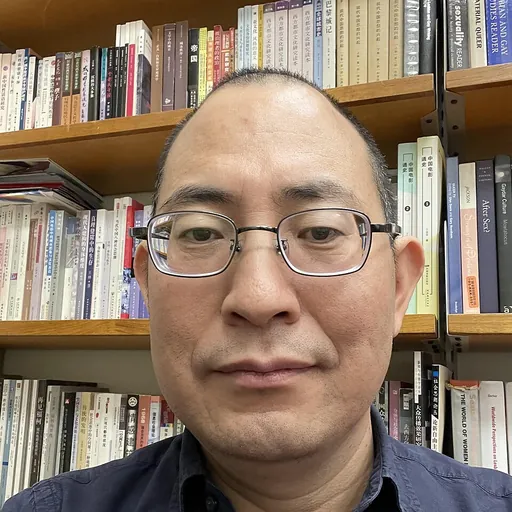
Bao Hongwei
British-Chinese academic (born 1977)
About Bao Hongwei
Bao Hongwei (English: /bɑʊ̯ː hʊŋˈweɪ/; Chinese: 包宏偉; pinyin: Bāo Hóngwěi, pronounced [paʊ xʊŋ.weɪ], born August 1977) is a British Chinese scholar at the intersection of Asian studies and queer studies, sometimes focusing more specifically on the intersection of Chinese studies and queer studies. His name is often printed and written as Hongwei Bao, following the structural conventions of an English name. He has written and co-edited numerous academic works and also writes poetry.
His commentary has been cited by multiple Wikipedia articles such as LGBTQ culture in Shanghai, Shitou (activist), Shanghai Queer Film Festival, and others. He has contributed his opinion to major news outlets such as The New York Times, The Guardian, The Economist, South China Morning Post, Times Higher Education, and the Australian Broadcasting Corporation, among others. He is a Fellow of the Royal Asiatic Society of Great Britain and Ireland, as well as a Fellow of Advance HE. He attended Xi'an International Studies University from 1996 to 2000, receiving his Bachelor of Arts degree in English. He then attended Peking University from 2000 to 2002, receiving a second BA in International and Intercultural Communication. He studied at Nanjing University from 2002 to 2003, where he obtained a certificate in American Studies. He later returned to Peking University from 2004 to 2006, where he obtained a certificate in Art History and Theory. Bao then pursued his PhD at the University of Sydney, where he received a doctoral degree in Gender and Cultural Studies. From 2014 to 2017, he studied for and obtained a Postgraduate Certificate in Higher Education from the University of Nottingham, where he now works. Dr. Jamie J. Zhao, reviewing the same book, complimented Bao's inclusiveness of groups in the margins, specifically queer women, calling it an "important academic source in queer Chinese studies." Feminist Encounters praised the thoroughness of Bao's examination, calling the book a "wonderful and timely contribution to the studies of art, film, media." Dr. Lisa Rofel at UC Santa Cruz appreciated how groundbreaking Queer Comrades: Gay Identity and Tongzhi Activism in Postsocialist China was, highlighting Bao's unique perspective. Bao's poetry has also been praised, with Dr. Gregory Woods, the author of A History of Gay Literature: The Male Tradition, calling The Passion of the Rabbit God a "brilliant, liberating debut." Bao received the 2nd Plaza Prize in Microfiction in 2023 for his work A Postcard from Berlin.
Bao's co-edited work has also received acclaim. Dr. Chris Berry of King's College London commented that the legacy of the Routledge Handbook of Chinese Gender & Sexuality would be enduring. The China Quarterly called Contemporary Queer Chinese Art a "major achievement for the study of Queer art in China." Dr. Ari Heinrich of the Australian National University predicted that Queer Literature in the Sinosphere would "become required reading in classrooms centering LGBTQ material from around the world." Dr. Tina Steiner of Stellenbosch University claimed that Entanglements and Ambivalences: Africa and China Encounters in Media and Culture was a significant addition to the literature and praised the way in which the co-editors, Bao included, were able to illuminate the complexities of relations between Africa and China. Kimiko Suda of WagREV called Queer/Tongzhi China: New Perspectives on Research, Activism and Media Cultures a "great overview" of its topic. Bao's latest work, Queering the Asian Diaspora, is forthcoming.
Contribution of expertise to media outlets Dr. Bao has offered insight and commentary to several prominent media outlets. For the New York Times, he commented on the ways in which a transgender person might receive more recognition than some gay people in Chinese media by embracing assimilation, given the pathologization of transness as it is prevalent in China and the country's embrace of surgical procedures as proper medical treatment. For The Guardian, Bao highlighted how tensions between the West and China are tied to a rise in Chinese nationalism and spoke about the dynamics between the Chinese authorities and the people at large. He also talked about the association between Chinese birth rate policies and discrimination towards LGBTQ+ people.
Bao spoke to The Economist about the ways in which Western far right language makes its way into Chinese nationalist rhetoric. He commented on how Chinese national rhetoric is inclined toward correlating homosexuality and queerness with capitalism and "bourgeois decadence" for the South China Morning Post. Bao spoke on an online ban on queer speech to Times Higher Education and its harrowing effect on communities. He talked about China's more recent silencing of activism and its impact on LGBTQ+ people for the Australian Broadcasting Corporation.
Don’t just read it —
keep it.
Full-length biographies made to live with: read them, listen on the way to work, watch them tonight.
- E-book
- Audio
- Video
Instant download · yours to keep · every purchase keeps this site free
Frequently asked questions
Who was Bao Hongwei?
British-Chinese academic (born 1977)
Sources & further reading
Cite this page
APA: Biography.guide. (2026). Bao Hongwei. https://biography.guide/bao-hongwei/
MLA: "Bao Hongwei." Biography.guide, https://biography.guide/bao-hongwei/.
Chicago: "Bao Hongwei." Biography.guide. https://biography.guide/bao-hongwei/.
Data last updated: 2026-09-20 · Spot an error? Report a correction.
Page generated 2026-09-27 05:10 UTC