
Ban Zhao
Late 1st/early 2nd century Chinese historian, philosopher and scholar
About Ban Zhao
Lived AD 45 – 116 (aged 70–71). Ban Zhao was a Chinese historian, philosopher, writer, politician, poet and scholar.
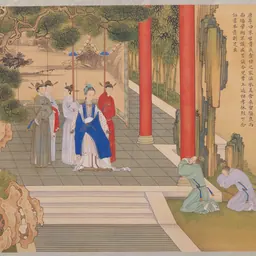
Ban Zhao (; 45 or 49 – c. 117/120 CE), courtesy name Huiban , was a Chinese historian, philosopher, and politician. She was the first known female Chinese historian and, along with Pamphile of Epidaurus, one of the first known female historians. She completed her brother Ban Gu's work on the history of the Western Han, the Book of Han. She also wrote Lessons for Women, an influential work on women's conduct. She also had great interest in astronomy and mathematics and wrote poems, commemorative writings, argumentations, commentaries, essays and several longer works, not all of which survive. She became China's most famous female scholar and an instructor of Taoist sexual practices for the imperial family. Ban Zhao is depicted in the Wu Shuang Pu (無雙譜, Table of Peerless Heroes) by Jin Guliang.
Family
Ban Zhao was born in Anling, near modern Xianyang, Shaanxi province. At age fourteen, she married a local resident named Cao Shishu and was called in the court by the name as Venerable Madame Cao . Her husband died when she was still young. She never remarried, instead devoting her life to scholarship. She was the daughter of the famous historian Ban Biao and younger sister of the general Ban Chao and of historian Ban Gu. She was also the grandniece of the notable scholar and poet Consort Ban.
Work
Ban Zhao contributed greatly to the completion and transmission of Hanshu (漢書, literally the "Book of the [Former] Han"), the official dynastic history of the Western Han. After Ban Gu was imprisoned and died in 92 because of his association with the family of Empress Dowager Dou, Ban Zhao helped finish the work by making up for the missing part of the Babiao (八表 Eight Tables). She added the genealogy of the mother of the emperor, providing much information which was not usually kept. Later, Ma Xu added a treatise on astronomy , making Hanshu a complete work.
Ban Zhao also wrote the Lessons for Women. This treatise on the education of women was dedicated to the daughters in Ban Zhao's family but was circulated immediately at court. It was popular for centuries in China as a guide for women's conduct.
Some modern interpretations of Lessons for Women claim that it is a founding text of Confucian feminism. One study asserts that it establishes a "different concept of agency... forged out of the powerlessness of individual women, which is familial, communal, indirect, and conferred by others." Such attitudes towards Zhao's work have roots in the Qing Dynasty, in which some praised Zhao as an example for Chinese women to get an education. Others, however, have argued that Ban Zhao's assertions of the value of a woman's mediocrity and servile behavior in Lessons for Women are incompatible with feminism and that attempts to present her as a feminist are misplaced. Since her text presents a woman's main task as submission to a husband or father and dismisses the significance of women's intelligence or talent, this has been seen as a Confucian endorsement of injustice against women.
She taught Empress Deng Sui and members of the court in the royal library, which gained her political influence. The Empress and concubines gave her the title Gifted one and the empress made her a Lady-in-waiting. As the Empress became regent for the infant Emperor Shang of Han, she often sought the advice of Ban Zhao. In gratitude, the Empress gave both Ban Zhao's sons appointments as officials.
In 113, Ban Zhao's son Cao Cheng was appointed an official in Chenliu Commandery. Ban accompanied him to Chenliu and wrote about the journey in Dong Zheng Fu (, which has survived. After her death, her daughter-in-law, née Ding, gathered her works in the three-volume Collected Works of Ban Zhao, but most have been lost.
Legacy
Ban Zhao crater on Venus is named after her.
Family Ban Biao (班彪; 3-54; father) Ban Gu (班固; 32–92; eldest brother) Ban Chao (班超; 32–102; second brother) Ban Xiong (班雄?-after 107; Ban Chao's eldest son) Ban Shi (班始?-130; Ban Chao's second son) Ban Yong (班勇?-after 127; Ban Chao's youngest son)
Don’t just read it —
keep it.
Full-length biographies made to live with: read them, listen on the way to work, watch them tonight.
- E-book
- Audio
- Video
Instant download · yours to keep · every purchase keeps this site free
Important facts
Family & relationships
People in Ban Zhao's life
Named in this biography and alive at the same time


Related people
Same field, nearest in time




Contemporaries
People whose lives overlapped Ban Zhao's

Frequently asked questions
Who was Ban Zhao?
late 1st/early 2nd century Chinese historian, philosopher and scholar
When was Ban Zhao born?
Ban Zhao was born in AD 45 in Eastern Han.
When did Ban Zhao die?
Ban Zhao died in 116 in Han dynasty.
What was Ban Zhao's occupation?
Ban Zhao was a historian, philosopher, writer, politician, poet and scholar.
What nationality was Ban Zhao?
Ban Zhao was Chinese.
Sources & further reading
Cite this page
APA: Biography.guide. (2026). Ban Zhao. https://biography.guide/ban-zhao/
MLA: "Ban Zhao." Biography.guide, https://biography.guide/ban-zhao/.
Chicago: "Ban Zhao." Biography.guide. https://biography.guide/ban-zhao/.
Data last updated: 2026-09-25 · Spot an error? Report a correction.
Page generated 2026-09-27 05:09 UTC