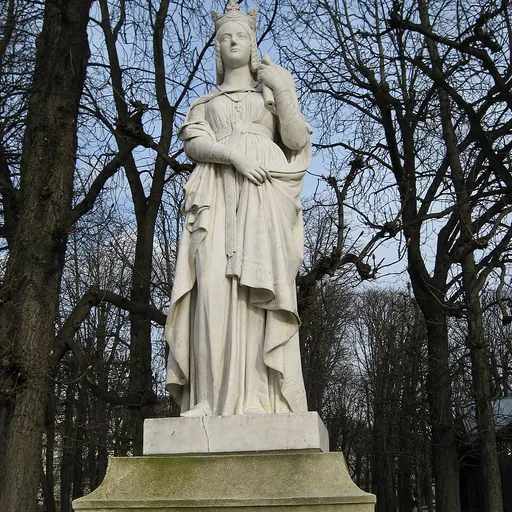
About Balthild
Lived 626 – 680 (aged 53–54). Balthild was a consort and abolitionist.
Balthild ( 626 – 30 January 680) (; , 'bold sword' or 'bold spear), also spelled Bathilda, Bauthieult or Baudour, was queen consort of Neustria and Burgundy by marriage to Clovis II, the King of Neustria and Burgundy (639–658), and regent during the minority of her son, Chlothar III. Her hagiography was intended to further her successful candidature for sainthood.
Tradition represents her as an Anglo-Saxon who was originally of noble birth, perhaps a relative of Ricberht of East Anglia, the last pagan king of East Anglia, although Pierre Fournet regards this as doubtful. Ricberht was ousted by Sigeberht, who had spent time as an exile in the Frankish court, during which he had converted to Christianity. Sigeberht was established as the rightful heir to the throne with Frankish help.
Hagiographic tradition
According to Vita S. Bathildis, Balthild was born circa 626–627. She was beautiful, intelligent, modest and attentive to the needs of others. Balthild was sold into slavery as a young girl and served in the household of Erchinoald, the mayor of the palace of Neustria to Clovis. Erchinoald, whose wife had died, was attracted to Balthild and wanted to marry her, but she did not want to marry him. She hid herself away and waited until Erchinoald had remarried. Later, possibly because of Erchinoald, Clovis noticed her and asked for her hand in marriage.
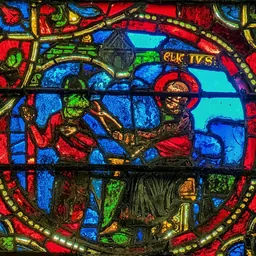
Even as queen, Balthild remained humble and modest. She is famous for her charitable service and generous donations. From her donations, the abbeys of Corbie and Chelles were founded; it is likely that others such as Jumièges, Jouarre and Luxeuil were also founded by the queen. She provided support for Claudius of Besançon and his abbey in the Jura Mountains.
Balthild bore Clovis three children, all of whom became kings: Clotaire, Childeric and Theuderic.
When Clovis died (between 655 and 658), his eldest son Clotaire succeeded to the throne. His mother Balthild acted as the queen regent. As queen, she was a capable stateswoman. She abolished the practice of trading Christian slaves and strove to free children who had been sold into slavery. Balthild and Eligius, according to Dado, "worked together on their favourite charity, the buying and freeing of slaves". After a power struggle with mayor Ebroin, Balthild withdrew to her favourite Abbey of Chelles near Paris. However, the bishop she so famously murdered, Dalfinus, is not listed as a bishop of Lyon. The story may have been written to embellish the life of Wilfrid.
A fragment of an apron thought to have belonged to Balthild is taken by scholars as evidence for her piety and frugality. Her devotion to her faith and forsaking of luxury is evident from a cross embroidered on the apron in silk, rather than gold thread.
Balthild seal matrix
A gold seal matrix, which was originally attached to a seal-ring, was uncovered in 1999 by a metal detector in a field in Postwick, east of Norwich, in Norfolk. One side shows a woman's face and her name BALDAHILDIS in Frankish lettering. The other side portrays two naked figures, a man and a woman, embracing one another beneath a cross.
In Merovingian Gaul, one side of the seal was intended to be used with official documents. The other side would have been used only for private papers. It is uncertain why the seal matrix came to East Anglia. It may have been a gift, or a representative of Balthild may have worn it as a form of identification. It has also been suggested that the seal matrix was returned to Balthild's kin after she died. The seal matrix is in the keeping of the Norwich Castle Museum.
Chemise of Balthild Balthild's ornate chemise both expresses her dedication to the church, as well as her status as a queen to Clovis II. The sleeveless tabard was probably crafted by either Balthid herself, or nuns of Chelles Abbey, and measures wide and tall. It intended to loosely hang over the front and back of the body over a dress, although the back portion is currently lost. The garment consists of simple linen as a gesture of humility towards the church, as linen was a fabric commonly worn by lower classes of the time. The silken details make up a large bejewelled Christian cross tall, small human and bird portraits, as well as several patterned rings around the collar mimicking studded golden necklaces. These embroidered necklaces were sewn in the exact likeness of the jewellery Balthild wore during her status as queen, and were also a symbol of Balthild's devotion, trading her actual jewellery for sewn replica as a member of Chelles Abbey.
There are conflicting claims on this history of this garment, centred on whether it was ever worn by Balthild herself in life, in death, or at all. The common argument is that it was a burial shirt that followed Balthild into her tomb. This is challenged by claims that the shirt was worn frequently by Balthild during her life in service at Chelles but not during her death. These arguments have surfaced due to the dubious history of the dress and Balthild's body, which have been disturbed multiple times muddying attempts at accurate documentation. Balthild's body and dress have been relocated two documented times. The first time they were moved, they were moved behind the Chelles Abbey altar as relics in 833, perhaps in hopes of attracting Christians on pilgrimages. The dress was said to be found once again hidden inside a sixteenth-century reliquary in attempts of saving it from destruction during the French Revolution.
Footnotes
Don’t just read it —
keep it.
Full-length biographies made to live with: read them, listen on the way to work, watch them tonight.
- E-book
- Audio
- Video
Instant download · yours to keep · every purchase keeps this site free
Important facts
People in Balthild's life
Named in this biography and alive at the same time
Related people
Same field, nearest in time




Contemporaries
People whose lives overlapped Balthild's





Frequently asked questions
Who was Balthild?
Wife of Clovis II
When was Balthild born?
Balthild was born in 626.
When did Balthild die?
Balthild died on 30 January 680 in Chelles.
What was Balthild's occupation?
Balthild was a consort and abolitionist.
Sources & further reading
· DBpedia: Balthild of Chelles
Cite this page
APA: Biography.guide. (2026). Balthild. https://biography.guide/balthild/
MLA: "Balthild." Biography.guide, https://biography.guide/balthild/.
Chicago: "Balthild." Biography.guide. https://biography.guide/balthild/.
Data last updated: 2026-09-23 · Spot an error? Report a correction.
Portrait: Wikimedia Commons · author & licence
Page generated 2026-09-27 05:08 UTC