About Baketmut
Baketmut was an Egyptian aristocrat.
Baketmut (, "Handmaid of Mut") was an ancient Egyptian princess of the Nineteenth Dynasty. She was the second daughter of Pharaoh Ramesses II.
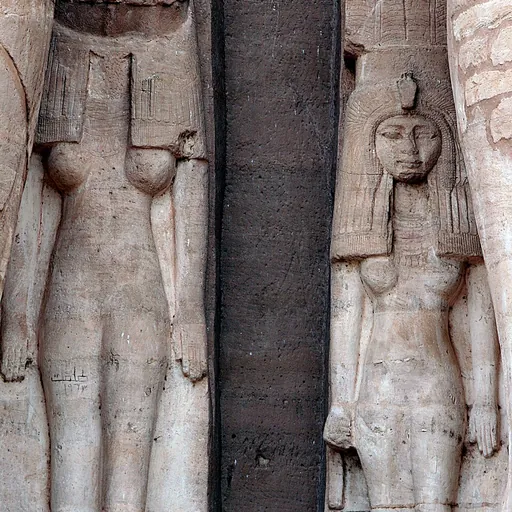
Her statue stands at the feet of one of her father's colossi at the Great Temple of Abu Simbel. She is depicted as an adult, with an uraeus on her head. She is also depicted inside the temple, in a procession of the nine eldest daughters of the pharaoh, where she is the second in line, behind Bintanath. It has been proposed that her mother was Queen Nefertari, but she is nowhere named as such. She is not shown on the facade of the Small Temple of Abu Simbel, which was built for Nefertari and decorated with statues of princes and princesses who are likely to have been her children.
Her tomb is not known.
Don’t just read it —
keep it.
Full-length biographies made to live with: read them, listen on the way to work, watch them tonight.
- E-book
- Audio
- Video
Instant download · yours to keep · every purchase keeps this site free
Important facts
Related people
Same field, nearest in time






Frequently asked questions
Who was Baketmut?
ancient Egyptian princess
What was Baketmut's occupation?
Baketmut was an aristocrat.
What nationality was Baketmut?
Baketmut was Egyptian.
Sources & further reading
Cite this page
APA: Biography.guide. (2026). Baketmut. https://biography.guide/baketmut/
MLA: "Baketmut." Biography.guide, https://biography.guide/baketmut/.
Chicago: "Baketmut." Biography.guide. https://biography.guide/baketmut/.
Data last updated: 2026-09-23 · Spot an error? Report a correction.
Portrait: Wikimedia Commons · author & licence
Page generated 2026-09-27 05:05 UTC