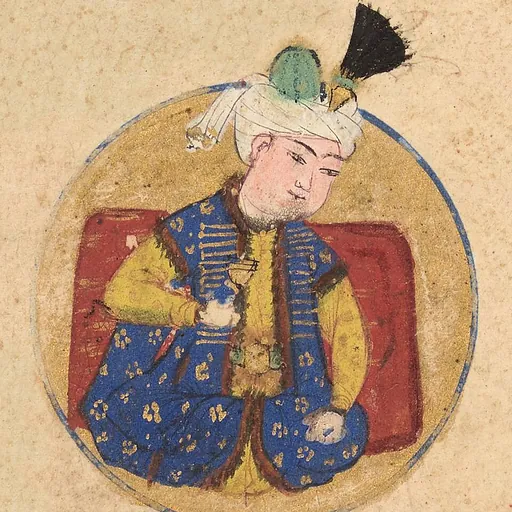
Bahram-Shah of Ghazna
Ghaznavid Sultan
About Bahram-Shah of Ghazna
Lived 1084 – 1152 (aged 67–68).
Bahram's reign Bahram's court was accompanied by a Seljuq amil or tax collector and the sending of his eldest son, Daulat Shah, to the Seljuq court at Merv as a hostage. It is believed that Bahram raided India once, attacking Sapadalaksha or eastern Rajputana.
Faced with a rebellious faction led by Muhammad b. 'Ali, Bahram marched an army to Multan in 1119. Bahram asked for Muhammad's obedience but was refused. The ensuing battle in western Punjab resulted in Muhammad's death and the deaths of most of his sons. Bahram appointed Salar Husain b. Ibrahim 'Alawi as his governor in India.
In 1135, Bahram stopped paying tribute to Ahmed Sanjar. In response, Sanjar marched an army to Ghazna, and Bahram, seeing the size of Sanjar's army, fled to Lahore the second Ghaznavid capital. After sending diplomatic entreaties, Bahram was assured of his throne, his position as a tributary of the Seljuq empire and returned to Ghazna. Between 1143 and 1146, Bahram commissioned Abu'l-Ma'ali Nasrallah to translate the Indian fable story Kalila wa Dimna from Arabic to Persian.
In an attempt to strengthen his hold over the Ghurids, Bahram invited Qutb ad-Din Muhammad b. Husain, his son in law, to court. Believing that Qutb and his brother Sayf al-Din Suri had come to court to scout the city for a future raid, Bahram had Qutb poisoned, though Sayf al-Din Suri escaped. By 1148, Sayf al-Din Suri returned with an army, scored a victory at the Battle of Ghazni while Bahram fled to Kurram. Building an army, Bahram marched back to Ghazna. Sayf al-Din Suri fled, but the Ghaznavid army caught up with him and a battle ensued at Sang-i Surakh. Sayf al-Din Suri and Majd ad-Din Musawi were captured and later crucified at Pul-i Yak Taq.
In response, Ala al-Din Husayn, younger brother of Sayf al-Din Suri and chief of the Ghurids, launched a campaign against Bahram in 1150. The Ghaznavid and Ghurid armies met at Tiginabad and through the heroic efforts of Kharmil Sam-i Husain and Kharmil Sam-i Banji the Ghaznavid army was routed. Bahram rallied elements of his army at the hot springs, Jush-i Ab-i Garm, but was again routed and fled back to Ghazna. Bahram again rallied the remaining elements of his army with the addition of the city's garrison, but again his army was routed and the city was burned by the Ghurids. Following this defeat, Bahram fled to the Ghaznavid territories in India. Ghazna was then subjected to seven days of pillage and rapine, in which 60,000 of the city were killed. All the tombs of the Ghaznavid rulers, with the exception of Mahmud, Mas'ud and Ibrahim, were broken open and the remains burned. From these events, Ala al-Din Husayn gained the nickname, World-Incendiary(i.e. World Burner).
Bahram stayed in northern India for over a year, rebuilding his army. After the defeat and capture of Ala al-Din Husayn at Herat by Seljuq forces, Bahram returned to Ghazna and removed the Ghurid governor. Bahram spent his remaining days in Ghazna, died in 1157 and was succeeded by his son, Khusrau Shah.
Raids on Indian kingdoms
Bahram Shah is said to have conducted two "holy wars" in India. The 13th-century historian Minhaj-i-Siraj states that Bahram Shah made several expeditions to India but was defeated.
According to Mihaj's Tabaqat-i Nasiri and Firishta's Tarikh-i-Firishta, Muhammad Bahlim or Bahalim (Bahram Shah's governor in India) had captured the Nagaur fort. After Bahlim died, Salar Hussain succeeded him as the governor of Ghaznavid territories in India. Nagaur was under the control of the Chahamana king Ajayaraja at least until 1121 CE, as attested by Prabhavaka Charita (the text calls him Alhadana, which appears to be a Sanskritized form of his alias Alhana). This suggests that Bahram Shah's forces captured Nagaur from Ajayaraja. The Prithviraja Vijaya states that Ajayaraja defeated the Garjana Matangas ("Ghazna Muslims"). This is probably a reference to Ajayaraja's repulsion of a raid by either Bahlim or Salar Hussain. The Prabandha Kosha also claims that Ajayaraja defeated "Sahavadina" (Sanskritized form of Shahab-ud-Din). This probably refers to his repulsion of invasions by Ghaznavid generals as well.
Ajayaraja's son Arnoraja also seems to have repulsed some Ghaznavid raids. According to his Ajmer prashasti inscription, Arnoraja adorned Ajmer with the blood of Turushkas (Turkic people). The Prithviraja Vijaya also states that Arnoraja repulsed a Muslim invasion. According to the text, these invaders came through the desert, and had to drink the blood of their horses in absence of water. After defeating these invaders, Arnoraja purified the place of their death by commissioning a lake, which is identified with the modern Ana Sagar. The lake was filled with the water of the Chandra river, identified with the modern Bandi River. Historian H. C. Ray theorized that the Muslim invaders defeated by Arnoraja were the Ghaznavid (Yamini) generals of Lahore. However, historian R. B. Singh identifies the invader as Bahram Shah himself. The Tabaqat-i Nasiri states that Bahlim revolted against his master Bahram Shah, who marched towards India to defeat the rebel. Bahlim also set out from Nagaur with his army, and the two armies met at Multan, where Bahlim was defeated and killed. Bahram Shah then left for Ghazna to fight the Ghurids. R. B. Singh speculates that after revolting against Bahram Shah, Bahlim sought asylum with the Chahamanas, and Arnoraja granted him the fief of Nagaur. After defeating Bahalim, Bahram Shah may have attempted to subdue Arnoraja, but was defeated. The Muslim chronicles probably omitted this event to avoid recording Bahram Shah's defeat.
Fall of the Ghaznavid Empire According to Bertold Spuler, a German Orientalist, Bahram's treachery, personal cowardice and desertion of his subjects directly contributed to the disintegration of the Ghaznavid Empire.
Don’t just read it —
keep it.
Full-length biographies made to live with: read them, listen on the way to work, watch them tonight.
- E-book
- Audio
- Video
Instant download · yours to keep · every purchase keeps this site free
Important facts
Family & relationships
Contemporaries
People whose lives overlapped Bahram-Shah of Ghazna's



Frequently asked questions
Who was Bahram-Shah of Ghazna?
Ghaznavid Sultan
When was Bahram-Shah of Ghazna born?
Bahram-Shah of Ghazna was born in 1084 in Ghazni, Ghaznavid Empire.
When did Bahram-Shah of Ghazna die?
Bahram-Shah of Ghazna died in 1152 in Ghazni, Ghaznavid Empire.
What nationality was Bahram-Shah of Ghazna?
Bahram-Shah of Ghazna's recorded nationality: Ghaznavid Empire.
Sources & further reading
· Wikipedia: Bahram-Shah of Ghazna
· DBpedia: Bahram-Shah of Ghazna
Cite this page
APA: Biography.guide. (2026). Bahram-Shah of Ghazna. https://biography.guide/bahram-shah-of-ghazna/
MLA: "Bahram-Shah of Ghazna." Biography.guide, https://biography.guide/bahram-shah-of-ghazna/.
Chicago: "Bahram-Shah of Ghazna." Biography.guide. https://biography.guide/bahram-shah-of-ghazna/.
Data last updated: 2026-09-20 · Spot an error? Report a correction.
Page generated 2026-09-27 05:10 UTC