
About Bahadur Shah Zafar
Lived 1775 – 1862 (aged 87). Bahadur Shah Zafar was an Indian poet, monarch and writer.
1857 Rebellion As the Indian Rebellion of 1857 spread, Sepoy regiments reached the Mughal Court at Delhi.
On 12 May 1857, Zafar held his first formal audience in several years. It was attended by several sepoys who were described as treating him "familiarly or disrespectfully". When the sepoys first arrived at Bahadur Shah Zafar's court, he asked them why they had come to him, because he had no means of maintaining them. Bahadur Shah Zafar's conduct was indecisive. However, he yielded to the demands of the sepoys when he was told that they would not be able to win against the East India Company without him.
On 16 May, sepoys and palace servants killed fifty-two Europeans who were prisoners of the palace and who were discovered hiding in the city. The executions took place under a peepul tree in front of the palace, despite Zafar's protests. The aim of the executioners was to implicate him in the killings. Once he had joined them, Bahadur Shah II took ownership for all the actions of the mutineers. Though dismayed by the looting and disorder, he gave his public support to the rebellion. It was later believed that Bahadur Shah was not directly responsible for the massacre, but that he may have been able to prevent it, and he was therefore considered a consenting party during his trial.
During the Siege of Delhi when the victory of the British became certain, Zafar took refuge at Humayun's Tomb, in an area that was then at the outskirts of Delhi. Company forces led by Major William Hodson surrounded the tomb and Zafar was captured on 20 September 1857. The next day, Hodson shot his sons Mirza Mughal and Mirza Khizr Sultan, and grandson Mirza Abu Bakht under his own authority at the Khooni Darwaza, near the Delhi Gate and declared Delhi to be captured. Bahadur Shah himself was taken to his wife's haveli, where he was treated disrespectfully by his captors. When brought news of the executions of his sons and grandson, the former emperor was described as being so shocked and depressed that he was unable to react.
After Zafar's defeat, he said: غازیوں میں بُو رہے گی جب تلک ایمان کی تخت لندن تک چلے گی تیغ ہندوستان کی As long as there remains the scent of faith in the hearts of our Ghazis, so long shall the sword of Hindustan flash before the throne of London.
Trial The trial was a consequence of the Sepoy Mutiny and lasted for 21 days, had 19 hearings, 21 witnesses and over a hundred documents in Persian and Urdu, with their English translations, were produced in the court. At first the trial was suggested to be held at Calcutta, the place where Directors of East India company used to their sittings in connection with their commercial pursuits. But instead, the Red Fort in Delhi was selected for the trial. It was the first case to be tried at the Red Fort.
Zafar was tried and charged on four counts:
On the 20th day of the trial, Bahadur Shah II defended himself against these charges. The eighty-two-year old poet-king was harassed by the mutineers and was neither inclined to nor capable of providing any real leadership. Despite this, he was the primary accused in the trial for the rebellion.
Respecting Hodson's guarantee on his surrender, Zafar was not sentenced to death but exiled to Rangoon, Burma.
Death
In 1862, at the age of 87, he fell ill. In October, his condition deteriorated. He was "spoon-fed on broth" but he found that difficult too by 3 November. On 6 November, the British Commissioner in Rangoon, Captain H. Nelson Davies, wrote that Zafar "is evidently sinking from pure desuetude and paralysis in the region of his throat". To prepare for his death, Davies commanded the collection of lime and bricks, and a spot was selected at the "back of Zafar's enclosure" for his burial. Zafar died on Friday, 7 November 1862 at 5 am. and was buried at 4 pm near the Shwedagon Pagoda at 6 Ziwaka Road, near the intersection with Shwedagon Pagoda Road, Yangon. The shrine of Bahadur Shah Zafar Dargah was built there after the restoration of his tomb on 16 February 1991. Davies commenting on Zafar, described his life as "very uncertain".
Family and descendants
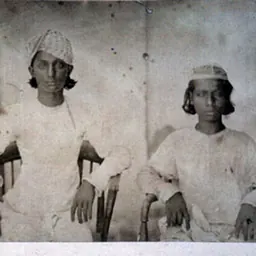
Sons of Bahadur Shah Zafar. On the left is Jawan Bakht, and on the right is Mirza Shah Abbas.
Bahadur Shah Zafar had four wives and numerous concubines. His wives were:
Begum Ashraf Mahal Begum Akhtar Mahal Begum Zeenat Mahal Begum Taj Mahal
He had twenty-two sons including:
Mirza Dara Bakht Miran Shah (1790–1841) Mirza Muhammed Shahrukh Bahadur Mirza Kayumar Bahadur Mirza Fath-ul-Mulk Bahadur (alias Mirza Fakhru) (1816–1856) Mirza Muhammad Quwaish Bahadur Mirza Mughal (1817–1857) Mirza Quraish Shikoh (1820–c. 1889) Mirza Farkhanda Shah Bahadur Mirza Khizr Sultan (1834–1857) Mirza Bakhtavar Shah Bahadur Mirza Sohrab Hindi Bahadur Mirza Abu Nasr Mirza Muhammad Bahadur Mirza Abdullah Mirza Kuchak Sultan Mirza Abu Bakr (1837–1857) Mirza Jawan Bakht (1841–1884) Mirza Shah Abbas (1845–1910) Muhammad Sher Shah Nooruddin Mohammad Shoeb He had at least thirty-two daughters including:
Rabeya Begum Begum Fatima Sultan Kulsum Zamani Begum Raunaq Zamani Begum (possibly a granddaughter, d. 1930)
Many individuals claim to be descendants of Bahadur Shah Zafar, living in places throughout India, such as Hyderabad, Aurangabad, Delhi, Bhopal, Kolkata, Bihar, and Bengaluru. However, the claims are often disputed.
Religious beliefs
Bahadur Shah Zafar was a devout Sufi.
As a poet, Zafar imbibed the highest subtleties of mystical Sufi teachings.
In one of his verses, Zafar explicitly stated that both Hinduism and Islam shared the same essence. This philosophy was implemented by his court which embodied a multicultural composite Hindu-Islamic Mughal culture. Zafar was also tolerant of Shia Muslims who regained their lost influence at the Mughal court under him.
Epitaph He was a prolific Urdu poet and calligrapher. He wrote the following Ghazal as his own epitaph. In his book, The Last Mughal, William Dalrymple states that, according to Lahore scholar Imran Khan, the beginning of the verse, umr-e-darāz māṅg ke ("I asked for a long life") was not written by Zafar, and does not appear in any of the works published during Zafar's lifetime. The verse was allegedly written by Simab Akbarabadi.
Original UrduDevanagari transliterationRoman transliterationEnglish translation
लगता नहीं है जी मेरा उजड़े दयार में किसकी बनी है आलम-ए-नापायेदार में
बुलबुल को पासबाँ से न सैयाद से गिला क़िस्मत में क़ैद लिखी थी फ़स्ल-ए-बहार में
कह दो इन हसरतों से कहीं और जा बसें इतनी जगह कहाँ है दिल-ए-दाग़दार में
इक शाख़-ए-गुल पे बैठ के बुलबुल है शादमाँ काँटे बिछा दिये हैं दिल-ए-लालाज़ार में
उम्र-ए-दराज़ माँगके लाए थे चार दिन दो आरज़ू में कट गए, दो इन्तज़ार में
दिन ज़िन्दगी के ख़त्म हुए शाम हो गई फैला के पाँव सोएँगे कुंज-ए-मज़ार में
कितना है बदनसीब "ज़फ़र″ दफ़्न के लिए दो गज़ ज़मीन भी न मिली कू-ए-यार मेंlagtā nahī̃ hai jī mirā ujṛe dayār mẽ kis kī banī hai ālam-e-nā-pāedār mẽ
bulbul ko pāsbā̃ se na sayyād se gilā qismat mẽ qaid likkhī thī fasl-e-bahār mẽ
kah do in hasratõ se kahī̃ aur jā basẽ itnī jagah kahā̃ hai dil-e-dāġdār mẽ
ik shāx-e-gul pe baiṭh ke bulbul hai shādmā̃ kā̃ṭe bichā diye hãi dil-e-lālāzār mẽ
umr-e-darāz māṅg ke lāe the cār din do ārzū mẽ kaṭ gae do intizār mẽ
din zindagī ke xatm hue shām ho gaī phailā ke pāõ soeṅge kūñj-e-mazār mẽ
kitnā hai badnasīb zafar dafn ke lie do gaz zamīn bhī na milī kū-e-yār mẽMy heart has no repose in this despoiled land Who has ever felt fulfilled in this futile world?
The nightingale complains about neither the sentinel nor the hunter Fate had decreed imprisonment during the harvest of spring
Tell these longings to go dwell elsewhere What space is there for them in this besmirched heart?
Sitting on a branch of flowers, the nightingale rejoices It has strewn thorns in the garden of my heart
I asked for a long life, I received four days Two passed in desire, two in waiting.
The days of life are over, evening has fallen I shall sleep, legs outstretched, in my tomb
How unfortunate is Zafar! For his burial Not even two yards of land were to be had, in the land of his beloved.
Image gallery
Legacy
Zafar is seen as the hero of Indian rebellion of 1857. In 1943, the Indian National Army paid tribute to his tomb in Rangoon. In 1975, Indian government released a postal stamp in his honour.
In popular culture
Zafar was portrayed in the play 1857: Ek Safarnama set during the Indian Rebellion of 1857 by Javed Siddiqui. It was staged at Purana Qila, Delhi ramparts by Nadira Babbar and the National School of Drama repertory company in 2008. A Hindi-Urdu black-and-white movie, Lal Quila (1960), directed by Nanabhai Bhatt, showcased Bahadur Shah Zafar extensively.
TV serials and films A television show, Bahadur Shah Zafar, aired on Doordarshan in 1986. Ashok Kumar played the lead role in it.
In the 2001 Hindi historical drama series 1857 Kranti, on DD National, the character of Bahadur Shah Zafar was played by S. M. Zaheer.
In the 2005 Bollywood film Mangal Pandey: The Rising, directed by Ketan Mehta, the character of Bahadur Shah Zafar was played by Habib Tanveer.
In historical series Bharat Ek Khoj which aired on Doordarshan he was portrayed by Virendra Razdan.
In Gulzar's TV serial Mirza Ghalib, Zafar was played by Sudhir Dalvi.
Don’t just read it —
keep it.
Full-length biographies made to live with: read them, listen on the way to work, watch them tonight.
- E-book
- Audio
- Video
Instant download · yours to keep · every purchase keeps this site free
Important facts
Family & relationships
People in Bahadur Shah Zafar's life
Named in this biography and alive at the same time
Related people
Same field, nearest in time

Contemporaries
People whose lives overlapped Bahadur Shah Zafar's




Frequently asked questions
Who was Bahadur Shah Zafar?
18th and last Mughal Emperor from 1837 to 1857
When was Bahadur Shah Zafar born?
Bahadur Shah Zafar was born on 24 October 1775 in Delhi.
When did Bahadur Shah Zafar die?
Bahadur Shah Zafar died on 7 November 1862 in Yangon.
What was Bahadur Shah Zafar's occupation?
Bahadur Shah Zafar was a poet, monarch and writer.
What nationality was Bahadur Shah Zafar?
Bahadur Shah Zafar was Indian.
Sources & further reading
· Wikipedia: Bahadur Shah Zafar
Cite this page
APA: Biography.guide. (2026). Bahadur Shah Zafar. https://biography.guide/bahadur-shah-zafar/
MLA: "Bahadur Shah Zafar." Biography.guide, https://biography.guide/bahadur-shah-zafar/.
Chicago: "Bahadur Shah Zafar." Biography.guide. https://biography.guide/bahadur-shah-zafar/.
Data last updated: 2026-09-20 · Spot an error? Report a correction.
Page generated 2026-09-27 05:23 UTC