
About Bagrat Ulubabyan
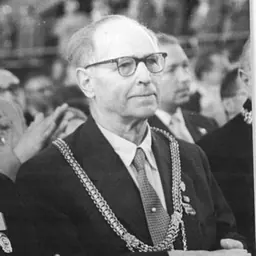
Lived 1925 – 2001 (aged 75). Bagrat Ulubabyan was a Russian and Armenian writer and historian.
Bagrat Arshaki Ulubabyan (; December 9, 1925 – November 19, 2001) was an Armenian writer and historian, known most prominently for his work on the histories of Nagorno-Karabakh and Artsakh.
Biography Early life and education Ulubabyan was born in the village of Mushkapat in the Martuni region of the Nagorno-Karabakh Autonomous Oblast (NKAO), Azerbaijan SSR, on December 9, 1925. In 1944, he graduated from Shusha's Pedagogical Institute. Two years later, he received his degrees in Armenian language and Armenian literature from Baku's Pedagogical Institute. From 1949 until 1967, he returned to Nagorno-Karabakh and was the head of the province's Writers Union. During those years, he was also a writer for the Armenian language newspaper Sovetakan Gharabagh (Soviet Karabakh) and a deputy to the head of NKAO's executive committee. In 1968, Ulubabyan moved from the NKAO to Yerevan, the capital of the Armenian SSR, and in the following year, became a senior researcher in the history department at the Armenian Academy of Sciences.
Works Ulubabyan's first works were in the field of poetry. In 1952 and 1956, he completed two works, "Songs about Work and Peace" and "This Morning". He, however, shifted his focus and began writing short stories as well as epics: "Aygestan" (1960), "Tartar" (1963), "The Grain Never Dies" (1967), and "Lamp" (1976). He also wrote two novels, Armenian Land in 1959 and The Man in 1963. During the 1960s, Ulubabyan had also been the author and one of thirteen signatories of a letter sent to Moscow, asking that the Soviet Union to consider Karabakh's incorporation into Armenia.
On May 7, 2001, in honor of his work in regards to Armenian history, he was decorated with the Order of Saint Gregory the Illuminator by the Nagorno Karabakh Republic's then-president, Arkady Ghukasyan. After suffering from a long bout of lung disease, Ulubabyan died on November 19, 2001.
Endorsement, recognition and criticism In modern academic world Bagrat Ulubabyan is acknowledged as a respected scholar in the field of Caucasiology. Western scholars, such as Robert Hewsen or Patrick Donabedian, have extensively used Ulubabyan's research on eastern lands of Armenia, directly or indirectly endorsing his statements and views. In an essay on the kingdom of Artsakh, Hewsen also referred to Ulubabyan's Principality of Khachen as an "important work" and suggested it as a supplemental source to readers who are interested in learning more about the region and its medieval history.
However, Russian historian Victor Schnirelmann considers Ulubabyan as one of several scholars who tried to create an Armenian "myth" of the history of Nagorno-Karabakh. Schnirelmann criticized Ulubabyans contention that in the early Middle Ages the Caucasian Albanians populated only the lands to the north of the Kura River, and that despite the traditional point of view according to which the Udi people represent the descendants of medieval Albanian tribe of Utis, Ulubabyan claimed that the latter were not only Armenicized very early, but were almost originally Armenian.
Don’t just read it —
keep it.
Full-length biographies made to live with: read them, listen on the way to work, watch them tonight.
- E-book
- Audio
- Video
Instant download · yours to keep · every purchase keeps this site free
Important facts
People in Bagrat Ulubabyan's life
Named in this biography and alive at the same time

Related people
Same field, nearest in time


Contemporaries
People whose lives overlapped Bagrat Ulubabyan's



Frequently asked questions
Who was Bagrat Ulubabyan?
Armenian historian (1925–2001)
When was Bagrat Ulubabyan born?
Bagrat Ulubabyan was born on 9 December 1925 in Mushkapat.
When did Bagrat Ulubabyan die?
Bagrat Ulubabyan died on 19 November 2001 in Yeghvard.
What was Bagrat Ulubabyan's occupation?
Bagrat Ulubabyan was a writer and historian.
What nationality was Bagrat Ulubabyan?
Bagrat Ulubabyan was Russian and Armenian.
Sources & further reading
Cite this page
APA: Biography.guide. (2026). Bagrat Ulubabyan. https://biography.guide/bagrat-ulubabyan/
MLA: "Bagrat Ulubabyan." Biography.guide, https://biography.guide/bagrat-ulubabyan/.
Chicago: "Bagrat Ulubabyan." Biography.guide. https://biography.guide/bagrat-ulubabyan/.
Data last updated: 2026-09-26 · Spot an error? Report a correction.
Page generated 2026-09-27 05:14 UTC