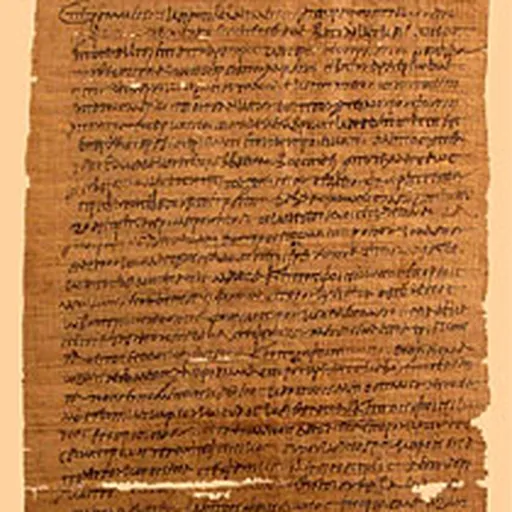
Babatha
Roman era Jewish woman
About Babatha
Babatha bat Shimʿon, also known as Babata ( – after 132) was a Jewish woman who lived in the town of Maḥoza at the southeastern tip of the Dead Sea in what is now Jordan at the beginning of the 2nd century CE.
In 1960, archaeologist Yigael Yadin discovered a leather pouch containing her documents in what came to be known as the Cave of Letters, near the Dead Sea. The documents found include such legal contracts concerning marriage (ketubah), property transfers, and guardianship. These documents, ranging from 96 to 134, depict a vivid picture of life for an upper-middle class Jewish woman during that time. They also provide an example of the Roman bureaucracy and legal system under which she lived.
Life
Babatha was born in approximately 104 CE, probably in Mahoza (alternatively Maḥoz ‘Aglatain), a village located south of the Dead Sea. The village was part of the Nabataean Kingdom until 106 CE, when the kingdom was incorporated into the Roman Empire, becoming the province of Arabia Petraea. Maḥoza was predominantly Nabatean but had a sizable Jewish community. It was located just inside Nabatea, close to the border with Judea. It was a seaside village and a thriving center of date palm cultivation.
Babatha's father, Shimon, son of Menachem, was from Ein Gedi in Judea and came to Maḥoza roughly around the time of her birth and bought property there. He is known to have bought a date palm orchard from Archelaus, a Nabatean provincial governor, in 99 CE. Archelaus had purchased the same orchard only a month before but rescinded the purchase. He gave Shimon two documents to help him secure his title to the orchard. This behaviour by such a high-status figure as Archelaus indicates that the Nabatean elite was not particularly status-fixated due to their nomadic background.
The earliest document that mentions Babatha is the deed gift that her father Shimon left to her mother Miriam. Most likely the eldest daughter, she inherited her father's property in Mahoza, several date palm orchards, upon her parents’ deaths. Her first husband was Jesus, son of Jesus, whom she probably married around 120, when she would likely have been around 12–15 years old. They had a son named Jesus.
By 124, her first husband had died. In 125, she married Judah, the son of Eleazar Ketushyon, the owner of three date palm orchards in Ein Gedi, who had another wife, Miriam, daughter of Beianus, and a teenage daughter, Shelamzion. The documents also show a dispute between Shelamzion and Judah's orphaned nephews over the ownership of a courtyard in Ein Gedi he had gifted to Shelamzion. An elite Roman woman, Julia Crispina, represented the nephews. The dispute was ultimately settled in Shelamzion's favor. Babatha's seizure of her late husband's property was contested by these same nephews, whom Julia Crispina again represented in the court of the provincial governor. At one point, Babatha summoned Julia Crispina to court, despite her Roman elite status, claiming that a false charge of violence had been made against her.
Death
The latest documents discovered in the pouch concern a summons to appear in an Ein Gedi court as Judah's first wife, Miriam, had brought a dispute against Babatha regarding their late husband's property. Therefore, it is assumed that Babatha was near Ein Gedi in 132 CE, placing her in the midst of the Bar Kokhba revolt. It is likely that Babatha fled with Miriam and her family from the imminent violence of the revolt. They are thought to have taken refuge in the Cave of Letters together with the family of Jonathan, son of Beianus, a Jewish general of the Bar-Kokhba revolt who was apparently Miriam's brother. The opening of the hole was sealed with a rock.
Don’t just read it —
keep it.
Full-length biographies made to live with: read them, listen on the way to work, watch them tonight.
- E-book
- Audio
- Video
Instant download · yours to keep · every purchase keeps this site free
Important facts
Frequently asked questions
Who was Babatha?
Roman era Jewish woman
When was Babatha born?
Babatha was born in Seleucia-Ctesiphon.
When did Babatha die?
Babatha died in Ein Gedi.
What nationality was Babatha?
Babatha's recorded nationality: Jews.
Sources & further reading
Cite this page
APA: Biography.guide. (2026). Babatha. https://biography.guide/babatha/
MLA: "Babatha." Biography.guide, https://biography.guide/babatha/.
Chicago: "Babatha." Biography.guide. https://biography.guide/babatha/.
Data last updated: 2026-09-23 · Spot an error? Report a correction.
Portrait: Wikimedia Commons · author & licence
Page generated 2026-09-27 05:06 UTC