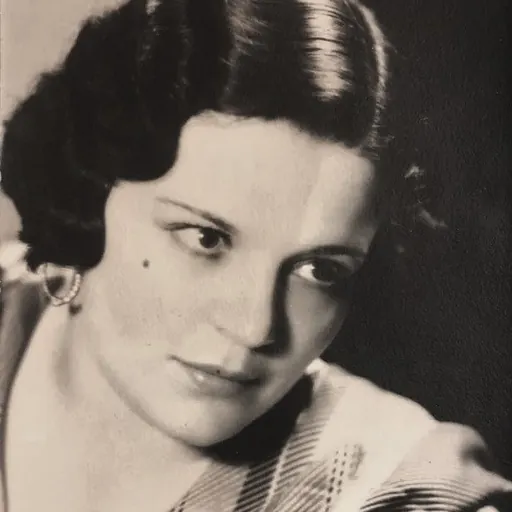
About Azucena Maizani
Lived 1902 – 1970 (aged 67). Azucena Maizani was an Argentine actor, composer, songwriter, opera singer, singer and actress.
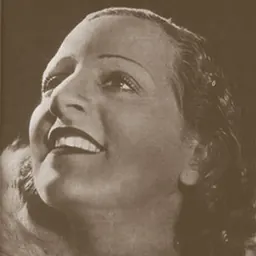
Azucena Maizani (17 November 1902 – 15 January 1970) was an Argentine tango singer, composer and actress. She was discovered in 1920 by Francisco Canaro and quickly emerged as a major star. Her frequent appearances on stage and radio made her the female counterpart of Carlos Gardel although she did not enjoy as successful a film career as he did, appearing in a handful of films of the Golden Age of Argentine cinema including ¡Tango! and Buenos Aires Sings (1947). During many years she gave performances dressed with men's suits or criollo cowboy attire for which she was known by the nickname "Funny-face Cowgirl", given to her by Libertad Lamarque in 1935.
Early years Maizani was born in Buenos Aires on 17 November 1902. She lived in the Palermo neighborhood until she was five in which, because it seemed that she had health problems and her parents were very poor, she was taken by some family members to live on Martín García island. On that island located in the middle of the Río de la Plata river, halfway between Argentina and Uruguay, she completed her grade school education and at 17, returned to Buenos Aires and began working as a seamstress in a shirt factory and in a fashion house. She liked singing and, according to Canaro, one night she went to Pigall where he acted and she convinced him to let her sing two tangos in public with his orchestra. If she did not get a job through this, it must have strengthened her in her artistic career, which began in 1922 in which she began as a chorus girl in the brothers César and Pepe Ratti's company which was putting on the piece, El bailarín del cabaret (The Cabaret Dancer) in the Apolo Theater, starring the singer Ignacio Corsini.
Beginnings as a singer At a family party that she went to with Delia Rodríguez, who at that moment was a well-known singer, she met Enrique Pedro Delfino accompanying everyone who wanted to sing on the piano. Maizani sang and left such an impression that the pianist introduced her to the theater business owner Pascual Carcavallo who in turn heard her and hired her. She debuted in the National Theater on July 27, 1923, with the comical sketch "A mí no me hablen de penas" (Don't tell me about your troubles) by Alberto Vacarezza. It did not have lyrics, she just sang the tango "Padre nuestro" (Our Father) composed especially for her by Delfino and Vacarezza.
Return to Buenos Aires Upon returning to her country, Maizani found that in her two-year absence, new female singers had emerged and, in many cases, were launched by frequent contests that were often organized by radio stations. They included: Libertad Lamarque, Ada Falcón, Adhelma Falcón, Tania, Mercedes Simone y Dorita Davis. She quickly recovered her popularity and acted in Tango (1933), the first Argentinian full-length film with sound. Maizani did not sing directly but her voice was heard singing La canción de Buenos Aires while the credits played along with an image of her face. Later on, she has a scene in which she sang Milonga sentimental while dressed in a man's suit.
In 1935 she appeared in a cabaret in the movie Monte criollo singing the tango of the same name with lyrics by Homero Manzi and the music of Francisco Pracánico. It was a loose police role directed by Arturo S. Mom and interpreted by Nedda Francy and Francisco Petrone.
In 1937, she went on an extensive tour in America that included Mexico and New York. In New York, she did radio acting, recorded albums and played a minor role in the film Di que me quieres, a film directed by William Rowland, that included the performance of a select group of ballerinas and typical Latin-American singers. Azucena also appeared in the 1940 film Nativa, in which she sings and explores an acting role without much development or transcendence.
In the 1940s she appeared less in the public sphere. She did, however, make some recordings, help fundraise for the victims of the earthquake of 1944 in San Juan by offering concerts, acted on Radio Argentina, and toured through the interior of Chile, Peru, Ecuador and Colombia, although she was no longer as famous as she used to be. Together with Ivo Pelay, she acted in the famous Uruguayan theater 18 de julio in Montevideo, and in the El Nacional theater in Buenos Aires. Azucena acted in cafes and went to Brazil in 1961 to record. In November 1962 by the initiative of Dorita Davis, a festival was made in her celebration at the Astral Theater, in which she sang in front of a crowd that welcomed and applauded her enthusiastically. In the next couple of years she continued to sing even up until her lonesome death on 15 January 1970, after she suffered a hemiplegia.
Personal life In 1928, Azucena Maizani married Juan Scarpino, but the couple separated shortly after the death of their only son. The following year, she teamed up with violinist Roberto Zerrillo, with whom she went on tour inside of the country, and later throughout Europe. Later, Azucena had a relationship with Rodolfo José María Caffaro, who began his career as a singer under the pseudonym Ricardo Colombres, but it was later discovered that he cheated on her, and in 1936 he committed suicide.
Compositions Azucena did not have an extensive amount of work with regard to composing; her first was Volvé Negro in 1924. Her most famous work was Pero yo sé in 1928- it became famous and successful, and it was recorded by numerous artists, highlighting Ángel Vargas' version from Ángel D'Agostino's orchestra. She also composed, in collaboration with Oreste Cúfaro and Manuel Romero the tango La canción de Buenos Aires, which was recorded by Carlos Gardel, a friend.
Other works include the waltz Pensando en ti with verses by Celedonio Flores; Decí que sí, a famous ranchera that she did with Cúfaro and Alberto Pidemunt; the milongas Adonde están los varones; Por qué se fue?; Dejáme entrar, hermano; En esta soledad, the ranchera Remigio; Lejos de mi tierra, among others.
Recording From 1923 to 1926, Azucena recorded with the Francisco Canaro orchestra, and later with Enrique Pedro Delfino at the piano and Manual Parada on the guitar, in both cases for the company Orión. From 1929 to 1931, she recorded for the label Brunswick, accompanied by the violinist Roberto Zerrillo, the pianist Oreste Cúfaro and Manual Parada, with the violinist Antonio Rodio making sporadic appearances. Azucena Maizani first recorded the tango Malena by Homero Manzi and Lucio Demare, and she also recorded Ninguna (lyrics by Homero Manzi and music by Raúl Fernández Siro) in 1942. In total, Azucena recorded over 270 works.
Discography Apología Tangeura. Barcelona, Altaya, T.A. 026, 1998, compact disc.
Azucena Maizani 1924-1939, Disco Latina DL-122, 1984, rpm.
Azucena Maizani, 1926-1935, vol 2, Disco Latina DL-142, 1986, rpm.
Azucena Maizani: la ñata gaucha. Azucena Maizani singing with accompaniment. Recorded in Buenos Aires, 1928–1935. Barcelona: El bandoneón, EBCD-27, 1991, compact disc.
Se Va la Vida: 1923-1945. Harlequin; Bexhill-On-Sea, England: Product of Interstate Music, HQ CD 54,1995, compact disc.
Tango Ladies. Harlequin; Bexhill-On-Sea, England: Product of Interstate Music, HQ CD 34, 1994, compact disc.
Selected filmography ¡Tango! (1933) Buenos Aires Sings (1947)
Don’t just read it —
keep it.
Full-length biographies made to live with: read them, listen on the way to work, watch them tonight.
- E-book
- Audio
- Video
Instant download · yours to keep · every purchase keeps this site free
Important facts
People in Azucena Maizani's life
Named in this biography and alive at the same time




Related people
Same field, nearest in time



Contemporaries
People whose lives overlapped Azucena Maizani's



Frequently asked questions
Who was Azucena Maizani?
Argentinian singer (1902-1970)
When was Azucena Maizani born?
Azucena Maizani was born on 17 November 1902 in Buenos Aires.
When did Azucena Maizani die?
Azucena Maizani died on 15 January 1970 in Buenos Aires.
What was Azucena Maizani's occupation?
Azucena Maizani was an actor, composer, songwriter, opera singer, singer and actress.
What nationality was Azucena Maizani?
Azucena Maizani was Argentine.
Sources & further reading
Cite this page
APA: Biography.guide. (2026). Azucena Maizani. https://biography.guide/azucena-maizani/
MLA: "Azucena Maizani." Biography.guide, https://biography.guide/azucena-maizani/.
Chicago: "Azucena Maizani." Biography.guide. https://biography.guide/azucena-maizani/.
Data last updated: 2026-09-21 · Spot an error? Report a correction.
Portrait: Wikimedia Commons · author & licence
Page generated 2026-09-27 05:00 UTC