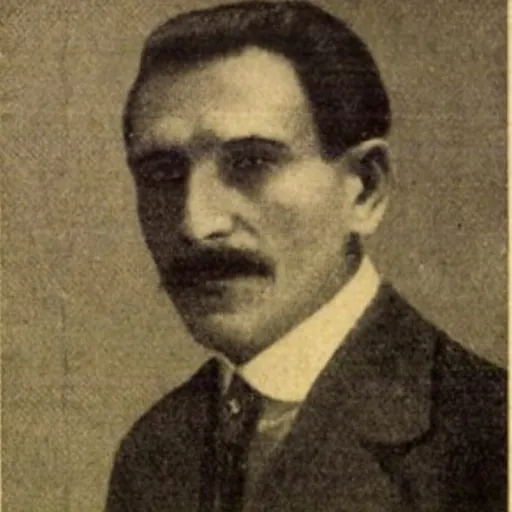
About Avrom Reyzen
Lived 1876 – 1953 (aged 76). Avrom Reyzen was a Russian and American writer and prose writer.
Avrom Reyzen (Yiddish: אַבֿרהם רייזען; April 8, 1876 – April 2, 1953), known as Abraham Reisen, was a Belorussian Jewish-American editor and writer, including autobiography, poetry and short stories. He was the elder brother of the Yiddishist Zalman Reisen.
Life Reyzen was born in Koidanov (Minsk Governorate, eastern Belarus). Supported by Yaknehoz (pseudonym of Yeshaye Nisn Hakoyen Goldberg), while in his early teens Reyzen sent articles to Dos Yudishes folks-blat in Saint Petersburg.
He corresponded with Jacob Dinezon and I. L. Peretz. In 1891, they published Reyzen's poem Ven dos lebn is farbitert ("When Life Is Embittered") in their Di yudishe bibliotek (The Yiddish Library). His first story, A kapore der noz abi a goldener zeyger mit 300 rubl nadn ("Damn the Nose, As Long As There Is a Dowry of a Watch and 300 Rubles") was published in Vilna in 1892.
In 1895, he joined the Imperial Russian Army, serving in a musicians' unit until 1899.
In addition to writing for the Zionist Der yud, in 1900 Reyzen created the literary anthology (The Twentieth Century) which includes work by I. L. Peretz, Hersh Dovid Nomberg, David Pinski, and others. A believer in the socialist ideology, Reyzen wrote for the General Jewish Labour Bund (a secular Jewish socialist party), sometimes under the pseudonym M. Vilner, during the late 19th and early 20th centuries.
In 1910, he began the Warsaw literary weekly Eyropeyishe literatur (European Literature) and another called Fraye erd (Free Land).
In early 1911, Reyzen moved to New York City and contributed to Forverts and Tsukunft. His (Sad Motifs Dedicated to the Poor) was published (at Sholem Aleichem's recommendation) in Philadelphia’s Shtot tsaytung. From 1929, he worked exclusively for Forverts, where he wrote a story each week, without a break. In 1935, he completed the three-volume autobiographical (Episodes from My Life). He died in New York City in 1953.
Irving Howe wrote about Reyzen: "The miracle of a Reisen is not that he derives from the people but that he remains at harmony with them... Precisely because he regards being a Jew as a "natural" condition of life, beyond query or challenge, his poems and stories take his culture utterly for granted: they neither explain nor justify"
At his death in 1953, Reyzen was eulogized: "There are many Yiddish writers who owe their success to Reisen's encouragement. For years he published and edited, under great sacrifices, Yiddish journals with the primary aim of providing a platform for young, struggling writers... He had no arrogance, no pretensions and no personal vanity."
Don’t just read it —
keep it.
Full-length biographies made to live with: read them, listen on the way to work, watch them tonight.
- E-book
- Audio
- Video
Instant download · yours to keep · every purchase keeps this site free
Important facts
People in Avrom Reyzen's life
Named in this biography and alive at the same time


Related people
Same field, nearest in time




Contemporaries
People whose lives overlapped Avrom Reyzen's

Frequently asked questions
Who was Avrom Reyzen?
Yiddish writer and poet (1876–1953)
When was Avrom Reyzen born?
Avrom Reyzen was born on 10 April 1876 in Dzyarzhynsk.
When did Avrom Reyzen die?
Avrom Reyzen died on 31 March 1953 in New York City.
What was Avrom Reyzen's occupation?
Avrom Reyzen was a writer and prose writer.
What nationality was Avrom Reyzen?
Avrom Reyzen was Russian and American.
Sources & further reading
Cite this page
APA: Biography.guide. (2026). Avrom Reyzen. https://biography.guide/avrom-reyzen/
MLA: "Avrom Reyzen." Biography.guide, https://biography.guide/avrom-reyzen/.
Chicago: "Avrom Reyzen." Biography.guide. https://biography.guide/avrom-reyzen/.
Data last updated: 2026-09-22 · Spot an error? Report a correction.
Portrait: Wikimedia Commons · author & licence
Page generated 2026-09-27 04:57 UTC