
About Autolycus of Pitane
Lived 360 BC – 290 BC (aged 69–70). Autolycus of Pitane was a mathematician and astronomer.
Autolycus of Pitane (; c. 360 – c. 290 BC) was a Greek astronomer, mathematician, and geographer. He is known today for his two surviving works On the Moving Sphere and On Risings and Settings, both about spherical geometry.
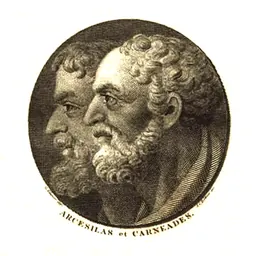
Life Autolycus was born in Pitane, a town of Aeolis within Ionia, Asia Minor. Of his personal life nothing is known, although he was a contemporary of Aristotle and his works seem to have been completed in Athens between 335–300 BC. Euclid references some of Autolycus' work, and Autolycus is known to have taught Arcesilaus.
The lunar crater Autolycus was named in his honour.
Work
Autolycus' two surviving works are about spherical geometry with application to astronomy: On the Moving Sphere and On Risings and Settings (of stars). In late antiquity, both were part of the "Little Astronomy", a collection of miscellaneous short works about geometry and astronomy which were commonly transmitted together. They were translated into Arabic in the 9th century, and with the addition of a few additional works became known as the "Middle Books" (sitting between Euclid's Elements and Ptolemy's Almagest). Both were preserved both in Greek and in Arabic, but were unknown in medieval Western Europe. They were translated from Arabic into Latin in the 12th century. Later, remaining Greek copies were also translated into Latin.
On the Moving Sphere
On the Moving Sphere concerns the movements of points and arcs on the sphere as it rotates on an axis. While the obvious application is the diurnal motion of the stars as the celestial sphere appears to rotate about an immobile Earth (as modeled at the time), Autolycus' treatise never explicitly discusses this application: its content consists entirely of elementary theorems about the arcs of great circles and parallel small circles on an abstract sphere. The work is simple and probably derivative of older works, but each theorem includes a clearly enunciated statement, a figure of the construction alongside its proof, and finally a concluding remark.
On the Moving Sphere is believed to be the oldest mathematical treatise from ancient Greece that is completely preserved: All prior Greek mathematical works are taken from later summaries, commentaries, or descriptions of the works. It shows that by Autolycus' day there was a thoroughly established textbook tradition in geometry that is today regarded as typical of classical Greek geometry. Moreover, it gives indications of what theorems were well known in his day (around 320 BC).
Two hundred years later Theodosius wrote the Spherics, a treatise establishing the fundamental definitions and constructions in spherical geometry whose content is believed to have a common origin with On the Moving Sphere in some pre-Euclidean textbook, possibly written by Eudoxus. In contrast to later astronomical analyses by Hipparchus (2nd century BC) and Ptolemy (2nd century AD), but similarly to the planar geometry of Euclid's Elements, both Autolycus's work and Theodosius' does not involve concrete quantification or trigonometry: spherical arcs are compared in size, but not given any numerical measure.
On Risings and Settings
In the two-book treatise On Risings and Settings , Autolycus studied the relationship between the rising and the setting of the stars throughout the year. The second book is an expansion of the first and of higher quality. He wrote that "any star which rises and sets always rises and sets at the same point in the horizon." Autolycus relied heavily on Eudoxus' astronomy and was a strong supporter of Eudoxus' theory of homocentric spheres.
Footnotes
Don’t just read it —
keep it.
Full-length biographies made to live with: read them, listen on the way to work, watch them tonight.
- E-book
- Audio
- Video
Instant download · yours to keep · every purchase keeps this site free
Important facts
People in Autolycus of Pitane's life
Named in this biography and alive at the same time


Related people
Same field, nearest in time


Contemporaries
People whose lives overlapped Autolycus of Pitane's
Frequently asked questions
Who was Autolycus of Pitane?
ancient Greek mathematician
When was Autolycus of Pitane born?
Autolycus of Pitane was born in 360 BC in Pitane.
When did Autolycus of Pitane die?
Autolycus of Pitane died in 290 BC.
What was Autolycus of Pitane's occupation?
Autolycus of Pitane was a mathematician and astronomer.
Sources & further reading
· Wikipedia: Autolycus of Pitane
· DBpedia: Autolycus of Pitane
Cite this page
APA: Biography.guide. (2026). Autolycus of Pitane. https://biography.guide/autolycus-of-pitane/
MLA: "Autolycus of Pitane." Biography.guide, https://biography.guide/autolycus-of-pitane/.
Chicago: "Autolycus of Pitane." Biography.guide. https://biography.guide/autolycus-of-pitane/.
Data last updated: 2026-09-20 · Spot an error? Report a correction.
Page generated 2026-09-27 05:07 UTC