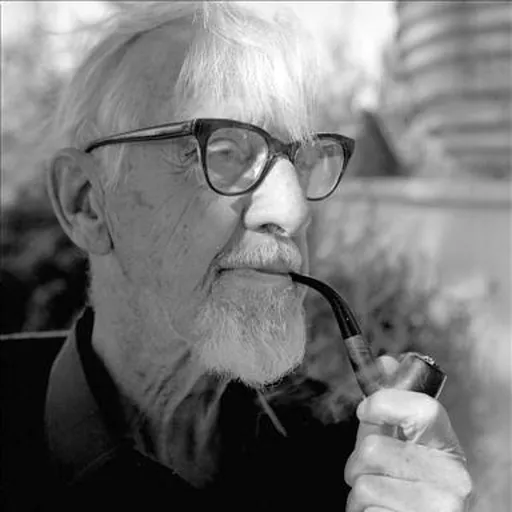
About Austen Harrison
Lived 1891 – 1976 (aged 84–85). Austen Harrison was a British architect.
Austen St. Barbe Harrison (1891–1976) was a British-born architect. While British, Harrison spent most of his career overseas, and mainly in the Middle East. His works include the British Representative's Residence, Amman, the High Commissioner's Residence, Jerusalem, the Rockefeller Museum, Jerusalem, 1935, and Nuffield College, Oxford.
Biography Early life and WWI Harrison was born in Kent in 1891. One of his ancestors was the renowned novelist Jane Austen after whom he was named.
His upper-middle-class family pushed him to pursue a career in the military. After attending Sandhurst, he was commissioned as a Lieutenant in the British Army and found himself in the trenches at the 1917 Battle of Passchendaele, near Ypres in Flanders, Belgium, during the Great War. The horror of what he saw convinced him that he wanted no part of either the military nor the war. When he informed his commanding officer that he intended to resign from the service and return to England, the officer told him that he could be court-martialled for refusing orders and desertion. Undeterred, Harrison replied, "So be it." Harrison's decision created a problem for the officer who apparently knew the young lieutenant's family and did not wish to suffer the indignity of having one of his junior officers court-martialled. Harrison, for his part, had no desire to create a scandal or crusade as a pacifist. He merely wanted no part of killing other human beings. The officer and Harrison eventually reached a compromise: Harrison could resign his commission and serve as stretcher bearer for the remainder of the campaign. Later in life, in recounting his experiences in that ghastly battle, he described how the greatest danger that the stretcher-bearers and medics faced was the ubiquitous mud. The battle was fought largely in swamp land during periods of unusually heavy rainfall. To step off the board walks—which were necessitated by the conditions—while carrying the dead and wounded from the front was to risk literally drowning in mud. At the end of his life, as time past and present merged in his mind, he relived the terror of that experience, confusing those around him with his stretcher-bearing comrades and warning them of the treacherous mud.
Studies After the war, he travelled to Canada where he studied architecture at McGill University, Montreal in Canada. He also pursued his favourite hobby: hiking. Later in life, while living in Jerusalem, he once walked from Amman, Jordan, to Cairo. Harrison completed his architectural studies at the School of Architecture at University College, London.
Greece Harrison joined the Department of Reconstruction for Eastern Macedonia after the First World War, where he was appointed Assistant Architect and Town Planner; his tasks included planning Nigrita and other settlements in Greece.
During his nearly 15 years in Jerusalem, he came to know many of the most famous residents and visitors to Palestine, including Albert Einstein. When Einstein visited Jerusalem in 1923, Harrison invited him to his home, presumably to discuss Einstein's plans for what would eventually become Hebrew University. Einstein repaid Harrison's hospitality by playing his violin for the architect. Harrison was also a great admirer of Arab culture—particularly, traditional Arabic architecture and design. He counted many Arabs among his friends and was outraged by the terms on which the British ended their mandate in Palestine.
England, Egypt, etc. After a donation to the University of Oxford from Lord Nuffield, Harrison next was appointed as architect for the newly established Nuffield College, Oxford, but the donor rejected his first plans for the college (which were heavily influenced by medieval Mediterranean buildings and traditional Arab design) and refused to allow his name to be associated with them, saying that they were "un-English". Harrison modified the design so that the college looked like "something on the lines of Cotswold domestic architecture", as Nuffield wanted. Nuffield College seems to have been the only building in Britain that he designed; his other work included the University College of the Gold Coast (today's University of Ghana), and a report (in 1945) on the planning of Valletta, Malta. He died at the Papadimos family home in 1976.
Archive Ioannis (Yani) Papadimos, the son of Dimitri Papadimos, one of the main contributors to this article, has written here in July 2010 that "The Papadimos family donated the Austen St. Barbe Harrison archive to the Rockefeller Museum." In a book by Adina Hoffman the author is mentioning the Austen St. Barbe Harrison archive at the Israel Antiquities Authority (IAA), whose seat is at the Rockefeller Museum. Ron Fuchs, a History of Architecture lecturer who wrote his PhD dissertation and further articles on Harrison, writes that Harrison's personal archive was, at least in parts, transferred from Dimitri Papadimos' estate to the IAA, but that the largest part of his personal material from the Palestine period had already been destroyed in Cairo in 1942, all papers of his Oxford-based firm finding the same fate when it closed down in 1968, and Harrison himself burned a great many of his personal papers before his death.
Works
British Representative's Residence, Amman, Jordan, 1926 Rockefeller Museum (Palestine Archaeological Museum), East Jerusalem, 1930-1938 Government House (High Commissioner's Residence & Headquarters, present United Nations Headquarters), Jerusalem, 1931 Government Mint building, Jerusalem, 1935. Established in 1937. (For current owner see here) Central Post House, Jerusalem, 1938 Central Post House, Jaffa Nuffield College, Oxford 1938-1960 Reconstruction plan for Valletta, Malta, 1943 University College of the Gold Coast, now University of Ghana, Legon, Accra, Ghana, 1958
Don’t just read it —
keep it.
Full-length biographies made to live with: read them, listen on the way to work, watch them tonight.
- E-book
- Audio
- Video
Instant download · yours to keep · every purchase keeps this site free
Important facts
People in Austen Harrison's life
Named in this biography and alive at the same time

Related people
Same field, nearest in time


Contemporaries
People whose lives overlapped Austen Harrison's




Frequently asked questions
Who was Austen Harrison?
British architect (1891-1976)
When was Austen Harrison born?
Austen Harrison was born in 1891 in Kent.
When did Austen Harrison die?
Austen Harrison died on 11 February 1976 in Athens.
What was Austen Harrison's occupation?
Austen Harrison was an architect.
What nationality was Austen Harrison?
Austen Harrison was British.
Sources & further reading
Cite this page
APA: Biography.guide. (2026). Austen Harrison. https://biography.guide/austen-harrison/
MLA: "Austen Harrison." Biography.guide, https://biography.guide/austen-harrison/.
Chicago: "Austen Harrison." Biography.guide. https://biography.guide/austen-harrison/.
Data last updated: 2026-09-20 · Spot an error? Report a correction.
Page generated 2026-09-27 05:10 UTC