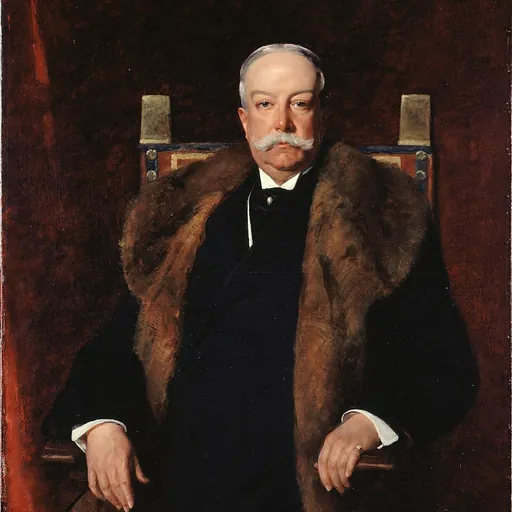
Augustus C. Gurnee
American socialite and art patron
About Augustus C. Gurnee
Lived 1855 – 1926 (aged 71). Augustus C. Gurnee was an American.
Augustus Coe Gurnee (March 11, 1855 – July 6, 1926) was an American socialite and art patron during the Gilded Age. Gurnee attended Harvard University and graduated with the class of 1878. Through his maternal uncle, Dr. Matthew Daniel Coe, he was a first cousin of Frantz Hunt Coe, the physician, public official and educator. Among his siblings was Delia E. Gurnee, Mary Evelyn Gurnee, Frances Medora Gurnee, Walter Scott Gurnee, Grace Gurnee, and Isabel Gurnee.
In 1863, the family moved to New York where his father engaged in banking and other businesses, serving as the treasurer and director of the Shelby Iron Company, the American Smelting and Refining Company, and the American Surety Company, among others. he briefly worked as a banker in New York. Gurnee was "free from the necessity of engaging in business" and, instead, spent his time "engrossed in the cultivation of the arts and spent much time in travel, living at intervals in Italy and France."
In 1892, Gurnee was included in Ward McAllister's "Four Hundred", purported to be an index of New York's best families, published in The New York Times. Conveniently, 400 was the number of people that could fit into Mrs. Astor's ballroom.
Personal life Gurnee had a home in Bar Harbor, Maine, Paris, and Nice, France. His home in Maine, known as Beaudesert, was originally designed by William Ralph Emerson in 1881, but was renovated for Gurnee in 1900 by architect Fred L. Savage, who also designed the nearby Breakwater, Reverie Cove, Raventhorp, and the Philler Cottage. In 1925, he donated his home in Nice, for the benefit of wounded soldiers, and a number of valuable works of art to the city of Paris, including twelve tapestries of Aubusson, Flanders, and Paris before the time of Gobelin. He was honored by France with the ribbon of the Chevalier of the Légion d’Honneur. and was interred at the Gurnee Mausoleum at Sleepy Hollow Cemetery. In his will, Gurnee left many large bequeaths to charity, including the Presbyterian Hospital, St. Luke's Hospital, the Nursery and Child's Hospital, and the Association for Improving the Condition of the Poor, many trust funds for his relatives, and then left his residuary estate to Harvard. His secretary, Gustave Frederick Dutschke, who lived at 17 Avenue d'Iéna in Paris, received $300,000 in three and a half per cent Liberty bonds and $20,000 a year from the residuary estate.
Don’t just read it —
keep it.
Full-length biographies made to live with: read them, listen on the way to work, watch them tonight.
- E-book
- Audio
- Video
Instant download · yours to keep · every purchase keeps this site free
Important facts
Family & relationships
People in Augustus C. Gurnee's life
Named in this biography and alive at the same time



Contemporaries
People whose lives overlapped Augustus C. Gurnee's



Frequently asked questions
Who was Augustus C. Gurnee?
American socialite and art patron
When was Augustus C. Gurnee born?
Augustus C. Gurnee was born on 11 March 1855 in Chicago.
When did Augustus C. Gurnee die?
Augustus C. Gurnee died on 6 July 1926 in Baden-Baden.
What nationality was Augustus C. Gurnee?
Augustus C. Gurnee was American.
Sources & further reading
· Wikipedia: Augustus C. Gurnee
Cite this page
APA: Biography.guide. (2026). Augustus C. Gurnee. https://biography.guide/augustus-c-gurnee/
MLA: "Augustus C. Gurnee." Biography.guide, https://biography.guide/augustus-c-gurnee/.
Chicago: "Augustus C. Gurnee." Biography.guide. https://biography.guide/augustus-c-gurnee/.
Data last updated: 2026-09-21 · Spot an error? Report a correction.
Portrait: Wikimedia Commons · author & licence
Page generated 2026-09-27 05:01 UTC