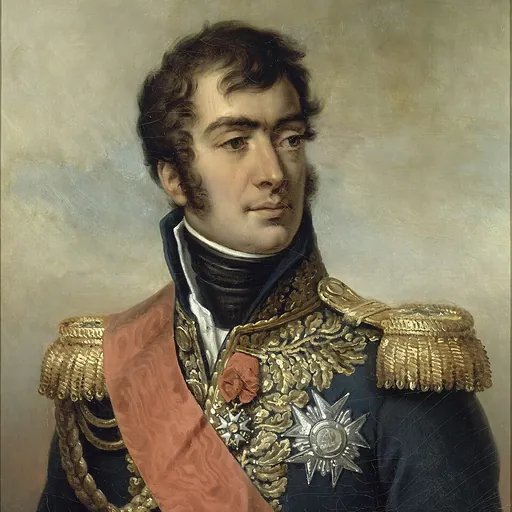
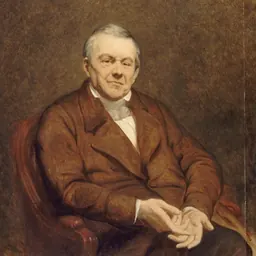
Auguste de Marmont
French General, nobleman and Marshal of France
About Auguste de Marmont
Lived 1774 – 1852 (aged 77). Auguste de Marmont was a French politician and military officer.
Auguste Frédéric Louis Viesse de Marmont, duc de Raguse ( , ; 20 July 1774 – 22 March 1852) was a French general and nobleman who rose to the rank of Marshal of the Empire and was awarded the title . In the Peninsular War, Marmont succeeded the disgraced André Masséna as commander of the French army in northern Spain but lost decisively at the Battle of Salamanca as France ultimately lost the war in Spain.
At the close of the War of the Sixth Coalition, Marmont went over to the Restoration and remained loyal to the Bourbons through the Hundred Days. This gave Marmont a reputation as a traitor among the remaining Bonapartists, and in French society more broadly. He led the royalist Paris garrison during the July Revolution in 1830, but his efforts proved incapable of quelling the revolution, leading King Charles X to accuse Marmont of betraying the Bourbons as he had betrayed the Bonapartes.
Marmont departed France with Charles's entourage and never returned to France. Spending his exile mostly in Vienna and other lands of the Austrian Empire, he died in Venice in 1852.
Early life and career
Marmont was born at Châtillon-sur-Seine, the son of an ex-officer in the army who belonged to the petite noblesse and adopted the principles of the Revolution. In his memoirs, Marmont claimed to have been taught how to read as a boy using the Compte rendu of Jacques Necker. His love of soldiering soon showed itself, and his father took him to Dijon to learn mathematics before entering the artillery. There, he made the acquaintance of Napoleon Bonaparte, which he renewed after obtaining his commission when he served in Toulon.
The acquaintance ripened into intimacy; Marmont became General Bonaparte's aide-de-camp, remained with him during his disgrace and accompanied him to Italy and Egypt, winning distinction and promotion to general of brigade. In 1799, he returned to Europe with his chief. He was present at the coup d'état of the 18th Brumaire and organized the artillery for the expedition to Italy, which he commanded with great effect at Marengo. For this, he was at once made general of division. In 1801, he became inspector-general of artillery, and in 1804, grand officer of the Legion of Honour. However, he was greatly disappointed at being omitted from the list of officers who were made marshals. Marmont arrived in time to fight in the Battle of Wagram on 5 and 6 July. In the subsequent pursuit of Archduke Charles, Marmont's corps was in a compromising position and was rescued only by the arrival of Napoleon with heavy reinforcements. Napoleon made him a Marshal of the Empire, though he said, "Between ourselves, you have not done enough to justify entirely my choice." Of the three marshals created after Wagram, the French soldiers said,
MacDonald is France's choiceOudinot is the army's choiceMarmont is friendship's choice.
Marmont was appointed governor-general of all the Illyrian provinces of the empire. This region included the Croatian port city state of Ragusa. In May 1811, Marmont was hastily summoned to succeed Masséna in the command of the French army in northern Spain. Despite the presence of the British army, his relief of Ciudad Rodrigo was a great feat. The manoeuvering which preceded the Battle of Salamanca was not successful, however, as Wellington ordered his cavalry to charge Marmont's unsuspecting left flank in the battle and inflicted a great defeat on the French. Marmont and his deputy commander Comte Jean-Pierre François Bonet were both struck by shrapnel very early in the battle. Marmont was gravely wounded in the right arm and side, and command of the battle passed to Bertrand Clauzel. He retired to France to recover.
Bourbon service
Marmont stayed loyal to the restored Bourbon king Louis XVIII during the Hundred Days, and following Waterloo, voted in favour of the execution of Marshal Ney.
He was made a Peer of France and a major-general of the Royal Guard, and in 1820, a knight of the Order of the Holy Spirit and a grand officer of the Order of Saint Louis. He was the major-general of the guard on duty in July 1830 during the July Revolution and was ordered to put down with a strong hand any opposition to the July Ordinances. Himself opposed to the court policy, he nevertheless tried to do his duty and only gave up the attempt to suppress the revolution when it became clear that his troops were outmatched. This brought more obloquy upon him, and Charles X even ordered him arrested, saying: Perhaps even more impressive is his study and evaluation of the Spanish theater of the war. He studied Wellington's nature of war, refusing to give battle against the British unless the ground was of Marmont's choosing. This led to a series of manoeuvres where Marmont frequently had the upper hand. Marmont understood the importance of cooperation in the Peninsula by supporting his fellow marshals. Tactically Marmont was deadly and quick to strike, but prone to sloppiness which caused him his two defeats.
Don’t just read it —
keep it.
Full-length biographies made to live with: read them, listen on the way to work, watch them tonight.
- E-book
- Audio
- Video
Instant download · yours to keep · every purchase keeps this site free
Important facts
People in Auguste de Marmont's life
Named in this biography and alive at the same time

Related people
Same field, nearest in time



Contemporaries
People whose lives overlapped Auguste de Marmont's




Frequently asked questions
Who was Auguste de Marmont?
French General, nobleman and Marshal of France (1774-1852)
When was Auguste de Marmont born?
Auguste de Marmont was born on 20 July 1774 in Châtillon-sur-Seine.
When did Auguste de Marmont die?
Auguste de Marmont died on 22 March 1852 in Venice.
What was Auguste de Marmont's occupation?
Auguste de Marmont was a politician and military officer.
What nationality was Auguste de Marmont?
Auguste de Marmont was French.
Sources & further reading
· Wikipedia: Auguste de Marmont
Cite this page
APA: Biography.guide. (2026). Auguste de Marmont. https://biography.guide/auguste-de-marmont/
MLA: "Auguste de Marmont." Biography.guide, https://biography.guide/auguste-de-marmont/.
Chicago: "Auguste de Marmont." Biography.guide. https://biography.guide/auguste-de-marmont/.
Data last updated: 2026-09-22 · Spot an error? Report a correction.
Portrait: Wikimedia Commons · author & licence
Page generated 2026-09-27 05:04 UTC