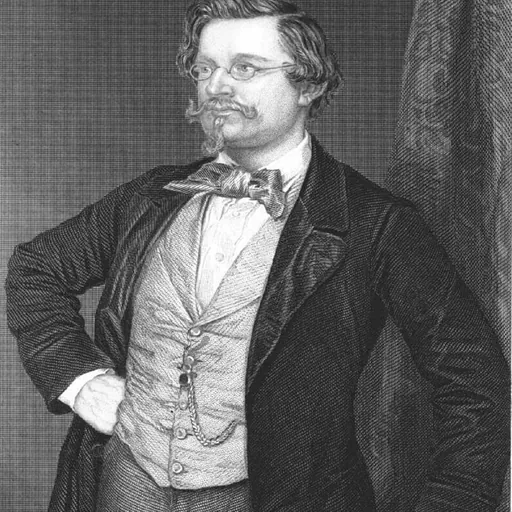
About August Wilhelm von Hofmann
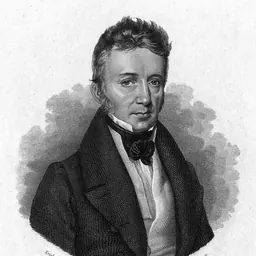
Lived 1818 – 1892 (aged 74). August Wilhelm von Hofmann was a German chemist and university teacher.
Berlin University In 1864 Hofmann was offered a chair of chemistry at the University of Bonn, and another at the University of Berlin. While taking his time to decide which offer to accept, Hofmann designed laboratory buildings for both universities, which were both subsequently built. In 1865 he succeeded Eilhard Mitscherlich at the University of Berlin as professor of chemistry and director of the chemical laboratory. He held the position until his death in 1892. Following his return to Germany Hofmann was the principal founder of the German Chemical Society (Deutsche Chemische Gesellschaft zu Berlin) (1867) and served 14 terms as its president. predating Kolbe's use of the term by some months. What Blyth and Hofmann called "synthesis" enabled them to make inferences about the constitution of styrole. A subsequent paper, Muspratt and Hofmann's "On Toluidine", described some of the first "synthetical experiments" (synthetische Versuche) in the field of organic chemistry.
While the ultimate goal of such experiments was to artificially produce naturally occurring substances, such a goal was not practically attainable at the time. The immediate purpose of the technique was the application of known reactions to a variety of materials to discover what products could be formed. Understanding a substance's method of formation was an important step in placing it within a developing taxonomy of substances. This technique became the basis of Hofmann's research program. He used organic synthesis as a method of investigation, to increase chemical understanding of reaction products and the processes by which they were formed.
Coal tar and anilines
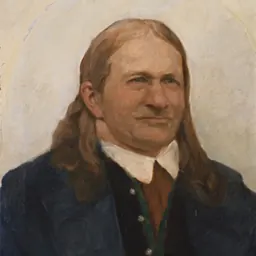
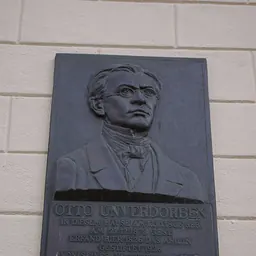
Hofmann's first research investigations, carried out in Liebig's laboratory at Giessen, was an examination of the organic bases of coal tar. Hofmann successfully isolated Kyanol and Leucol, bases previously reported by Friedlieb Ferdinand Runge, and showed that Kyanol was almost entirely aniline, previously shown to be a decomposition product of the plant dye indigo. In his first publication (1843) he demonstrated that a variety of substances which had been identified in contemporary chemical literature as obtainable from coal tar naphtha and its derivatives were all a single nitrogenous base, aniline. These included Kyanol, Carl Julius Fritzsche's Anilin, Otto Unverdorben's Krystallin, and Nikolai Zinin's Benzidam.
In 1856, Hofmann's student William Henry Perkin was attempting to synthesize quinine at the Royal College of Chemistry in London, when he discovered the first aniline dye, mauveine. The discovery led to the creation of a wide range of artificially created colourful textile dyes, revolutionising the fashion world. Hofmann's researches on rosaniline, which he first prepared in 1858, were the beginning of a series of investigations on colouring matter. In 1863, Hofmann showed that aniline blue is a triphenyl derivative of rosaniline and discovered that different alkyl groups could be introduced into the rosaniline molecule to produce dyes of various purple or violet colours, which became known as 'Hofmann's violets'. After his return to Germany, Hofmann continued to experiment with dyestuffs, finally creating quinoline red in 1887. Hofmann's original colour scheme (carbon = black, hydrogen = white, nitrogen = blue, oxygen = red, chlorine = green, and sulphur = yellow) has evolved into the CPK colour scheme and is in use even today. After 1874, when van't Hoff and Le Bel independently suggested organic molecules can be three-dimensional, molecular models began to assume their modern appearance.
Hofmann voltameter The Hofmann voltameter is an apparatus for electrolyzing water, invented by August Wilhelm von Hofmann in 1866. It consists of three joined upright cylinders, usually glass. The inner cylinder is open at the top to allow addition of water and an ionic compound to improve conductivity, such as a small amount of sulphuric acid. A platinum electrode is placed inside the bottom of each of the two side cylinders, connected to the positive and negative terminals of a source of electricity. When current is run through Hofmann's Voltameter, gaseous oxygen forms at the anode and gaseous hydrogen at the cathode. Each gas displaces water and collects at the top of the two outer tubes.
Publications
Hofmann was multilingual and published extensively, particularly about his work on coal tar and its derivatives. In 1865 Hofmann published An Introduction to Modern Chemistry, summarising type theory and emerging ideas about chemical structure. Type theory modelled four inorganic molecules, hydrogen, hydrogen chloride, water, and ammonia, and used them as a basis for systematising and categorising both organic and inorganic compounds by exploring the substitution of one or more atoms of hydrogen for an equivalent atom or group. Hofmann himself had focused on researching ammonia, but discussed all four models in his book. In it, he also first introduced the term valence, under its longer variant quantivalence, to describe the combining capacity of an atom. His textbook strongly influenced introductory textbooks in both Europe and the United States.
In addition to his scientific works, Hofmann wrote biographical notices and essays on the history of chemistry, including a study of Liebig. On his 70th birthday, in 1888, he was ennobled, enabling him to add the prefix "von" before his last name.
Later life
Hofmann died in 1892 and was buried in Berlin's Dorotheenstadt Cemetery.
Don’t just read it —
keep it.
Full-length biographies made to live with: read them, listen on the way to work, watch them tonight.
- E-book
- Audio
- Video
Instant download · yours to keep · every purchase keeps this site free
Important facts
People in August Wilhelm von Hofmann's life
Named in this biography and alive at the same time
Related people
Same field, nearest in time


Contemporaries
People whose lives overlapped August Wilhelm von Hofmann's




Frequently asked questions
Who was August Wilhelm von Hofmann?
German chemist (1818–1892)
When was August Wilhelm von Hofmann born?
August Wilhelm von Hofmann was born on 8 April 1818 in Giessen.
When did August Wilhelm von Hofmann die?
August Wilhelm von Hofmann died on 5 May 1892 in Berlin.
What was August Wilhelm von Hofmann's occupation?
August Wilhelm von Hofmann was a chemist and university teacher.
What nationality was August Wilhelm von Hofmann?
August Wilhelm von Hofmann was German.
Sources & further reading
· Wikipedia: August Wilhelm von Hofmann
· DBpedia: August Wilhelm von Hofmann
Cite this page
APA: Biography.guide. (2026). August Wilhelm von Hofmann. https://biography.guide/august-wilhelm-von-hofmann/
MLA: "August Wilhelm von Hofmann." Biography.guide, https://biography.guide/august-wilhelm-von-hofmann/.
Chicago: "August Wilhelm von Hofmann." Biography.guide. https://biography.guide/august-wilhelm-von-hofmann/.
Data last updated: 2026-09-22 · Spot an error? Report a correction.
Portrait: Wikimedia Commons · author & licence
Page generated 2026-09-27 05:01 UTC