
About August Manns
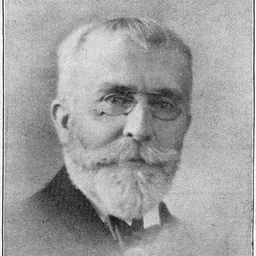
Lived 1825 – 1907 (aged 81). August Manns was a British conductor, chapelmaster, violinist and composer.
Sir August Friedrich Manns (12 March 1825 – 1 March 1907) was a German-born British conductor who made his career in England. After serving as a military bandmaster in Germany, he moved to England and soon became director of music at London's Crystal Palace. He increased the resident band to full symphonic strength and for more than forty years conducted concerts at popular prices. He introduced a wide range of music to London, including many works by young British composers, as well as works by German masters hitherto neglected in England. Among his British protégés were Arthur Sullivan, Charles Villiers Stanford, Hubert Parry, Hamish MacCunn, Edward Elgar and Edward German.
Manns performed the works of more than 300 composers, and was reckoned to have given more than 12,000 concerts during his tenure at the Crystal Palace, between 1855 and 1901. He became a British citizen in 1894 and was knighted in 1903.
Life and career Early years Manns was born at Stolzenburg in Prussia near Stettin (now Stolec in Poland). His father was a glass-blower, with, as Manns recalled, "a pound a week and ten children," of whom August was the fifth. At the age of ten, August temporarily took the place of one of his brothers at the factory, but he had no liking for the work of glass-blowing. His father briefly considered that August might be trained for a career as a schoolmaster, but the youth's predisposition for music prevailed. At the age of twelve he was sent to a school, kept by his uncle, at a neighbouring village. Here he was trained to play the flute, clarinet and violin. At fifteen he was apprenticed for three years to Urban, the town musician of Elbing, with whom Manns learnt to make the best of limited orchestral forces, transposing and switching instrumental parts as necessary. In his third year Manns played first violin in the string-band and first clarinet in the wind-band of Urban's Town-band; and he was selected by Urban to receive special lessons in harmony and composition.
In the same year , who had recently established a military band at the Crystal Palace in the suburbs of London, engaged Manns as clarinettist and sub-conductor. Within months there was a rift between the two men when Schallehn passed off a composition of Manns's as his own; when Manns protested, Schallehn dismissed him. Manns then earned a living teaching the violin in the English provinces, and playing in the opera orchestra in Edinburgh. The Musical World wrote,
Four British composers championed by Manns: top, Sullivan and Stanford; bottom, Elgar and GermanThe rest of Manns's career was almost exclusively associated with the Crystal Palace. When he took over, the permanent band was a wind ensemble, from which, with four specially engaged string players, Manns improvised an orchestra of about thirty-four performers. With the backing of Grove and the directors of the Crystal Palace he gradually expanded the band into a full orchestra, for which a new concert room was added to the Crystal Palace. Together, Grove and Manns made the Crystal Palace concerts the principal source of classical music at popular prices. The concert season ran from October to April, with concerts given on Saturday afternoons from 1855 to 1901. Thirty years after Manns introduced the Tempest music, Sullivan wrote to him, "How much do I not owe to you, my dear old friend, for the helping hand you gave me to mount the first step on the ladder! I shall always think of you with gratitude and affection."
Some fragments of a live performance of Handel's Israel in Egypt conducted by Manns at Crystal Palace in 1888 are among the earliest surviving recordings of classical music.
Other conductorships
Manns retained the position of director of music until his retirement in 1901, undertaking few outside engagements. At the Crystal Palace he also conducted the triennial Handel Festivals, from 1883. He took on the 1883 festival at a few hours' notice, when the established conductor, Sir Michael Costa was unwell. He was at first regarded as less successful as a choral conductor than in the orchestral repertory; his beat was eccentric and puzzling to the uninitiated.
Personal life Manns was married three times: his first wife died in 1850 or 1851; his second, Sarah Ann née Williams, with whom he had a daughter, died in 1893; his third wife, (Katharine Emily) Wilhelmina née Thellusson (b. 1865/6), whom he married on 7 January 1897, survived him.
Manns became a naturalised British citizen in May 1894. He was knighted in 1903 and died in Norwood, London, just short of his 82nd birthday. He was buried at West Norwood Cemetery.
Don’t just read it —
keep it.
Full-length biographies made to live with: read them, listen on the way to work, watch them tonight.
- E-book
- Audio
- Video
Instant download · yours to keep · every purchase keeps this site free
Important facts
People in August Manns's life
Named in this biography and alive at the same time


Related people
Same field, nearest in time


Contemporaries
People whose lives overlapped August Manns's




Frequently asked questions
Who was August Manns?
German conductor in Crystal Palace (1825-1907)
When was August Manns born?
August Manns was born on 12 March 1825 in Stolec, West Pomeranian Voivodeship.
When did August Manns die?
August Manns died on 1 March 1907 in West Norwood.
What was August Manns's occupation?
August Manns was a conductor, chapelmaster, violinist and composer.
What nationality was August Manns?
August Manns was British.
Sources & further reading
Cite this page
APA: Biography.guide. (2026). August Manns. https://biography.guide/august-manns/
MLA: "August Manns." Biography.guide, https://biography.guide/august-manns/.
Chicago: "August Manns." Biography.guide. https://biography.guide/august-manns/.
Data last updated: 2026-09-22 · Spot an error? Report a correction.
Page generated 2026-09-27 05:33 UTC