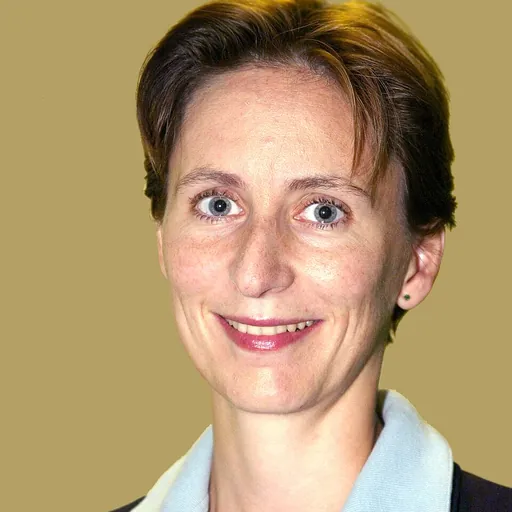
About Aude Billard
Born 1971. Aude Billard is a Swiss physicist, computer scientist, university teacher and engineer.
Aude G. Billard (born c. August 6, 1971) is a Swiss physicist in the fields of machine learning and human-robot interactions. As a full professor at the School of Engineering at Swiss Federal Institute of Technology in Lausanne (EPFL), Billard’s research focuses on applying machine learning to support robot learning through human guidance. Billard’s work on human-robot interactions has been recognized numerous times by the Institute of Electrical and Electronics Engineers (IEEE) and she currently holds a leadership position on the executive committee of the IEEE Robotics and Automation Society (RAS) as the vice president of publication activities.
Early life and education Billard was born in Lausanne, Switzerland, on August 6, 1971.
After completing her degrees at EPFL, Billard pursued further education at the University of Edinburgh in the Department of Artificial Intelligence. She developed a system that was capable of learning simple syntactical language and she used two mobile and autonomous robots, acting as teacher and student, to implement the architecture. Billard tested her novel learning architecture and found that learning through imitation can be achieved with simple computations and a photodetection system between the teacher and the learner to impart information about movement. To develop DRAMA, Billard used an anti-objectivist framework, distinguishing between cognitive and behavioral skills. All of their research works towards developing robotic systems that are able to adapt to fast changes, interact with humans and other robots in a humanistic way, and learn from teachers as well as from previous experiences. a Fellow of the computer science department at the University of Hertfordshire, a senior editor of the IEEE Transactions in Robotics, a member of the advisory board of Ecole des Mines & Telecommunication in Paris, and the associate editor of the International Journal of Social Robotics. The model was able to learn the principal features of an arm trajectory in a throwing/catching imitation task, was able to generalize across different demonstrations, was able to learn on-line, and its movements were robust to perturbations. She based her artificial neural networks on brain regions such as the visual and motor cortices and incorporated a decision making occurs region as well. This allowed Billard’s model to imitate a teacher just as well as a human subject would imitate in the same task. Further, Billard and her colleagues began to implement neurobiological concepts such as homeostatic plasticity, Hebbian reinforcement learning, and hormone feedback into their neural networks to again provide adaptability and flexibility like that exists in the human brain.
In 2006, Billard began adding social cues to interactions between humanoid robots to improve the ability of humanoids to switch between learning and reproduction phases in an imitation framework. She found that implementing a gesture recognition system and using motion sensors, as well as a Hidden Markov Model to extract the essential components of the social cues, produced more life-like behaviors in a social learning task. From 2008 on, Billard highlighted the power of dynamical systems in controlling fine robot movements and generalizing those movements within different contexts. Billard and her team used golf putting as a task to explore the ability of the robot to learn complex motions and adapt to changes in position, speed, and target location. Shortly after Billard published these astonishing results of the motor learning capabilities of robots, she showed that she could also teach robots to catch objects in flight. The video of their robot catching objects in flight has been viewed millions of times on YouTube and their publication in IEEE was the most frequently downloaded document in the journal. With 90% accuracy, they were able to decode three typical grasps, which provides a novel and effective approach to coordinating a subjects arm movements with a robotic hand to generate a natural pattern of motion. In this work, Billard and her students proposed a virtual object based dynamical systems control law that could generate autonomous and synchronized movements for a multi-arm robotic system. They were able to validate their approach using a dual-arm robotic system and they found that it was able to adapt and coordinate the motion of each arm to catch flying objects at high speeds and with uncertainty in trajectory.
Billard and her team have also implemented hierarchical knowledge systems to allow robots to learn both high-level complex task plans as well as lower level movements after demonstrations. Their work in 2016 showed that by combining a variant of a Hidden Markov Model with an algorithm that outputs transition probabilities, they were able to learn both low-level motor patterns during specific behaviors as well as the probability of a transition to the next behavior in the sequence. They combined linear parameter varying systems, to enable the learning of task sequences, with hidden Markov Models, to learn complex control policies of each subgoal/subtask, and were able to validate their approach using two different human demonstrations. By updating the parameters of their dynamical system to account for desired trajectory versus trajectory of the human interference, they were able to test their approach in real world experiments where robots successfully learned how to adjust their movements in relation to human interactions.
Awards and honors
(2017) European Research Council Advanced Grant for Skill Acquisition in Humans and Robots (2016) Nominated as Member of SATW, Swiss Academy of Engineering Sciences (2015) King-Sun Fu Best Transactions Paper Award, IEEE & Robotics and Automation Society
Personal life Billard is the mother of three girls.
Don’t just read it —
keep it.
Full-length biographies made to live with: read them, listen on the way to work, watch them tonight.
- E-book
- Audio
- Video
Instant download · yours to keep · every purchase keeps this site free
Important facts
People in Aude Billard's life
Named in this biography and alive at the same time


Related people
Same field, nearest in time



Contemporaries
People whose lives overlapped Aude Billard's



Frequently asked questions
Who is Aude Billard?
Swiss physicist
When was Aude Billard born?
Aude Billard was born in 1971 in Lausanne.
What is Aude Billard's occupation?
Aude Billard is a physicist, computer scientist, university teacher and engineer.
What nationality is Aude Billard?
Aude Billard is Swiss.
Sources & further reading
Cite this page
APA: Biography.guide. (2026). Aude Billard. https://biography.guide/aude-billard/
MLA: "Aude Billard." Biography.guide, https://biography.guide/aude-billard/.
Chicago: "Aude Billard." Biography.guide. https://biography.guide/aude-billard/.
Data last updated: 2026-09-20 · Spot an error? Report a correction.
Portrait: Wikimedia Commons · author & licence
Page generated 2026-09-27 04:58 UTC