
Athos Damasceno Ferreira
Brazilian writer, poet and literary critic
About Athos Damasceno Ferreira
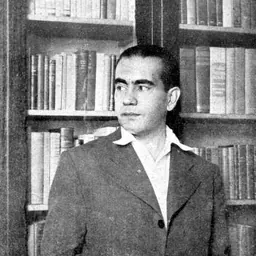
Lived 1902 – 1975 (aged 72). Athos Damasceno Ferreira was a Brazilian writer, poet, literary critic, novelist, journalist and historian.
Athos Damasceno Ferreira (Porto Alegre, September 3, 1902 – Porto Alegre, April 14, 1975) was a Brazilian poet, novelist, chronicler, translator, journalist, literary critic, and historian. He is considered the most important historian and chronicler of the city of Porto Alegre, is the founder of art historiography in the state of Rio Grande do Sul, and left a major contribution to the state historiography in the fields of culture and society, being a pioneer in the study of several themes. He was an advocate of the revaluation of regionalisms and a renowned poet and novelist, although being little remembered in this area.
Career He was the son of João Armando Damasceno Ferreira and Ana Dias da Silva. He did his early studies in religious schools, then studied languages with Ildefonso Gomes and humanities with Henrique Emílio Meyer. Damasceno began law school in Rio de Janeiro, but did not finish it, Cover of the book Poems of My City ("Poemas da Minha Cidade") (1936). He spent his life in Porto Alegre, city in which he would be the most prolific historian and chronicler. Guilhermino César stated that he produced "the greatest writing of a single man about the capital of Rio Grande do Sul."
However, his work was not limited to the state capital, being the pioneer in writing the general history of arts in Rio Grande do Sul with his classic Artes Plásticas no Rio Grande do Sul (1971), which goes to the primitive sources of art in the state and traces a wide panorama of its development until the 20th century, to this day a fundamental reference and, in its wide scope, not yet outdated, a work that was complemented by many separate articles. ) and Sacadas e Sacadinhas Porto-Alegrenses (1945), he interweaves his view of historian with his poetic side and his experience as a citizen, describing the changes in the urban scenario by the passage of time and the concomitant changes in the social meanings of the spaces and the lives of their occupants, focusing on the study of the "identity of the citizens of Porto Alegre, weakened by the advent of transformations in urban space in vogue from the 1940s," as Charles Monteiro stated, and at the same time denouncing, dismaying, the accelerated "erasing of the marks of the city of yesteryear," such as the old buildings, since he understood them as necessary elements for the preservation of a sense of identity for the locals. In his writing, as Gabriela Silva observed, Damasceno makes recurrent use of the first person and of interpellations to the reader, interweaving personal and collective memories and experiences to the critical analysis of history, a strategy "to refer the reader to a continuity between past and present, which leads to the strengthening of the identity that one wants to conform". This did not hinder his lucidity regarding aspects of the past that had changed, citing for example the poor sanitation conditions and precarious public transport of nineteenth-century Porto Alegre, distinguishing them from the aspects he deemed essential for the preservation of the essence of local identity.
Joana Figueiredo believes that "by historicizing the region and his city, in a sentimental and engaged way, Athos Damasceno inserts himself as an author committed to the past, its present and a future of the letters and arts of Rio Grande do Sul. His writing is at the same time memory and history, testimony and document". For Figueiredo, his role in the historiography of Rio Grande do Sul art compares to that of Vasari for the Italian arts of the Renaissance. He was an articulator of concepts related to regionalism. An excerpt from one of the articles, that fueled the polemic with Vargas Netto, is illustrative of his position:
Literature
Early on, his poetic work was influenced by the Symbolism of poets such as Mallarmé, Rodenbach, and Verlaine and musicians such as Debussy, leaving two remarkable collections of pieces in this style. The first, Poemas do Sonho e da Desesperança (1925), is dedicated to his wife, Clara, and centers on the theme of mystical and spiritual love, tinged with melancholy, a sense of longing, and a desire to escape from reality, which was offset by hope and pity. The second, Poemas de Minha Cidade (1936), is one of the culminating points of Symbolism in Gaúcho (Rio Grande do Sul) lands, creating the same misty, crepuscular, and subjective atmospheres as the other work, but also adding touches of irony and humor, and revealing, as Cristiano Fretta states, "an artist aware of the universality of literature but extremely attached to the (provincial) environment in which he found himself", "which means that the artists of the time were clearly aware of what the city was then". In the meantime, he had experimented with Modernism in the collection Lua de Vidro (1930), which likewise remains one of the main Rio Grande do Sul contributions to this school. Nevertheless, for Cristiano Fretta his production is representative of the interests of the group, especially by the approach he takes to Porto Alegre and the adoption in his literary work of aesthetic principles common to all. He was like the others, as Regina Zilberman believes, engaged in the process of renewal of local literature through the incorporation of novelties introduced by the modern avant-garde, but preserving ties with the past and previous literature.
An excerpt from the poem Praça da Harmonia, about the old square which was a meeting place for local poets and was dismantled to make room for the Mauá Pier, serves as an illustration of the first stage:
In the field of prose literature, the novels Moleque: novelinha de arrabalde (1938) and Menininha (1941) are highlights, as well as the short story book Persianas Verdes: contos e manchas (1967), which set prosaic characters in the humble settings of the streets and houses of the periphery, in the bars and popular parties, leading often miserable, sad and meaningless lives, lost in unsatisfied dreams of freedom and justice and excluded from the bright hustle and bustle and big events of urban centers, a theme that knew great vogue at the time. The author acknowledged his special debt to Eça de Queiroz: "None of us has escaped the influence of Eça de Queiroz. There is no use in wrinkling our noses, pretending to hide what is so clear. A writer much more Brazilian than Portuguese, he was to us a kind of older brother, to be admired and imitated. In our literature there was much of his monocle." Erico Veríssimo held his artistic work in high regard, praising his "sharp, right-handed prose, [that] knows how to tell a story and make a poem. A skillful verbal juggler, he can give novel interest to the most insipid and heavy subjects." He was also a renowned literary critic. In the words of Celso Luft, his production in this field is precious, being a cultured author, of great analytical and interpretative capacity who, handling a clean and fluent prose, left books at the same time instructive and pleasant to read. which gave him national renown while he lived and made Carlos Reverbel define him as a poet of great skill is now forgotten. According to Luís Augusto Fischer, he was "one of the great writers from South Rio Grande do Sul overshadowed by the remarkable literary quality of Erico Verissimo."
His complete work and 28 folders of research material and correspondence are deposited at the Historical and Geographical Institute of Rio Grande do Sul. In 1975 he was chosen as the patron of the Porto Alegre Book Fair, a city that honored him by naming a square after him.
Don’t just read it —
keep it.
Full-length biographies made to live with: read them, listen on the way to work, watch them tonight.
- E-book
- Audio
- Video
Instant download · yours to keep · every purchase keeps this site free
Important facts
People in Athos Damasceno Ferreira's life
Named in this biography and alive at the same time


Related people
Same field, nearest in time




Contemporaries
People whose lives overlapped Athos Damasceno Ferreira's



Frequently asked questions
Who was Athos Damasceno Ferreira?
Brazilian writer, poet and literary critic (1902-1975)
When was Athos Damasceno Ferreira born?
Athos Damasceno Ferreira was born on 3 September 1902 in Porto Alegre.
When did Athos Damasceno Ferreira die?
Athos Damasceno Ferreira died on 14 April 1975 in Porto Alegre.
What was Athos Damasceno Ferreira's occupation?
Athos Damasceno Ferreira was a writer, poet, literary critic, novelist, journalist and historian.
What nationality was Athos Damasceno Ferreira?
Athos Damasceno Ferreira was Brazilian.
Sources & further reading
· Wikipedia: Athos Damasceno Ferreira
· DBpedia: Athos Damasceno Ferreira
Cite this page
APA: Biography.guide. (2026). Athos Damasceno Ferreira. https://biography.guide/athos-damasceno-ferreira/
MLA: "Athos Damasceno Ferreira." Biography.guide, https://biography.guide/athos-damasceno-ferreira/.
Chicago: "Athos Damasceno Ferreira." Biography.guide. https://biography.guide/athos-damasceno-ferreira/.
Data last updated: 2026-09-20 · Spot an error? Report a correction.
Page generated 2026-09-27 05:25 UTC