About Ashur-nadin-apli
Lived 1300 BC – 1200 BC. Ashur-nadin-apli was a sovereign.
Aššūr-nādin-apli, inscribed maš-šur-SUM-DUMU.UŠ, was a king of Assyria, reigning in 1206 BC–1203 BC or 1196 BC–1193 BC (short chronology). The alternate dating is due to uncertainty over the length of reign of a later monarch, Ninurta-apal-Ekur, where conflicting king lists differ by ten years. His name meant "Aššur is the giver of an heir" in the Akkadian language. He was a son of Tukulti-Ninurta I.
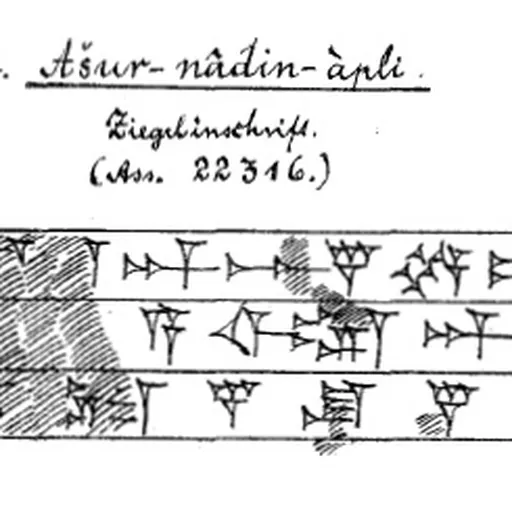
Biography Schroeder's line art for Aššūr-nādin-apli's brick inscription.
The events surrounding the overthrow of Tukulti-Ninurta remain somewhat shrouded in mystery. His military conquests seem to have taken place during the first half of his reign with modern scholarship suggesting that his climactic victory against Kaštiliašu IV and the city of Babylon occurred during two campaigns during his thirteenth and fifteenth years, if the placing of the eponyms, the Assyrian dating system, of Etel-pi-Aššur and Aššur-bel-ilani are correct. The latter part of his reign was characterized by reversal as the over-extended Assyrian military struggled to hold on to the earlier prizes and this may well have been the reason for his toppling.
Copies of the Assyrian King List record that "Aššūr-nādin or nāṣir-apli, his son, seized the throne (for himself and) ruled for three or four years." Brinkman relates that "it is uncertain whether one or two princes lie behind the conflicting scribal traditions," but Grayson is more emphatic, "there seem to have been at least two sons." Yamada, however, argues that it was scribal confusion with the later succession of Tukulti-Ninurta II by Aššūr-nāṣir-apli II. The names differ by just one cuneiform character, PAB for nāṣir and SUM for nādin. The Babylonian Chronicle P recalls "Aššur-nāṣir-apli, his son (mar-šu) and the officers of Assyria rebelled, removed him from his throne, shut him up in a room and killed him."
It was Aššūr-nādin-apli who succeeded to the throne, as testified by the scanty inscriptions left behind, which include bricks
He was succeeded by Aššur-nerari III, who was either his son or his nephew, again depending on the existence of Aššūr-naṣir-apli.
Inscriptions
Don’t just read it —
keep it.
Full-length biographies made to live with: read them, listen on the way to work, watch them tonight.
- E-book
- Audio
- Video
Instant download · yours to keep · every purchase keeps this site free
Important facts
Family & relationships
Related people
Same field, nearest in time



Contemporaries
People whose lives overlapped Ashur-nadin-apli's


Frequently asked questions
Who was Ashur-nadin-apli?
Assyrian king
When was Ashur-nadin-apli born?
Ashur-nadin-apli was born in 1300 BC.
When did Ashur-nadin-apli die?
Ashur-nadin-apli died in 1200 BC.
What was Ashur-nadin-apli's occupation?
Ashur-nadin-apli was a sovereign.
What nationality was Ashur-nadin-apli?
Ashur-nadin-apli's recorded nationality: Assyrian Empire.
Sources & further reading
Cite this page
APA: Biography.guide. (2026). Ashur-nadin-apli. https://biography.guide/ashur-nadin-apli/
MLA: "Ashur-nadin-apli." Biography.guide, https://biography.guide/ashur-nadin-apli/.
Chicago: "Ashur-nadin-apli." Biography.guide. https://biography.guide/ashur-nadin-apli/.
Data last updated: 2026-09-24 · Spot an error? Report a correction.
Portrait: Wikimedia Commons · author & licence
Page generated 2026-09-27 05:08 UTC