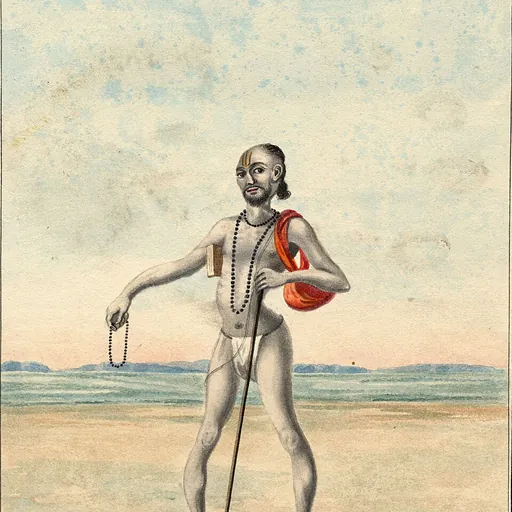
About Ashtavakra
Ashtavakra was an author.
Ashtavakra (, ) is a revered Vedic sage in Hinduism. His maternal grandfather was the Vedic sage Aruni, his parents were both Vedic students at Aruni's school. Ashtavakra studied, became a sage and a celebrated character of the Hindu Itihasa epics and Puranas.
History Little is known about the life or century in which Ashtavakra actually lived, except for the accounts found in the major Indian Chronicle (the Ramayana and the Mahabharata) and the Puranas. The legends state that sage Aruni, mentioned in the Chāndogya Upaniṣad, ran an ashram teaching the Vedas. Kahoḍa was one of his students, along with Aruni's daughter Sujata. Aruni's daughter married Kahoḍa. She got pregnant, and during her pregnancy, the developing baby heard the chanting of the Vedas and learnt the correct recitation. According to one version of the legends surrounding Ashtavakra, his father was once reciting the Vedas, but erred in correct intonation. The fetus spoke from the womb and told his father about the limited knowledge he was aware of from the Vedic books, there is much more to know apart from these books. The father got angry and cursed him to be born with eight deformities, hence the name 'Ashtavakra'.
His father, Kahoda, once went to ask for riches, to Janaka, the ancient king of Videha, for his family was poor. He was, there, defeated in debates of science by Vandin, and in consequence was drowned in water. Hearing of the drowning of her husband, Sujata kept it secret from her child. When Ashtavakra grew up, he learned everything about his curse and his father. Then he asked his mother to come with him to witness the great sacrifice of king Janaka. He was stopped from entering the king's sacrifice as only learned Brahamanas and Kings were allowed to enter, and he was just in his tenth year. With the proficiency of speaking, he had the king amazed with the knowledge he possessed; so, he was allowed to enter. There, he challenged the Vandin for controversy. After a heated debate, he defeated Vandin in knowledge by words. And asked the king, as Vandin used to cast Brahmanas into the water, let him meet with the same fate. Vandin then revealed that he is the son of Varun, and explained that the reason he drowned those Brahmins was a ritual that his father is performing for twelve years and needed a large number of Brahmins. By then, the ritual was done and thus all the Brahmins he drowned, including Ashtavakra's father Kahoda, were freed. Kahoda was very impressed with his son, Ashtavakra, and while going back home, asked him to take a dip in the river Samanga. As Ashtavakra came out of the river, it was seen all of his deformities had been cured.
Attributed texts
Ashtavakra is credited as the author of the Ashtavakra Gita , which means "song of Ashtavakra". The text is also known as Ashtavakra Saṃhitā. The Ashtavakra Gita examines the metaphysical nature of existence and the meaning of individual freedom, presenting its thesis that there is only one Supreme Reality (Brahman), the entirety of universe is oneness and manifestation of this reality, everything is interconnected, all Self (Atman, soul) are part of that one, and that individual freedom is not the end point but a given, a starting point, innate.
According to American scholar Jessica Wilson, the Sanskrit poetics in Ashtavakra Gita is not driven by critical syllogism, but is rich in philosophical premises, spiritual effectiveness and its resonant narrative because of "textual indeterminacy between the audience's disposition and the foregrounded theme of non-individuation in the text. This tension... results in consistency building by the audience, which enables the transcendence of these two viewpoints (reader and text)".
According to Radhakamal Mukerjee, the Ashtavakra Gita was likely composed after the Bhagavad Gita but before the start of the common era, and attributed to sage Ashtavakra out of reverence for his ideas.
Literature
Ramayana Ashtavakra is referenced in verse 6.119.17 of Yuddha Kāṇḍa in Vālmikī's Rāmāyaṇa. When Daśaratha comes to see Rāma from heaven after the war of the Rāmāyaṇa, he tells Rāma –
In the Aranya Kanda of Adhyatma Ramayana, the demon Kabandha narrates his story to Rama and Lakshmana, in which he says that he was a Gandharva earlier who was cursed by Ashtavakra to become a demon when he laughed on seeing him (Ashtavakra). When the Gandharva then bowed down to Ashtavakra, Ashtavakra said that he would be released from the curse by Rama in Treta Yuga. Ashtavakra's wisdom on various aspects of human existence is recited in the Mahābhārata. For example: quote|text= A grey head does not make an elder, Not by years, not by grey hairs, not by riches nor by relations did the seers make the Law, He who is great to us, is one who has learning. — Ashtavakra|source=Vana Parva, Mahabharata Book iii
In arts Ashtavakra is one of the characters in the First Act of the Sanskrit play Uttara-Rāmacaritam composed by Bhavabhuti in the 8th century. The 571st volume of the Amar Chitra Katha, first published in 1976, is titled Dhruva and Ashtavakra. The second half of the volume presents the narrative of Ashtavakra. A puppet play on Ashtavakra was staged by the Dhaatu Artist group in Ranga Shankara in Bangalore in 2010. Ashtavakra Gita became very popular after Indian Spiritual leader Sri Sri Ravi Shankar gave a commentary in Bangalore in 1991.
Don’t just read it —
keep it.
Full-length biographies made to live with: read them, listen on the way to work, watch them tonight.
- E-book
- Audio
- Video
Instant download · yours to keep · every purchase keeps this site free
Important facts
Related people
Same field, nearest in time



Frequently asked questions
Who was Ashtavakra?
Vedic sage
When was Ashtavakra born?
Ashtavakra was born in Janakpur, Nepal, Videha.
What was Ashtavakra's occupation?
Ashtavakra was an author.
Sources & further reading
Cite this page
APA: Biography.guide. (2026). Ashtavakra. https://biography.guide/ashtavakra/
MLA: "Ashtavakra." Biography.guide, https://biography.guide/ashtavakra/.
Chicago: "Ashtavakra." Biography.guide. https://biography.guide/ashtavakra/.
Data last updated: 2026-09-22 · Spot an error? Report a correction.
Portrait: Wikimedia Commons · author & licence
Page generated 2026-09-27 05:03 UTC