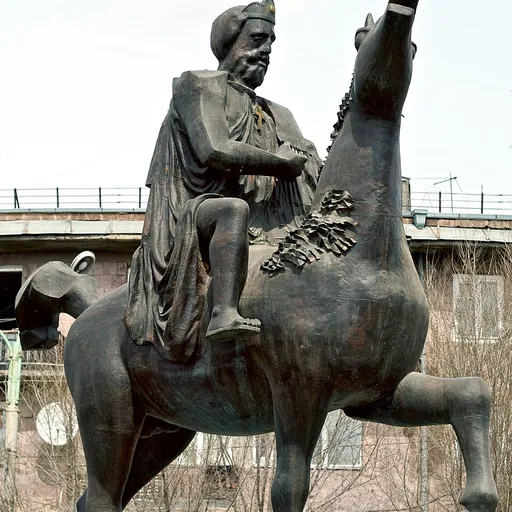
About Ashot III of Armenia
Ashot III of Armenia was a statesperson and sovereign.
Ashot III was a king of Armenia, ruling the medieval kingdom of Bagratid Armenia from 952/53–77. Known as Ashot III the Merciful (Աշոտ Գ Ողորմած) and acknowledged by foreign rulers as the Shahanshah (king of kings) of Mets Hayk (Greater Armenia), he moved his royal seat of residence to Ani and oversaw its development and of the kingdom as a whole. Armenia reached the height of its golden era during his reign and that of his sons and successors, Smbat II (977–89) and Gagik I (990–1020).
Biography King Abas (929–953) was succeeded by his son, Ashot III the Merciful (953–978), who enjoyed great authority both in Armenia and in neighboring countries. Ashot was the eldest among King Abas's sons. He had two brothers, Atrnerseh and Mushegh; the latter later ruled in Kars. During the reign of Ashot the Merciful, Armenia experienced an economic and cultural resurgence, and a relatively peaceful situation prevailed in the country. Under his rule, old cities expanded, and new ones were built. In 966, his wife, Queen Khosrovanuysh, founded the Sanahin Monastery, and in 976, the Haghpat Monastery, both of which quickly became scientific and educational centers. Ashot III opened schools, hospitals, and almshouses in the country's major cities, allocating certain revenues for their maintenance—an exceptional phenomenon for that time. Ashot III was a benefactor, which is why he was called "the Merciful" (Voghormats).
Explanation of the title "Merciful" King Ashot III is known in historiography as "the Merciful" (Voghormats). He appears under this epithet in the works of 12th- and 13th-century historians. For example, Mkhitar of Ani calls him as such ("Ashot the Merciful, son of Abas"), Kirakos Gandzaketsi refers to him similarly ("...by order of King Ashot, who was called the Merciful") , as does Vardan Vardapet ("Ashot..., called the Merciful").Meanwhile, his contemporary, Catholicos and author Anania Mokatsi (Catholicos of Armenia: 941–966), as well as Asoghik—an author who lived and wrote shortly after his reign in the second half of the 10th and early 11th centuries—do not refer to him as "the Merciful." Anania Mokatsi, who had personal contact with Ashot III, mentions him as "...the pious King Ashot of Greater Armenia..." Ashot III's supremacy was also recognized by the rulers of local Armenian state entities—such as the kingdoms of Vaspurakan and Kars, as well as Khachen, Parisos, and Shirvan—who viewed the Bagratuni Kingdom as a unifying, viable, and powerful force. Ashot III sought to strengthen this confederation as much as possible, recognizing their rights and providing military assistance when necessary. He gathered an army of 30,000 men from among the Armenians, Lezgins, and other non-believers, and encamped near a place close to it (Dvin) called Nauard. Neither Bagaran nor Yerazgavors could compete with Ani in terms of natural defenses, which provided a safe haven in case of danger.
By capturing Dvin, Ashot III was attempting to resolve the issue of a permanent capital, as three different centers of the kingdom (Bagaran, Yerazgavors, and Kars) had been changed during the reigns of the first four Bagratuni rulers. Having failed in this endeavor, he focused on the developing city of Ani. During this period, Ani was an important trade hub on the route entering Armenia from the southeast and continuing through Dvin toward Trebizond and Constantinople, which is why one of Dvin's gates was called "Bab Ani" (Gate of Ani). Ani expanded so rapidly that just a generation later, a new and longer system of defensive walls was built further north, known as the Walls of King Smbat. Consequently, Ashot’s wall lost its original significance over time and gradually fell into ruin. Ashot III managed to temporarily halt the advance of Byzantium, which had seized Taron in 968. Consequently, the empire would await a new opportunity to realize its objectives. However, due to his leanings toward the Chalcedonian Church, he was deposed at a council convened in Ani in 969 by order of Ashot III. A new phenomenon that began under Ashot III's reign and continued under his successors was the establishment of sub-kingdoms throughout Bagratuni Armenia. Ashot III had sent his brother Mushegh I to rule in Kars (Vanand) and had allowed him to use the title of king. The administrative district of Dzoraget near Lake Sevan was given to Ashot's son Gurgen, the progenitor of the Kyurikid line, in 966, who would later assume the title of king. The proliferation of so many kingdoms worked to the benefit of Armenia so long as the king in Ani remained strong and maintained his hegemony over other kings. Otherwise, the kings, as well their respective bishops who would claim the position of catholicos and formulate their own doctrines, would begin to test the limits of their autonomy.
Death The information provided by the historian Asoghik is of great importance for clarifying the dates of King Ashot III the Merciful's ascension to the throne and his death. He attributes a 25-year reign to Ashot III, starting from the year 402 of the Armenian era (April 953 – April 954), and dates his death to the year 426 of the Armenian era (March 977 – March 978). Based on these data, it is currently accepted in historiography that Ashot III reigned from 953 to 977. However, the interval between 953 and 977 does not amount to 25 years. In fact, the period between the Armenian years 402 (April 953 – April 954) and 426 (March 977 – March 978) counts as 25 years if his reign is dated from 953 to 978. The accuracy of such dating is demonstrated by valuable information preserved in the Synaxarion (Yaysmavourk), which notes that the memory (death) day of Ashot III was commemorated on the 13th of the month of Mareri. Since Asoghik was a contemporary of Ashot III, the probability that he made an error regarding the year of the king's death is extremely low. Therefore, the 13th of Mareri in the Armenian year 426 should be considered the exact day of the king's death, which corresponds to January 3, 978. On this basis, we can record that he reigned for 25 years, from 953 to 978. Scholars have suggested that he was buried either in Ani or at the nearby Horomos monastic complex. which served as the royal sepulcher during his reign. Near the St. Gevorg Church of the monastery, his tombstone—bearing the inscription "...King Ashot..."—was preserved until the beginning of the 20th century.
Don’t just read it —
keep it.
Full-length biographies made to live with: read them, listen on the way to work, watch them tonight.
- E-book
- Audio
- Video
Instant download · yours to keep · every purchase keeps this site free
Important facts
Family & relationships
Related people
Same field, nearest in time




Frequently asked questions
Who was Ashot III of Armenia?
Armenian king
When did Ashot III of Armenia die?
Ashot III of Armenia died in 977.
What was Ashot III of Armenia's occupation?
Ashot III of Armenia was a statesperson and sovereign.
Sources & further reading
· Wikipedia: Ashot III of Armenia
· DBpedia: Ashot III of Armenia
Cite this page
APA: Biography.guide. (2026). Ashot III of Armenia. https://biography.guide/ashot-iii-of-armenia/
MLA: "Ashot III of Armenia." Biography.guide, https://biography.guide/ashot-iii-of-armenia/.
Chicago: "Ashot III of Armenia." Biography.guide. https://biography.guide/ashot-iii-of-armenia/.
Data last updated: 2026-09-20 · Spot an error? Report a correction.
Page generated 2026-09-27 05:09 UTC