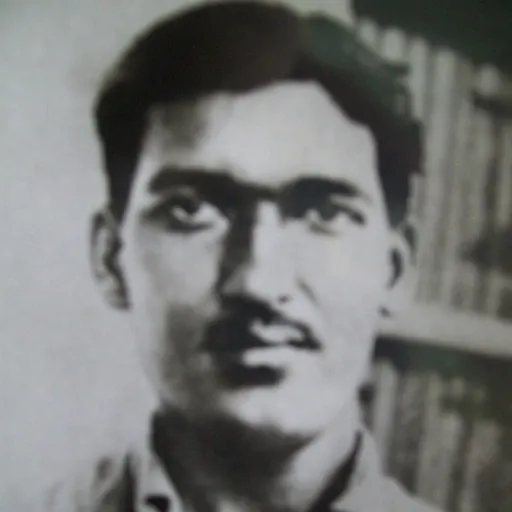
Ashfaqulla Khan
Indian poet and fighter for independence
About Ashfaqulla Khan
Lived 1900 – 1927 (aged 27). Ashfaqulla Khan was an Indian revolutionary, freedom fighter and activist, known for Kakori train robbery.
Ashfaqulla Khan (22 October 1900 – 19 December 1927) was an Indian freedom fighter and martyr in the Indian independence movement against British rule, and the co-founder of the Hindustan Republican Association, later to become the Hindustan Socialist Republican Association.
Early life Khan was born in the Shahjahanpur district of the United Provinces and was of Pathan descent. He was the youngest among his five siblings.
In 1918, while Khan was in the seventh standard, police raided his school and arrested fellow student Rajaram Bhartiya with regard to the Mainpuri Conspiracy, in which activists organised looting in Mainpuri to fund the publication of anti-colonial literature. The arrest spurred Khan's engagement in revolutionary activities in the United Provinces.
Khan met Ram Prasad Bismil, a revolutionary who was closely involved in the Mainpuri Conspiracy, through a friend. He soon became closely tied to Bismil and joined him in activities related to non-cooperation, the Swaraj Party, and the Hindustan Republican Association. It is said that the Britishers had to keep Bismil and Ashfaq in cells far away from each other because they would sing "Sarfaroshi ki tamanna ab hamare dil mein hai, dekhna hai zor kitna baazu-e-katil mein hai" and hear each other's voices and then laugh triumphantly in the face of atrocities. This irritated and broke the will of their oppressors. They chose each other and their fight for freedom and were hanged in the end, and happily so, after the trial for the Kakori rail dacoity.
Like others in the Hindustan Republican Association, Khan was strongly inspired by Lenin and the Bolshevik Revolution in Russia. He expressed beliefs in the liberation of the poor and the rejection of capitalist interests. He also spoke against religious communalism, identifying it as a British tool to control the Indian population and prevent Indian independence. He was originally against the Kakori train robbery, but eventually agreed to participate when others in the HRA expressed approval of the plan.
On 9 August 1925, Khan and other revolutionaries, namely Ram Prasad Bismil, Rajendra Lahiri, Sachindra Bakshi, Chandrashekhar Azad, Keshab Chakravarty, Banwari Lal, Murari Lal Gupta, Mukundi Lal, and Manmathnath Gupta, attacked and robbed a government train in Kakori near Lucknow. After the robbery, the British government launched an extensive investigative campaign to catch the perpetrators. The HRA had released an official statement in 1925 claiming that they did not consider themselves terrorists and instead saw their revolutionary activities as a way to fight back against the violence of the colonial government. While in prison, Khan wrote a letter that expressed a similar sentiment, confirming that he did not aim to spread violence through the HRA but only hoped to ensure India's independence.
Death and aftermath The case for the Kakori dacoity was concluded by imposing the death sentence on Bismil, Khan, Lahiri, and Roshan. The others were given life sentences. Khan was sentenced to death by hanging and executed on 19 December 1927 at the Faizabad Jail.
Just before he was hanged at the Faizabad jail, he was asked about his last wish. In reply, he recited the following"Kuchh aarzoo naheeN hai, hai aarzoo to yeh hai
Rakh de koi zara si KHaak-e-watan kafan men
bahaar aaii hai, shorish hai, junoon-e-fitnaa saamaaN kii
ilaahii Khair rakhnaa too mire jaib-o-GhariibaaN kii
bhalaa jazbaat-e-ulfat bhii kahiiN miTne se miTte haiN
abas haiN dhamkiaaN daar-o-rasan kii aur zindaaN kii
vo gulshan jo kabhii aazaad thaa guzare zamaane meN
maiN hooN shaaKh-e-shikasta yaaN usii ujaRhe gulistaaN kii
nahiiN tum se shikaayat ham_safeeraan-e-chaman mujh ko
mirii taqdeer hii meN thaa qafas aur qaid zindaaN kii #Ashfaqullah #shair
zamiiN dushman, zamaaN dushman, jo apne the paraae haiN
sunoge daastaaN kyaa tum, mire haal-e-pareeshaaN kii
ye jhagRhe aur bakheRhe meT kar aapas meN mil jaao
abas tafreeq hai tum meN yeh hindoo aur musalmaaN kii
sabhii saamaan-e-ishrat the, maze se apnii kaTtii thii
watan ke ishq ne ham ko havaa khilvaaii zindaaN kii
ba_hamd illaah chamak uTThaa sitaaraa merii qismat kaa
ki taqleed-e-haqeeqee kii ataa shaah-e-shaheedaaN kii
idhar Khauf-e-KhizaaN hai aashiyaaN ka Gham udhar dil ko
hameN yaksaaN hai tafreeh-e-chaman aur qaid zindaaN kii" The six-feet tall Ashfaqulla Khan then went up to the pole bravely like a lion and kissed the rope stating, “My hands are not soiled with the murder of man. The charge against me is false. God will give me justice.” Then he prayed “La ilahi il Allah, Mohammed Ur Rasool Allah.” (There is no god but God, and Muhammad is the messenger of God.) He is considered a martyr for the cause of India's independence.
After the hangings of Khan, Bismil, Lahiri, and Roshan, the HRA changed their name to the Hindustan Socialist Republican Army and began officially espousing socialist and Marxist ideologies.
Don’t just read it —
keep it.
Full-length biographies made to live with: read them, listen on the way to work, watch them tonight.
- E-book
- Audio
- Video
Instant download · yours to keep · every purchase keeps this site free
Important facts
People in Ashfaqulla Khan's life
Named in this biography and alive at the same time

Related people
Same field, nearest in time



Contemporaries
People whose lives overlapped Ashfaqulla Khan's





Frequently asked questions
Who was Ashfaqulla Khan?
Indian poet and fighter for independence (1900-1927)
When was Ashfaqulla Khan born?
Ashfaqulla Khan was born on 22 October 1900 in Shahjahanpur.
When did Ashfaqulla Khan die?
Ashfaqulla Khan died on 19 December 1927 in Faizabad.
What was Ashfaqulla Khan's occupation?
Ashfaqulla Khan was a revolutionary, freedom fighter and activist.
What was Ashfaqulla Khan known for?
Ashfaqulla Khan was known for Kakori train robbery.
What nationality was Ashfaqulla Khan?
Ashfaqulla Khan was Indian.
Sources & further reading
Cite this page
APA: Biography.guide. (2026). Ashfaqulla Khan. https://biography.guide/ashfaqulla-khan/
MLA: "Ashfaqulla Khan." Biography.guide, https://biography.guide/ashfaqulla-khan/.
Chicago: "Ashfaqulla Khan." Biography.guide. https://biography.guide/ashfaqulla-khan/.
Data last updated: 2026-09-22 · Spot an error? Report a correction.
Portrait: Wikimedia Commons · author & licence
Page generated 2026-09-27 05:03 UTC