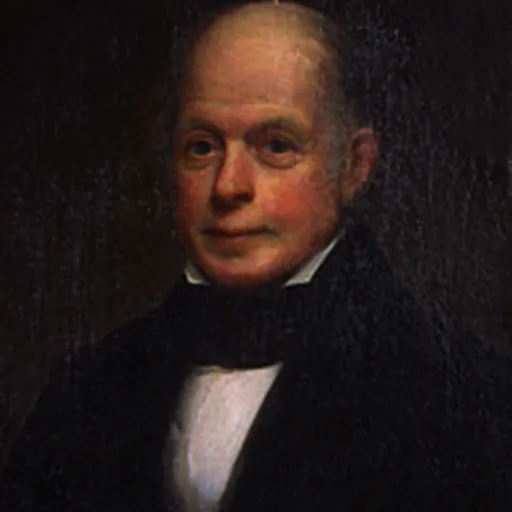
About Asher Benjamin
Lived 1773 – 1845 (aged 72). Asher Benjamin was an American architect.
Asher Benjamin (June 15, 1773 – July 26, 1845) was an American architect and author whose work transitioned between Federal architecture and the later Greek Revival architecture. His seven handbooks on design deeply influenced the look of cities and towns throughout New England until the Civil War. Builders also copied his plans in the Midwest and in the South.
Life and work Asher Benjamin was born in rural Hartland, Connecticut, shortly before the death of his father. He resided until the age of 30 in the Connecticut River Valley, where he received his first training from a local builder. Benjamin exhibited an aptitude for architecture by carving Ionic capitals for the 1794 modifications to the Oliver Phelps House at Suffield, Connecticut. In 1795-1796 he designed and built a stone spiral staircase in the Old State House at Hartford, which had been designed by Charles Bulfinch. The latter's use of overall symmetry, blind arches, fanlights and smooth brick greatly influenced Benjamin, who popularized the urbane Federal style in countryside estates. Gideon Granger wrote of Benjamin:
"From a poor boy unaided by friends, by his indefatigable industry and talents in a few years he has raised himself to the first rank of his profession."
Upon leaving Connecticut, Benjamin settled in Greenfield, Massachusetts. There he built two large houses, including the Leavitt House (today's Leavitt-Hovey House) for Judge Jonathan Leavitt, and published his first handbook, The Country Builder's Assistant (1797). On November 30, 1797, he married Achsah Hitchcock of Brookfield, with whom he had four children. Benjamin relocated to Windsor, Vermont, where he built three large houses and the Old South Congregational Church (1798).
By 1803, Benjamin was living in Boston, listed in the city directory as a housewright. He designed numerous churches and houses, and also appears to have conducted the country's first architecture school. Robert Henry Eddy, Elias Carter, Solomon Willard, Samuel Shepherd and Ithiel Town are credited among his pupils. After his first wife died on January 30, 1805, on July 24 he married Nancy Bryant of Springfield, whom he had four more children with.
In 1823 and 1824, Benjamin was elected alderman of Boston as part of the "Middling Interest": a coalition of middle class entrepreneurs and artisans opposed to the Federalists, who supported Josiah Quincy for mayor. He assisted Mayor Quincy and Alexander Parris in the planning of Quincy Market. Finding himself under a financial strain that led him to declare bankruptcy in 1825, Benjamin's political ambitions were soon curtailed. From 1825 to 1827 he left Boston to supervise construction of locks, canals, roads and mill buildings for the Nashua Manufacturing Company in Nashua, New Hampshire. He designed two churches there before returning to Boston.
Benjamin's greatest influence is derived from his pattern books. The first written by an American architect, they introduced architectural history, style and geometry to ordinary builders in the field. He adapted many designs by James Gibbs and Colen Campbell of Great Britain to fit the scale and finances of New England communities. These handbooks provided superb drawings and practical advice for full house plans, including such details as circular staircases, doorways, fireplace mantels, dormer windows, pilasters, balusters and fences. He sketched proposals for dwellings and churches, even a courthouse. The archeological sources of his designs were scrupulously cited, from the Temple of Hephaestus in Athens to the Arch of Titus in Rome. Other architects, including Ithiel Town and Ammi B. Young, freely assimilated his plans, as did innumerable carpenters. Indeed, the charm of many early New England towns owes a debt to Asher Benjamin. The Ridge in Orford, New Hampshire features a series of houses based on designs from his books, many of which remain in print. Although he helped disseminate the Federal style, he was not averse to changing fashions. In fact, his book published in 1830, The Architect, or, Practical House Carpenter, helped redirect American taste towards the Greek Revival movement.
Architectural historian Talbot Hamlin writes:
"...he, more than any other person, is responsible for the character we roughly call 'Late Colonial'; his moldings, his doors and windows and his mantels and cornices decorate or at least inspire the decorations of numberless houses up and down the New England coast and in the New England river valleys."
Asher Benjamin died in Springfield the age of 72.
Books
The Country Builder's Assistant, 1797 The American Builder's Companion, with Daniel Raynerd, 1806. 3rd ed., 1816. The Rudiments of Architecture, 1814 The Architect, or, Practical House Carpenter, 1830 The Practice of Architecture, 1833 The Builder's Guide, 1838 The Elements of Architecture, 1843
Designs
1796—Luke Baldwin House, Brookfield, Massachusetts (demolished) 1796—Samuel Hinckley House, Northampton, Massachusetts (demolished) 1796-1797—Coleman-Hollister House, Greenfield, Massachusetts 1797 -- Leavitt-Hovey House (now Greenfield Public Library), Greenfield, Massachusetts 1797-1798—First Deerfield Academy Building (now Memorial Hall), Deerfield, Massachusetts 1798-1799—Stebbins House, Deerfield, Massachusetts 1798—Old South Congregational Church, Windsor, Vermont 1800—Fullerton House, Windsor, Vermont (demolished) 1802—Harriet Lane House, Windsor, Vermont (demolished) 1803—Hubbard House, Windsor, Vermont (demolished) 1804 -- Charles Street Meeting House, 70 Charles Street, Boston, Massachusetts 1805--Church on the Hill, Lenox, Massachusetts 1806 -- Old West Church, 131 Cambridge Street, Boston, Massachusetts 1806 -- African Meeting House, 8 Smith Court, Boston, Massachusetts 1807 -- Sumner Mansion, Hartland, Vermont 1808 -- Headquarters House, 54-55 Beacon Street, Boston, Massachusetts 1808—60 or 61 Beacon Street, Boston, Massachusetts 1808—Fourth Meeting House of the First Church, Chauncy Street, Boston, Massachusetts 1809—First Parish Church, Ashby, Massachusetts 1809 -- Exchange Coffee House, Boston 1811—Alexander House, Springfield, Massachusetts 1811-1812—Fourth Meeting House, Northampton, Massachusetts (demolished) 1812-1814—Center Church, New Haven, Connecticut (with Ithiel Town) 1817—Rhode Island Union Bank, Newport, Rhode Island (demolished) 1818—Bulfinch Hall (originally called Brick Academy), Phillips Academy, Andover, Massachusetts 1819—Boylston Villa, Princeton, Massachusetts (For Ward Nicholas Boylston) 1820—Ransom Stiles House, Argyle, New York 1824-1827—The Black House, Ellsworth, Maine 1825—Unitarian Church, Peterborough, New Hampshire 1826-1832 -- Asa Waters Mansion, Millbury, Massachusetts 1827—Unitarian Church, Canal Street, Nashua, New Hampshire 1827—Olive Street Church, Nashua, New Hampshire (demolished) 1828—70-75 Beacon Street, Boston, Massachusetts 1830—Isaac Munson House, South Wallingford, Vermont (demolished) 1832—Cambridgeport Town Hall, Cambridgeport, Massachusetts (demolished) 1833—Asher Benjamin House, 9 West Cedar Street, Boston, Massachusetts 1833—7 West Cedar Street, Boston, Massachusetts 1833 - Ellen Stone Building, 735 Massachusetts Ave., Lexington Massachusetts 1834 -- Thatcher Magoun Mansion, Medford, Massachusetts (demolished) 1835—Lexington-Concord Battle Monument, Peabody, Massachusetts 1836—Dr. George Shattuck Monument, Mount Auburn Cemetery, Massachusetts 1836—William Ellery Channing House, 83 Mount Vernon Street, Boston, Massachusetts 1836 -- Forest Home, the F. O. J. Smith House, Westbrook, Maine (demolished) 1837—Proposal for the Custom House, Boston, Massachusetts (competition lost to Ammi B. Young) 1838-1839—Fifth Universalist Church (now the Charles Playhouse), 74 Warrenton Street, Boston, Massachusetts 1840—Richmond Street Church, Dorchester, Massachusetts (demolished) 1841—Edmund Hastings House, Medford, Massachusetts (demolished)
Gallery of designs
Don’t just read it —
keep it.
Full-length biographies made to live with: read them, listen on the way to work, watch them tonight.
- E-book
- Audio
- Video
Instant download · yours to keep · every purchase keeps this site free
Important facts
People in Asher Benjamin's life
Named in this biography and alive at the same time





Related people
Same field, nearest in time



Contemporaries
People whose lives overlapped Asher Benjamin's


Frequently asked questions
Who was Asher Benjamin?
American architect
When was Asher Benjamin born?
Asher Benjamin was born on 15 June 1773 in Hartland.
When did Asher Benjamin die?
Asher Benjamin died on 26 July 1845 in Springfield.
What was Asher Benjamin's occupation?
Asher Benjamin was an architect.
What nationality was Asher Benjamin?
Asher Benjamin was American.
Sources & further reading
Cite this page
APA: Biography.guide. (2026). Asher Benjamin. https://biography.guide/asher-benjamin/
MLA: "Asher Benjamin." Biography.guide, https://biography.guide/asher-benjamin/.
Chicago: "Asher Benjamin." Biography.guide. https://biography.guide/asher-benjamin/.
Data last updated: 2026-09-21 · Spot an error? Report a correction.
Portrait: Wikimedia Commons · author & licence
Page generated 2026-09-27 05:01 UTC