
About Asander
Lived 350 BC – 313 BC (aged 36–37). Asander was a military personnel and satrap.
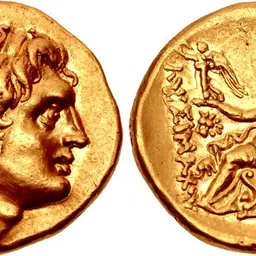
Coin of Philip III Arrhidaios, struck under Asandros as satrap of Caria in Miletus circa 323-319 BC, in the name and types of Alexander the Great. Asander or Asandros (; lived 4th century BC) was the son of Philotas and brother of Parmenion and Agathon. He was a Macedonian general under Alexander the Great, and satrap of Lydia from 334 BC as well as satrap of Caria after Alexander's death. During Alexander's reign Asander's position suffered for a period following Parmenion's execution, he was sent to Media to gather reinforcements during this time, and a year later was sent to Bactra.
Satrap of Caria In the division of the empire after the death of Alexander in 323, Asander obtained Caria for his satrapy, in which he was afterwards confirmed by Antipater. While acting as satrap of Caria he fought at the command of Antipater against Attalus and Alcetas, both supporters of Perdiccas, but was defeated by them. He also supported the Iranian colonists in Caria by increasing the position of local Zoroastrians.
In 317, while Antigonus was campaigning against Eumenes in Persia and Media, Asander increased his power in Asia Minor, expanding into Lycia and Cappadocia; and was undoubtedly a member of the alliance which was formed by Ptolemy, ruler of Egypt, and Cassander, ruler of Macedonia, against Antigonus. In 315, when Antigonus began his operations against the forces allied against him, he sent a general named Ptolemy, a nephew of his, with an army to relieve Amisus, and to expel from Cappadocia the army loyal to Asander which had invaded that country. However, as Asander was supported by Ptolemy and Cassander, he was able to maintain his control of his territories.
In 313 Antigonus decided to march against Asander and forced him to conclude a treaty with him under which he was required to surrender his whole army, and to surrender his brother Agathon as a hostage. After a few days Asander breached this humiliating treaty. He managed to get his brother out of the hands of Antigonus and sent ambassadors to Ptolemy and Seleucus seeking their assistance. Antigonus was indignant at these acts and immediately sent out an army to restore the territories covered by the treaty by force of arms. Caria also appears to have been conquered and from this time Asander disappears from the historical record.
Coinage During his tenure in Caria, Asander minted several types of coins at Miletus, in the names of Alexander the Great and Philip III Arrhidaeus.
Don’t just read it —
keep it.
Full-length biographies made to live with: read them, listen on the way to work, watch them tonight.
- E-book
- Audio
- Video
Instant download · yours to keep · every purchase keeps this site free
Important facts
People in Asander's life
Named in this biography and alive at the same time



Related people
Same field, nearest in time

Contemporaries
People whose lives overlapped Asander's


Frequently asked questions
Who was Asander?
4th-century BC Macedonian general
When was Asander born?
Asander was born in 350 BC.
When did Asander die?
Asander died in 313 BC.
What was Asander's occupation?
Asander was a military personnel and satrap.
Sources & further reading
Cite this page
APA: Biography.guide. (2026). Asander. https://biography.guide/asander-military-personnel/
MLA: "Asander." Biography.guide, https://biography.guide/asander-military-personnel/.
Chicago: "Asander." Biography.guide. https://biography.guide/asander-military-personnel/.
Data last updated: 2026-09-20 · Spot an error? Report a correction.
Page generated 2026-09-27 05:30 UTC